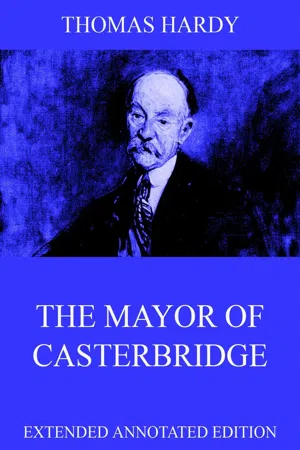
This is the annotated edition including a rare biographical essay on the life and works of the author.In the setting of this story we recognize much of our author's old power. The quiet rural town is set as distinctly before us as Cranford is. But the people to whom Mr. Hardy introduces us upon its streets are not the people Mrs. Gaskeil makes us know and love. There is to our mind not a really attractive character in the whole book. The good ones have a tendency to become commonplace, the bad ones can hardly be said to be interesting. It is true that Michael Henchard, the self-made hero, is a remarkable character study from the point of view of a psychologist or a sociologist, but that does not make him a proper hero for a novel, and we are forced to conclude that even the genius of Mr. Hardy cannot long sustain its eagle flight when, to borrow a metaphor from Shelley, its wings are cramped by the constraining folds of the serpent of pessimism.
- 406 pages
- English
- ePUB (mobile friendly)
- Available on iOS & Android
eBook - ePub
The Mayor Of Casterbridge
About this book
Information
Subtopic
ClassicsIndex
LiteratureThe Mayor Of Casterbridge
Thomas Hardy
Contents:
Thomas Hardy – A Biographical Primer
The Mayor Of Casterbridge
1.
2.
3.
4.
5.
6.
7.
8.
9.
10.
11.
12.
13.
14.
15.
16.
17.
18.
19.
20.
21.
22.
23.
24.
25.
26.
27.
28.
29.
30.
31.
32.
33.
34.
35.
36.
37.
38.
39.
40.
41.
42.
43.
44.
45.
The Mayor Of Casterbridge, T. Hardy
Jazzybee Verlag Jürgen Beck
86450 Altenmünster, Loschberg 9
Germany
ISBN: 9783849637880
www.jazzybee-verlag.de
www.facebook.com/jazzybeeverlag
Thomas Hardy – A Biographical Primer
English novelist, was born in Dorsetshire on the 2nd of June 1840. His family was one of the branches of the Dorset Hardys, formerly of influence in and near the valley of the Frome, claiming descent of John Le Hardy of Jersey (son of Clement Le Hardy, lieutenant-governor of that island in 1488), who settled in the west of England. His maternal ancestors were the Swetman, Childs or Child, and kindred families, who before and after 1635 were small landed proprietors in Melbury Osmond, Dorset, and adjoining parishes. He was educated at local schools, 1848–1854, and afterwards privately, and in 1856 was articled to Mr. John Hicks, an ecclesiastical architect of Dorchester. In 1859 he began writing verse and essays, but in 1861 was compelled to apply himself more strictly to architecture, sketching and measuring many old Dorset churches with a view to their restoration. In 1862 he went to London (which he had first visited at the age of nine) and became assistant to the late Sir Arthur Blomfield, R.A. In 1863 he won the medal of the Royal Institute of British Architects for an essay on Coloured Brick and Terra-cotta Architecture, and in the same year won the prize of the Architectural Association for design. In March 1965 his first short story was published in Chamber’s Journal, and during the next two or three years he wrote a great deal of verse, being somewhat uncertain whether to take to architecture or to literature as a profession. In 1867 he left London for Weymouth, and during that and the following year wrote a “purpose” story, which in 1869 was accepted by Messrs Chapman and Hall. The manuscript had been read by Mr. George Meredith, who asked the writer to call on him, and advised him not to print it, but to try another, with more plot. The manuscript was withdrawn and re-written, but never published. In 1870 Mr. Hardy took Mr. Meredith’s advice too literally, and constructed a novel that was all plot, which was published under the title Desperate Remedies. In 1872 appeared Under the Greenwood Tree, “a rural painting of the Dutch school,” in which Mr. Hardy had already “found himself,” and which he has never surpassed in happy and delicate perfection of art. A Pair of Blue Eyes, in which tragedy and irony come into his work together, was published in 1873. In 1874 Mr. Hardy married Emma Lavinia, daughter of the late T. Attersoll Gifford of Plymouth. His first popular success was made by Far from the Madding Crowd (1874), which, on its appearance anonymously in the Cornhill Magazine, was attributed by many to George Eliot. Then came The Hand of Ethelberta (1876), described, not inaptly, as “a comedy in chapters”; The Return of the Native (1878), the most sombre and, in some ways, the most powerful and characteristic of Mr. Hardy’s novels; The Trumpet-Major (1880); A Laodicean (1881); Two on a Tower (1882), a long excursion in constructive irony; The Mayor of Casterbridge (1886); The Woodlanders (1887); Wessex Tales (1888); A Group of Noble Dames (1891); Tess of the D’ Urbervilles (1891), Mr. Hardy’s most famous novel; Life’s Little Ironies (1894); Jude the Obscure (1895), his most thoughtful and least popular book; The Well-Beloved, a reprint, with some revision, of a story originally published in the Illustrated London News in 1892 (1897); Wessex Poems, written during the previous thirty years, with illustrations by the author; and The Dynasts (2 parts, 1904–1906). In 1909 appeared Time’s Laughing-stocks and other Verses. In all his works Mr. Hardy is concerned with one thing, seen under two aspects; not civilizations, nor manners, but the principle of life itself, invisibly realized in humanity as sex, seen visibly in the world as what we call nature. He is a fatalist, perhaps rather a determinist, and he studies the workings of fate or law (ruling through inexorable moods or humours), in the chief vivifying and disturbing influence in life, women. His view of women is more French than English; it is subtle, a little cruel, not as tolerant as it seems, thoroughly a man’s point of view, and not, as with Mr. Meredith, man’s and woman’s at once. He sees all that is irresponsible for good and evil in a woman’s character, all that is untrustworthy in her brain and will, all that is alluring in her variability. He is her apologist, but always with a reserve of private judgment. No one has created more attractive women of a certain class, women whom a man would have been more likely to love or regret loving. In his earlier books he is somewhat careful over the reputation of his heroines; gradually, he allows them more liberty, with a franker treatment of instinct and its consequence. Jude the Obscure is perhaps the most unbiased consideration in English fiction of the more complicated question of sex. There is almost no passion in his work, neither the author nor his characters ever seeming to pass beyond the state of curiosity, the most intellectually interesting of limitations, under the influence of any emotion. In his feeling for nature, curiosity sometimes seems to broaden into a more intimate communion. The heath, the village with its peasants, the change of every hour among the fields and on the roads of that English countryside which he made his own—the Dorsetshire and Wiltshire “Wessex”—mean more to him, in a sense, than ev...
Table of contents
- Thomas Hardy – A Biographical Primer
Trusted by 375,005 students
Access to over 1.5 million titles for a fair monthly price.
Study more efficiently using our study tools.
Frequently asked questions
Yes, you can cancel anytime from the Subscription tab in your account settings on the Perlego website. Your subscription will stay active until the end of your current billing period. Learn how to cancel your subscription
No, books cannot be downloaded as external files, such as PDFs, for use outside of Perlego. However, you can download books within the Perlego app for offline reading on mobile or tablet. Learn how to download books offline
Perlego offers two plans: Essential and Complete
- Essential is ideal for learners and professionals who enjoy exploring a wide range of subjects. Access the Essential Library with 800,000+ trusted titles and best-sellers across business, personal growth, and the humanities. Includes unlimited reading time and Standard Read Aloud voice.
- Complete: Perfect for advanced learners and researchers needing full, unrestricted access. Unlock 1.5M+ books across hundreds of subjects, including academic and specialized titles. The Complete Plan also includes advanced features like Premium Read Aloud and Research Assistant.
We are an online textbook subscription service, where you can get access to an entire online library for less than the price of a single book per month. With over 1.5 million books across 990+ topics, we’ve got you covered! Learn about our mission
Look out for the read-aloud symbol on your next book to see if you can listen to it. The read-aloud tool reads text aloud for you, highlighting the text as it is being read. You can pause it, speed it up and slow it down. Learn more about Read Aloud
Yes! You can use the Perlego app on both iOS and Android devices to read anytime, anywhere — even offline. Perfect for commutes or when you’re on the go.
Please note we cannot support devices running on iOS 13 and Android 7 or earlier. Learn more about using the app
Please note we cannot support devices running on iOS 13 and Android 7 or earlier. Learn more about using the app
Yes, you can access The Mayor Of Casterbridge by Thomas Hardy in PDF and/or ePUB format, as well as other popular books in Literature & Classics. We have over 1.5 million books available in our catalogue for you to explore.