Originally a part of the "Historic Towns" series, this title gives a comprehensive account of the history of Boston, one of the oldest towns in the United States. The author takes us from the Puritan beginnings through Colonial times, further on to the role of Boston in the American revolution and the Civil War, and far beyond these times.
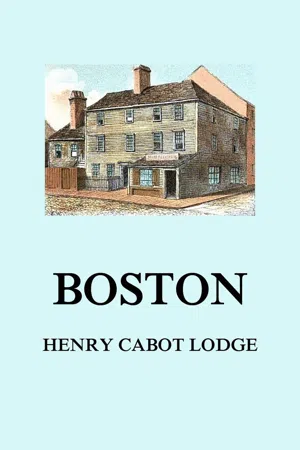
- 260 pages
- English
- ePUB (mobile friendly)
- Available on iOS & Android
eBook - ePub
Boston
About this book
Information
Subtopic
North American HistoryIndex
HistoryCHAPTER I. FOUNDING THE TOWN.
Among the towns of which the history is told in this series, Boston in Massachusetts seems very modern.
Yet these ancient towns of England are but of yesterday, when we place them beside the cities of Greece and Italy; and even the story of London itself, reaching, in tradition at least, from the days of Caesar to those of Victoria, would cover but a modest period in the long roll of the centuries witnessed by the Temple of Bubastis. The fact is that this is a comparative world, and the antiquity of races of men, or of their dwelling-places, depends altogether on the standard by which we determine age. In the United States, if we except New York, Boston is the oldest of the European settlements on the North American continent which has neither been abandoned nor remained, as at the beginning, a small town, but which has grown steadily with the growth of the country. To travelers from England, although Boston in its older part looks like many towns in their native land which have risen into importance in the last two hundred and fifty years, it seems nevertheless essentially modern. To inhabitants of the Western States, on the other hand, who have never been out of their own country, Boston seems a very ancient place indeed; and its crooked streets, where men have walked for more than two centuries, fill them with a curious interest, in which the respect that antiquity inspires is not unmingled with pity for a population which is not convulsed by a census, and for a city which is not laid out exclusively on right angles. Age, moreover, may be reckoned in another way than by years. On the sound principle laid down in Lord Tennyson's familiar line, that fifty years of Europe are better than a cycle of Cathay, the age and historic interest of a town may be judged best by events, and by the part it has played on the wider field of national life, and in the advance of what is called civilization.
In this view Boston, again with the exception of New York, is the ripest in age of any of the towns or cities in the United States. In the political events which have affected the history of the entire country, and in shaping the thought of a people who have come to be a great nation, Boston has played a leading part. Much has been crowded into her two hundred and fifty years, and in that time the town has lived a long life. In years alone, therefore, does Boston differ essentially from the other towns chronicled in this series. Yet this shortcoming, if it be one, is not without its advantages, for it enables us to go back to the beginning of things; to observe the origin of the community thus gathered together, and to understand the sources of its strength and of such influence as it may have had in the world. It is to-day but little more than two hundred and fifty years since the spot where Boston now stands was an unbroken wilderness. It is not possible, nor would it probably be very profitable, to know who the first Europeans actually were who gazed upon the fair harbour, with its wooded islands, its winding river, and its background of blue hills hemming in the little peninsula where a dense and busy population is now gathered.
The Norsemen, pushing southward from Iceland, probably visited that region, and some persons think that they can even identify the spots in the neighbourhood of Boston where the old sea-kings landed and lived. But if they came at all, they passed away and, so far as we know, left no trace, so that they have neither value nor interest except as agreeable subjects of antiquarian discussion. Centuries elapsed after the period of the Norse adventurers, and then the Cabots ran down the coast, glancing perhaps into the harbour, and laying the foundation of the title to the largest territory ever conquered and held by the English-speaking race. Other navigators followed in their wake at various times; but it was not until the seventeenth century had begun that the impending wave of European settlement and conquest really drew near. Then it was that the hardy Dutch skippers rounded Cape Cod — reaching out like a bended arm into the sea — and explored the coast; making rude maps, and laying the groundwork for claims of ownership on their own part which proved less perfect than those of the Cabots, for more reasons than one. Then, too, came Captain John Smith, hero of many adventures, and of many books of his own writing.
He also skirted the coast of New England, looked with some care into Boston Harbour, made a map, — very creditably indeed considering his opportunities, — and then sailed away again, after christening the headlands and rivers, and laying, by his voyage, a much better foundation for permanent occupation than either his Dutch cousins or the earlier navigators.
The van of those who were actually to enter in and take possession of the land was indeed not far behind him. Five years after his voyage, the little band of men and women famous in history as the " Pilgrims" reached Cape Cod, made their compact in the cabin of the "Mayflower," and then crossing the bay founded their settlement at Plymouth. The following year in the lovely weather of early autumn, a party of them under Miles Standish made the first real exploration of Boston Harbour. They touched at some of the islands and headlands, pushed up the Mystic River, visited the deserted camps of the Indians, and traded with some of the survivors of the tribes which had been swept away by war and disease as if to leave the country open to the new comers. The Pilgrims liked the region about the harbour, but seem nevertheless to have made no serious effort to occupy it.
It was, however, too inviting a spot to remain long untouched. A little more than six months after the visit of Standish, in May, 1622, the advance-guard of a party sent out by Thomas Weston appeared, and established themselves on the southern shore of the harbour at a place called Wessagusset, now known as Weymouth. Weston was a merchant who had relations with the Plymouth people; but he was simply an adventurer and trader, and sent out his expedition solely for gain. The whole business was ill-managed, and came to a wretched end. The trading-post was abandoned, and the party dispersed.
The next effort was of a widely different character, and aimed at nothing less than the erection of a principality instead of a paltry trading-post. It was one of the numerous attempts of Sir Ferdinando Gorges, a familiar figure in the early history of New England, to carve out for himself and his children a vast domain among the unbroken forests of America. It was one of those visionary schemes — almost pathetic now, in their wild impracticability and wasted hopes — with which the new world seems to have filled the minds of adventurous men two hundred and fifty years ago. The enterprise began in all the pomp and circumstance which befitted the dreams of its projectors. The Council for New England, established under a charter granted in 1620 to the elder Gorges and thirty-nine other patentees, met at Greenwich, June 29, 1623. This charter covered the whole of the New England coast; and among the adventurers were the Dukes of Buckingham and Richmond, four earls, and many lords and gentlemen who came to Greenwich to draw lots for possessions in the new country. King James himself drew for Buckingham; and Sir Ferdinando Gorges and his son Robert were to go out at once to take possession of the new kingdom. A few weeks later in midsummer 1623 Robert Gorges sailed, commissioned as lieutenant of the Council, with full powers, civil, military, and ecclesiastical. He was to settle in the neighbourhood of Plymouth, absorb those unconsidered sectaries who were really laying the foundations of a nation, and begin the administration of the vast province which had been allotted to him and the rest of his associates, on paper. When he reached New England, therefore, he established himself at Wessagusset, the scene of Weston's ill-fated venture, and proceeded to look about him. The usual result followed. All the bright hopes melted rapidly away in the presence of the hard facts of the climate and the wilderness. America was not to be conquered in that way, nor by people of that sort, and Gorges seems to have done nothing positive, except to quarrel angrily with his predecessor, Thomas Weston.
In the spring of 1624 he went back to England, "not having found the state of things near to answer his qualitie and condition," and shortly after died. The gorgeous array of names whose owners had gathered together before King James at Greenwich had meant nothing. Sir Ferdinando was in fact the only one really interested, and he could not carry the burden.
No second party came. Some of Gorges's followers went home with him; others struggled through the winter, aided by the Plymouth people, and then returned to England; while others still remained. Few of them were of the right stuff, and the whole conception of the enterprise, indeed, was wildly wrong.
There was no place for principalities nor powers in the new world, which needed hard-working men to build States, not adventurers seeking to transplant the forms and fashions of royalty and aristocracy, which withered and died as soon as they touched the rough new soil.
Gorges's expedition, however, made the first permanent settlement on the shores of Boston harbour, for the post at Wessagusset was never wholly abandoned; and from the remnant of his people came the men who first established themselves in solitary plantations within the actual limits of what is now the city of Boston.
Two of these little settlements were made in 1625, on the shores of the bay at the head of which the future town was to stand. One was at Hull, where some men exiled from Plymouth and a few stragglers of uncertain origin gathered together. The other was formed by a trading-party under the lead of one Captain Wollaston, who settled within the limits of the present town of Quincy on a low hill near the shore, which still bears the name of the leader. Wollaston himself soon became dissatisfied and departed for Virginia, where he disposed of his indented servants and sent back for more, the trade in human beings having proved profitable.
The second detachment was despatched, and then a revolt broke out among the ten men who were left, and Wollaston's representative was deposed, and driven away.
The leader of this revolution was one Thomas Morton, "of Clifford's Inn, Gent.," who perhaps had visited the country before with Weston, and who had certainly come out in Wollaston's company. He was one of the strangest of the many strange figures that flitted across the stage of early adventure and settlement in America. With some education, and not a little literary ability, he was as clever and worthless a scamp as can well be imagined, and when he took possession of Mount Wollaston, which he named Merry Mount, — or Mare Mount, — he proceeded to enjoy himself freely after his own fashion. His followers were a drunken set, who traded spirits and ammunition with the savages, maintained apparently a harem of Indian women, and set up a May-pole, around which they celebrated the 1st of May in a wild and fantastic manner, not much resembling the English custom from which it was borrowed. It was easy to see that all the loose characters of the coast, — runaway servants, deserters from ships, and the like, — would flock eagerly to the standard thus erected, and that the motley crew collected in this way would prove a source of danger, as it already was a scandal, to their soberer neighbours in the other plantations. Accordingly, the Plymouth people proceeded from warnings to stronger measures; and in 1627 Miles Standish appeared at Mount Wollaston, captured Morton and took him to Plymouth, whence he was shipped to England. In the following year he found his way back again, only to fall immediately into stronger and less merciful hands than those of the Pilgrims. The Puritans came down upon him, dealt with him in their thorough fashion, and broke up his settlement. He had however one great advantage over both his Pilgrim and Puritan enemies, for he wrote a narrative of his adventures in a reckless and amusing fashion of which they were incapable, and thus has kept the laugh forever on his side. His worthless and picturesque career and his wild and disorderly settlement have furnished material for the imagination of Hawthorne and Motley; and while better men are forgotten, Morton and Merry Mount stand out with a glow of colour against the dark background of suffering which make up the story of the first years of New England settlement, and are still freshly remembered among the descendants of the very men who brought Morton himself to condign punishment.
The little plantations at Weymouth, Hull, and Mount Wollaston, although within the limits of Boston Bay, nevertheless do not concern us here so much as the solitary men who had made homes for themselves upon the land now actually part of the modern city. On an island in the harbour was settled David Thomson, "Gent.," an attorney for Gorges, with his family.
Thomson died in 1628, leaving to his family his island and to the island his name, which it has borne ever since.
On Noddle's Island, now East Boston, was established Samuel Maverick, a young gentleman of property and education, who had there laid out a farm, built him a house and fort, where four guns were mounted, and which served as a refuge and defence for all the planters of the neighbourhood. On the next peninsula, where Charlestown grew up, where the battle of Bunker Hill was fought, and which has now been absorbed by the city, was settled Thomas Walford, a blacksmith, with his family. Across the bay from Maverick and Walford, on the very spot where the future city was to rise, William Blackstone had laid out a farm and orchard, and built him a house on the western slope of one of the hills, whence he could see the sun set across the windings of the river Charles, and over the wide brown marshes through which it made its way. Blackstone was a graduate of Cambridge, a man of learning and of books, who managed apparently to bring a library with him to the wilderness, and who seems to have sought only to be silent and alone. He was another of those characters that look dimly mysterious now, and thus excite our curiosity, but which no doubt would prove commonplace enough if we could ever get them into nearer view. When new comers arrived, Puritans, for whom he had no love apparently, he withdrew to Rhode Island, and there in a solitary spot lived to be eighty years of age. His diaries were burned after his death when the Indians destroyed his house, and the mystery and story of his life, if there were any, perished.
These four early settlers of Boston were all survivors of the Gorges expedition. Of the three settled within the actual limits of the city, two were gentlemen of property and education, and all were members of the Church of England. It is a curious fact that the first settlers on the ground where that town was destined to be built which was above all others the town of the English Puritan, were all of the Church of England and of the Court party. But they were merely the driftwood of a wreck. The Court and Church hud fulled to conquer and possess New England, and the time was at hand when the real conquerors — men of the same race but of widely different character and creed — were to come and make the land their own.
The title under which these new comers took possession starts with the Company of Northern Virginia, which in 1620 turned over its property to the better-known Council for New England. The latter organization, heavy with much aristocracy, had a brief period of hope, and a still briefer period of prosperity due to the fisheries, and soon overclouded by French and Spanish wars. Then dividing its property in 1623, it relapsed into silence so far as records are concerned, only to emerge into a second existence, vocal but unimportant, in 1631. In the interval of silence, however, under cover of the titles and court finery and empty parlance of the Council for New England, something real had been accomplished by people of a plainer but more effective sort. John White, clergyman of Dorchester, a man of serious mind, as men were in those days, was troubled by the godless life of those among his parishioners — and they were not a few — who were engaged in the fisheries, he conceived the scheme of forming a little settlement within the territory of the Council for New England, where fishing-crews could be better supplied with provisions, money made by trade, and religious instruction given to both the fishermen and the settlers. For this pious and frugal scheme he raised £ 3,000; a vessel was bought, and a fishing-station or settlement established at Cape Ann, near the present city of Gloucester. The little venture did not prosper.
The money in stock melted away, no new money came in, and after three years the association dissolved their company, and sold what property they had. The causes of the failure may be learned from White himself, but they were common to new settlements, and are not now of moment.
The sinking of the little fortunes of the Dorchester Associates in the vast sea of colonial losses and mishaps would not be worth remembering were it not for the thread, slender withal, but yet distinct and strong, which connects them with successors of a very similar character. The people in England who were shortly to furnish the force to move the English world were the hard-working, God-fearing men who took life and religion and politics very seriously, and who urged, in persistent fashion, that matters in England both in Church and State were in evil plight, and in sore need of reform. Whenever in that first half of the seventeenth century in England we come across these men, we may know that, whether wisely or unwisely, something was actually and effectually done, and that we have got clear of the court atmosphere of lies and vacillations, of halting action and unworthy ambition. In the founder of the little Dorchester company we have one of these earnest men, full of serious purpose, troubled about many things, and striving much, whom the world knows as Puritans. With such a promoter as John White there were sure to be some followers of like character; and when the little enterprise went to pieces there were four "prudent and honest men" who remained.
Headed by Roger Conant, a man still clear to us as possessed of leadership and force, these four went southward and westward from Cape Ann and settled at a place called Naumkeag, to be better known in future as Salem. To these men, if they would stay, as stay they did in very manful fashion, the Rev. John White promised aid, support, and a patent. How much he had to do with what followed is not perfectly determined, and is now of little consequence; it suffices that he kept his word.
Then during the ...
Table of contents
- PREFACE.
- CHAPTER I. FOUNDING THE TOWN.
- CHAPTER II. THE RISE OF CHURCH AND STATE.
- CHAPTER III. THE DEFENCE OF THE CHARTER.
- CHAPTER IV. KING PHILIP'S WAR, AND THE LOSS OF THE CHARTER
- CHAPTER V. UNDER THE CROWN.
- CHAPTER VI. UNDER THE PROVINCE CHARTER.
- CHAPTER VII. THE CAPITAL OF THE PROVINCE.
- CHAPTER VIII. THE BEGINNING OF THE REVOLUTION.
- CHAPTER IX. REVOLUTION.
- CHAPTER X. BOSTON.
- CHAPTER XI. THE CITY OF BOSTON.
Trusted by 375,005 students
Access to over 1.5 million titles for a fair monthly price.
Study more efficiently using our study tools.
Frequently asked questions
Yes, you can cancel anytime from the Subscription tab in your account settings on the Perlego website. Your subscription will stay active until the end of your current billing period. Learn how to cancel your subscription
No, books cannot be downloaded as external files, such as PDFs, for use outside of Perlego. However, you can download books within the Perlego app for offline reading on mobile or tablet. Learn how to download books offline
Perlego offers two plans: Essential and Complete
- Essential is ideal for learners and professionals who enjoy exploring a wide range of subjects. Access the Essential Library with 800,000+ trusted titles and best-sellers across business, personal growth, and the humanities. Includes unlimited reading time and Standard Read Aloud voice.
- Complete: Perfect for advanced learners and researchers needing full, unrestricted access. Unlock 1.5M+ books across hundreds of subjects, including academic and specialized titles. The Complete Plan also includes advanced features like Premium Read Aloud and Research Assistant.
We are an online textbook subscription service, where you can get access to an entire online library for less than the price of a single book per month. With over 1.5 million books across 990+ topics, we’ve got you covered! Learn about our mission
Look out for the read-aloud symbol on your next book to see if you can listen to it. The read-aloud tool reads text aloud for you, highlighting the text as it is being read. You can pause it, speed it up and slow it down. Learn more about Read Aloud
Yes! You can use the Perlego app on both iOS and Android devices to read anytime, anywhere — even offline. Perfect for commutes or when you’re on the go.
Please note we cannot support devices running on iOS 13 and Android 7 or earlier. Learn more about using the app
Please note we cannot support devices running on iOS 13 and Android 7 or earlier. Learn more about using the app
Yes, you can access Boston by Henry Cabot Lodge in PDF and/or ePUB format, as well as other popular books in History & North American History. We have over 1.5 million books available in our catalogue for you to explore.