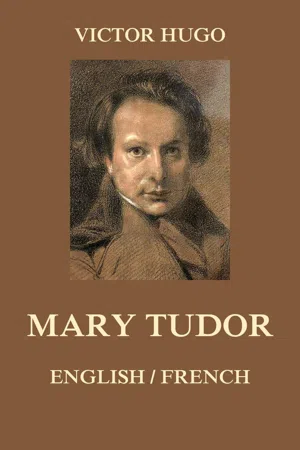
'Mary Tudor' is a drama by Victor Hugo. The French writer finished it in 1833. The historical work portrays the rise, fall and execution of Fabiano Fabiani, a fictional favourite of Mary I. of England. The Queen has Fabiani thrown in the tower until his death penalty and is unable to save him, although she thinks twice later.
eBook - ePub
Mary Tudor
About this book
Information
Subtopic
European DramaIndex
LiteratureMARY TUDOR
PREFACE
There are two ways of arousing the interest of the play-going public: by the great and by the true. The great appeals to the masses, the true to the individual.
The aim therefore of the dramatic poet, whatever may be the general tenor of his opinions concerning his art, ought always to be, before everything, to represent the great, as Corneille does, or the true, like Moliére: or better still, and this is the greatest triumph that genius can attain, to achieve the great and the true at once, the great in the true, the true in the great, like Shakespeare.
For, we may remark in passing, it was given to Shakespeare, and therein lies the sovereignty of his genius, to reconcile, to unite and to weld together time and again in his works, these two qualities, grandeur and truth, almost always set over against each other, or at least so clearly distinguished that the lack of either of them constitutes the opposite of the other. The stumbling-block of the true is the trivial: the stumbling-block of the great is the false. In all of Shakespeare’s works there is grandeur which is true, and truth which is great. At the centre of all his creations we find the point of intersection between grandeur and truth: and where things that are great and things that are true come together, art has done its perfect work. Shakespeare, like Michael Angelo, seems to have been created to solve the interesting problem, the simple enunciation of which has an absurd sound: —— how to remain always true to Nature, while overstepping her bounds at times. Shakespeare exaggerates proportions, but exhibits things in their proper relations. Marvelous omnipotence of the poet! he conceived characters greater than we, who live as we do.
Hamlet, for example, is as true to life as anyone of us, and far greater. Hamlet is colossal, and still true to life. The fact is that Hamlet is not you, nor I, but all of us together. Hamlet is not a man, but man. Constantly to exalt the great through the agency of the true, and the true through the agency of the great, such, in the opinion of the author of this drama, who reaffirms nevertheless such other opinions as he has taken occasion to exploit in such matters, such should be the aim of the poet who writes for the stage. And these two words, great and true, embrace everything. Truth includes morality, the great includes the beautiful. The reader will not credit him with the presumption of thinking that he has himself ever attained this result, or even that he ever could attain it, but he may be permitted to attest publicly his own sincerity by declaring that he has never sought any other end in any of his writing for the stage to this day. The new drama which is about to be produced is another attempt to reach that glorious result. What is the thought which he has sought to develop in Marie Tudor? It is this. A queen who is also a woman. Great as queen. True as woman.
He has heretofore said in another place that the drama as he feels that it should be, the drama as he would like to see it made by a man of genius, the drama according to nineteenth century ideas, is not the lofty, impassioned and sublime Spanish tragic comedy of Corneille; it is not the abstract, amorous, idealistic and judiciously sad tragedy of Racine: it is not the profound, acute, sagacious, but too pitilessly satirical comedy of Molière: it is not the tragedy with philosophical leanings of Voltaire: it is not the comedy of revolutionary days of Beaumarchais: it is not more than all of these, but it is all of these at once: or, I should rather say, it is something different from any of them. It does not consist, as in the works of these great men, in systematically and incessantly emphasizing a single aspect of things, but in looking at everything in all aspects at once. If there were a man living to-day who could realize our understanding of what the drama should be, his work would be an epitome of the human heart, the human head, human passions and the human will; it would be the past brought to life again for the benefit of the present; it would be the history our fathers made brought face to face with the history we are making; it would be a commingling upon the stage of all those things which are mingled in real life; there would be an émeute here, a love scene there, and in the love scene a lesson for the people, and in the émeute an appeal to the heart; there would be laughter, there would...
Table of contents
- MARY TUDOR
- Marie Tudor
Trusted by 375,005 students
Access to over 1.5 million titles for a fair monthly price.
Study more efficiently using our study tools.
Frequently asked questions
Yes, you can cancel anytime from the Subscription tab in your account settings on the Perlego website. Your subscription will stay active until the end of your current billing period. Learn how to cancel your subscription
No, books cannot be downloaded as external files, such as PDFs, for use outside of Perlego. However, you can download books within the Perlego app for offline reading on mobile or tablet. Learn how to download books offline
We are an online textbook subscription service, where you can get access to an entire online library for less than the price of a single book per month. With over 1.5 million books across 990+ topics, we’ve got you covered! Learn about our mission
Look out for the read-aloud symbol on your next book to see if you can listen to it. The read-aloud tool reads text aloud for you, highlighting the text as it is being read. You can pause it, speed it up and slow it down. Learn more about Read Aloud
Yes! You can use the Perlego app on both iOS and Android devices to read anytime, anywhere — even offline. Perfect for commutes or when you’re on the go.
Please note we cannot support devices running on iOS 13 and Android 7 or earlier. Learn more about using the app
Please note we cannot support devices running on iOS 13 and Android 7 or earlier. Learn more about using the app
Yes, you can access Mary Tudor by Victor Hugo in PDF and/or ePUB format, as well as other popular books in Literature & European Drama. We have over 1.5 million books available in our catalogue for you to explore.