'Lucrezia Borgia' is a drama by Victor Hugo. The French writer finished it in 1833. The historical work portrays the Renaissance-era Italian aristocrat Lucrezia Borgia. The libretto of Donizetti's opera 'Lucrezia Borgia' was based on Hugo's play.
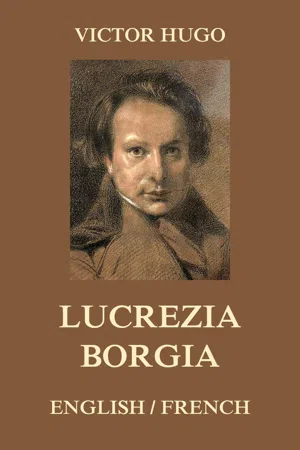
- 268 pages
- English
- ePUB (mobile friendly)
- Available on iOS & Android
eBook - ePub
Lucrezia Borgia
About this book
Information
Topic
LiteraturSubtopic
Europäisches DramaLucrezia Borgia
PREFACE
As he promised to do in the preface to his last drama, the author has reverted to the occupation of his whole life, art. He has resumed his favorite task, even before he has altogether adjusted matters with the petty political opponents who have been annoying him for two months past. And then, to bring forth a. new drama six weeks after the proscription of the other was one way of speaking plainly to the present government. It was equivalent to showing it that its trouble was thrown away. It was equivalent to proving to it that art and liberty can spring up again in one night beneath the very foot which tramples on them. It is his purpose, therefore, to go forward henceforth with his political strife, so far as occasion requires, and his literary work, pari passu. One can do his duty and his task at the same time. The one does not interfere with the other. Man has two hands.
Le Roi s’Amuse and Lucréce Borgia resemble each other not at all either in form or substance, and the fate of the two works has been so different, that the one will perhaps someday mark the principal political date, and the other the principal literary date in the author’s life. He deems it his duty to say, however, that the two dramas, different as they are in form, substance and destiny, are very closely coupled in his thought. The idea which gave birth to Le Roi s'Amuse, and the idea which gave birth to Lucréce Borgia, were born at the same moment in the same corner of the heart. What is, in fact, the fundamental thought, concealed under three or four concentric envelopes, in Le Roi s’Amuse? It is this. Take the most hideous, the most repulsive, the most unrelieved physical deformity: place it where it stands out most prominently,—on the lowest, the farthest underground, the most despised story of the social structure: let the glaring light of contrast shine in from all sides upon the wretched creature: and then cast into it a soul, and endow that soul with the purest sentiment which man can feel, the sentiment of paternity.
What will take place? The sublime sentiment, warmed to life according to certain conditions, will transform the degraded creature under your eyes: the petty will become great: the deformed will become beautiful.
That is the substance of Le Roi s’Amuse.
And now, what is Lucréce Borgia? Take the most hideous, the most repulsive, the most unrelieved moral deformity: place it where it stands out most prominently,—in a woman’s heart, with all the surroundings of physical beauty and regal grandeur, which give notoriety to crime! and now mingle with all this moral deformity, a single pure sentiment, the purest and holiest that a woman can feel, the sentiment of maternity: inject a touch of the mother into your monster, and the monster will arouse your interest, and the monster will bring tears to your eyes: the creature which terrified you will move you to pity, and the deformed soul will become almost beautiful to look upon. Thus Le Roi s’Amuse represents paternity sanctifying physical deformity: Lucréce Borgia, maternity purifying moral deformity. If bilogie were not a vulgar word, the author could well express his thought by saying that the two pieces were naught but a bilogie sui generis, the title of which might well be “The Father and Mother.” Fate separated them, however, and what does it matter? One has been successful, the other was paralyzed by a lettre de cachet! the idea upon which the first is based will, it is probable, be hidden from many eyes for a long time to come, by innumerable prejudices! the idea which gave birth to the second, seems, if we are not deluded, to be accepted and understood every evening by an intelligent and sympathetic multitude. Habent sua fata! but whatever may be the fate of the two plays, which have no other merit than the consideration which the public has been pleased to bestow upon them, they are twin sisters, the laurel-crowned and the proscribed were planted side by side, like Louis XIV. and the Iron Mask.
Corneille and Moliére were accustomed to answer in detail the criticisms called forth by their works, and it is extremely interesting to-day to see how these giants of the stage struggled and squirmed in prefaces and notices to the reader, under the inextricable network of criticisms which contemporary critics were constantly weaving about them. The author of this drama deems himself unworthy to follow such great examples. He prefers to hold his peace in the face of criticism. That which becomes men of authority, like Moliere and Corneille, does no...
Table of contents
- Lucrezia Borgia
- LUCRÈCE BORGIA
Trusted by 375,005 students
Access to over 1.5 million titles for a fair monthly price.
Study more efficiently using our study tools.
Frequently asked questions
Yes, you can cancel anytime from the Subscription tab in your account settings on the Perlego website. Your subscription will stay active until the end of your current billing period. Learn how to cancel your subscription
No, books cannot be downloaded as external files, such as PDFs, for use outside of Perlego. However, you can download books within the Perlego app for offline reading on mobile or tablet. Learn how to download books offline
Perlego offers two plans: Essential and Complete
- Essential is ideal for learners and professionals who enjoy exploring a wide range of subjects. Access the Essential Library with 800,000+ trusted titles and best-sellers across business, personal growth, and the humanities. Includes unlimited reading time and Standard Read Aloud voice.
- Complete: Perfect for advanced learners and researchers needing full, unrestricted access. Unlock 1.5M+ books across hundreds of subjects, including academic and specialized titles. The Complete Plan also includes advanced features like Premium Read Aloud and Research Assistant.
We are an online textbook subscription service, where you can get access to an entire online library for less than the price of a single book per month. With over 1.5 million books across 990+ topics, we’ve got you covered! Learn about our mission
Look out for the read-aloud symbol on your next book to see if you can listen to it. The read-aloud tool reads text aloud for you, highlighting the text as it is being read. You can pause it, speed it up and slow it down. Learn more about Read Aloud
Yes! You can use the Perlego app on both iOS and Android devices to read anytime, anywhere — even offline. Perfect for commutes or when you’re on the go.
Please note we cannot support devices running on iOS 13 and Android 7 or earlier. Learn more about using the app
Please note we cannot support devices running on iOS 13 and Android 7 or earlier. Learn more about using the app
Yes, you can access Lucrezia Borgia by Victor Hugo in PDF and/or ePUB format, as well as other popular books in Literatur & Europäisches Drama. We have over 1.5 million books available in our catalogue for you to explore.