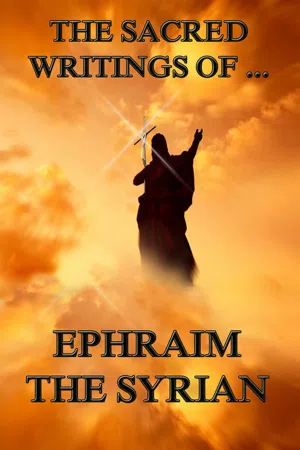
"The Sacred Writings Of..." provides you with the essential works among the Early Christian writings. The volumes cover the beginning of Christianity until before the promulgation of the Nicene Creed at the First Council of Nicaea.Ephraim the Syrian was a Syriac and a prolific Syriac-language hymnographer and theologian of the 4th century. His works are hailed by Christians throughout the world and many denominations venerate him as a saint. He has been declared a Doctor of the Church in Roman Catholicism. He is especially beloved in the Syriac Orthodox Church.Ephrem wrote a wide variety of hymns, poems, and sermons in verse, as well as prose biblical exegesis. These were works of practical theology for the edification of the church in troubled times. So popular were his works, that, for centuries after his death, Christian authors wrote hundreds of pseudepigraphal works in his name. Ephrem's works witness to an early form of Christianity in which western ideas take little part. He has been called the most significant of all of the fathers of the Syriac-speaking church tradition. (courtesy of wikipedia.com)This editions includes: The Nisibene HymnsNineteen Hymns on the Nativity of Christ in the Flesh.Fifteen Hymns for the Feast of the Epiphany.The Pearl-Seven Hymns on the FaithThree HomiliesSelect Demonstrations.
- 486 pages
- English
- ePUB (mobile friendly)
- Available on iOS & Android
eBook - ePub
The Sacred Writings of Ephraim the Syrian
About this book
Information
Topic
Theology & ReligionSubtopic
Christian Theology(1) The Nisibene Hymns, (2) The Hymns of the Nativity, (3) The Hymns for the Epiphany, (4) Three Homilies (i., On our Lord; ii., On Reproof and Repentance; iii., On the Sinful Woman).
Of (2) the Nativity Hymns, the first thirteen are reprinted from the version by the Rex. J. B. Morris (Oxford, 1847), made from the Roman Edition of the Syriac Works of Ephraim. The rest of the series as translated (six in number, making nineteen in all) were unknown when that edition was completed in 1743. These latter, and also (3) the Epiphany Hymns (with one exception) have since come to light in the Nitrian collection of the British Museum, and were printed by Professor Lamy in his St. Ephraim (Tom. 1, cc. 1–144; Tom. II., cc. 427–504), 1882–1889. In the same edition (Tom. I., cc. 145–274; 311–338) were first printed (4) the three Homilies. Our translations of these follow Lamy’s text, with here and there a slight variation where errors seem to exist. These two series of Hymns belong to the ecclesiastical class: their titles appropriate them to two great Festivals of the Church, and portions of these are embodied in Syriac Rituals still in use. Of the two Homilies, the former was written for the Feast of the Epiphany, like the Hymns which precede it.
The Nisibene Hymns (1) are translated from the text as first printed by Dr. Bickell (1866), whose edition, like that of Dr. Lamy, rests upon mss. of the Nitrian collection. They also were unknown to the Roman editors of the last century, and to the English translator of 1847; and they have not till now appeared in English. The series when complete consisted of 77 Hymns. Of these the first division (I.-XXXIV.) treat of the fortunes of the Church in Nisibis, Carrhena [Haran], and an unnamed city (probably Edessa). The remainder (XXXV. to end) deal with the topics of Death and the Resurrection. The present selection comprises 46 of these, namely:—of the first division, the first 21, those which relate to Nisibis and which are the Nisibene Hymns proper; of the second division, two series—one of 8 hymns (XXXV.-XLII.) in which Death and Satan hold monologue or dialogue,—the other of 17 (LII.-LXVIII.), similar in character, but with Man as a third interlocutor.
X.—Probable Dates of His Works.
Of the compositions contained in this volume, none yields internal evidence of its date, except the Nisibene Hymns of the first division. Hymns XXXV.-XLII. (not included here), apparently belong to the later (or Edessene) period of Ephraim’s life, and to the reign of Valens,—i.e., they are later than the year 363. The 21 Hymns which stand first in our collection may confidently be assigned to the year of the third siege (350) and the thirteen following years. Hymn I. was indubitably composed while the siege was still urgent; Hymns I. and III. immediately after the deliverance; Hymns IV.-XII. deal with the fortunes of the city and country in a troubled time of invasion that succeeded; the rest (XIII.-XXI.) treat of the four successive Bishops of Nisibis under whom Ephraim lived—Jacob, Babu, Valgesh, and Abraham. The last-named is not elsewhere recorded except by Elias of Nisibis, but the death of Valgesh is known to have occurred in 361. The Hymns therefore which celebrate the accession of Abraham to the See (XVII.-XXI.) must be placed in the interval, 361–363, the latter being the year when Ephraim with all the Christian population of the city was driven out by Sapor. Hymns XIII.-XVI., being written while Valgesh was Bishop—for they compare him with his two predecessors—fall into the interval between the year of the siege (350) which they speak of as past,—and the year of the death of Valgesh (361). Bickell assigns IV.-XII. to the months of Sapor’s invasion in 359; XIII.-XVI. to 358 and 359; XVII.-XXI. to 363, in the short space between Julian’s death and the surrender of Nisibis.
It is probable that most of his Hymns that are definitely controversial belong, like most of his controversial writings, to the years of his later life, at Edessa. And as we have seen, the earliest of them that can be confidently dated. is not earlier than 350. But it would be hasty to conclude that he had composed no Hymns before that date, and that in the Nisibene Hymns of the siege we have the first fruits of the vine of his vision. In 350 he must have been over forty—perhaps over fifty years of age; and it is highly improbable that a fertility which proved to be so abundant, did not begin to manifest itself at a much earlier age; or that a literary offspring of such bulk and importance was all produced in the last five and twenty years of a long life. The earlier authorities concerning his life give no definite information on this head; and the Syriac Life is vague in its statements and untrustworthy in its chronology. The account given of Barhebraeus, a well-informed but very late writer (thirteenth century), can hardly be accepted as embodying any genuine tradition, but has probability in its favor:—”From the time of the Nicene Council (he writes ), Ephraim began to write canticles and hymns against the heresies of his time,”—for few of his hymns are without a polemic spirit, though (as has been said) those that are purely controversial seem to be of a later period. A much later author indeed, Georgius “Bishop of the Arabians” (writing in 714) warns us that there is no evidence to assign any of Ephraim’s writings to the twenty years’ interval between the Nicene Council and the year 345—”especially (he adds) to the years before 337.” This writer, however, is here arguing in support of the claim of Aphrahat to be an independent author, against those who regarded him as a disciple of Ephraim; and he rests his case on the ground that whereas the Demonstrations of Aphrahat are (as we shall see presently) dated from 337 to 345, no composition of Ephraim’s can be shown to have been written so early. And it must be admitted that the earliest date (as above noted) that can be fixed with certainty for any of Ephraim’s innumerable productions in 350,—thirteen years later than Aphrahat’s earlier Demonstrations. Against this is to be set the tradition of Ephraim’s presence at Nicaea, implying as it does that even in 325 he had made himself a notable person,-and the probability that one who has left such ample proof of the copiousness of his literary gift, must have begun to exercise it before a date at which he would have passed his thirtieth year (supposing his birth to have been in 306), or even have entered middle life (if we place it at the beginning of the century). The two writers were unquestionably contemporary, and as yet no sufficient data have been discovered to determine to which of them seniority belongs.
Second Part—The Persian Sage.
1. Name of Author of Demonstrations long Unknown.—The author of the Demonstrations, eight of which appear (for the first time in an English version) in the present volume, has a singular literary history. By nationality a Persian, in an age when Zoroastrianism was the religion of Persia, he wrote in Syriac as a Christian theologian. His writings, now known to us as the works of Aphrahat, were remembered, cited, translated, and transcribed for at least two centuries after his death; but his proper name seems to have been for a time forgotten, so that in the mss. of the fifth and s...
Table of contents
- Ephraim the Syrian – A Biography
- The Nisibene Hymns
- Nineteen Hymns on the Nativity of Christ in the Flesh.
- Fifteen Hymns for the Feast of the Epiphany.
- The Pearl—Seven Hymns on the Faith
- Three Homilies
- Aphrahat Select Demonstrations .
Trusted by 375,005 students
Access to over 1.5 million titles for a fair monthly price.
Study more efficiently using our study tools.
Frequently asked questions
Yes, you can cancel anytime from the Subscription tab in your account settings on the Perlego website. Your subscription will stay active until the end of your current billing period. Learn how to cancel your subscription
No, books cannot be downloaded as external files, such as PDFs, for use outside of Perlego. However, you can download books within the Perlego app for offline reading on mobile or tablet. Learn how to download books offline
Perlego offers two plans: Essential and Complete
- Essential is ideal for learners and professionals who enjoy exploring a wide range of subjects. Access the Essential Library with 800,000+ trusted titles and best-sellers across business, personal growth, and the humanities. Includes unlimited reading time and Standard Read Aloud voice.
- Complete: Perfect for advanced learners and researchers needing full, unrestricted access. Unlock 1.5M+ books across hundreds of subjects, including academic and specialized titles. The Complete Plan also includes advanced features like Premium Read Aloud and Research Assistant.
We are an online textbook subscription service, where you can get access to an entire online library for less than the price of a single book per month. With over 1.5 million books across 990+ topics, we’ve got you covered! Learn about our mission
Look out for the read-aloud symbol on your next book to see if you can listen to it. The read-aloud tool reads text aloud for you, highlighting the text as it is being read. You can pause it, speed it up and slow it down. Learn more about Read Aloud
Yes! You can use the Perlego app on both iOS and Android devices to read anytime, anywhere — even offline. Perfect for commutes or when you’re on the go.
Please note we cannot support devices running on iOS 13 and Android 7 or earlier. Learn more about using the app
Please note we cannot support devices running on iOS 13 and Android 7 or earlier. Learn more about using the app
Yes, you can access The Sacred Writings of Ephraim the Syrian by Ephraim the Syrian, Philipp Schaff in PDF and/or ePUB format, as well as other popular books in Theology & Religion & Christian Theology. We have over 1.5 million books available in our catalogue for you to explore.