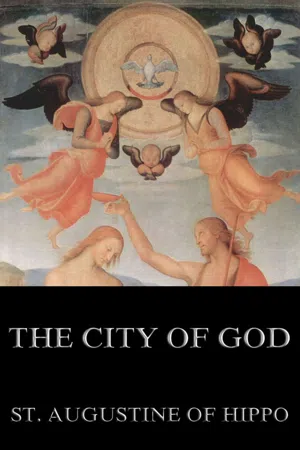
De Civitate Dei, (full title: De Civitate Dei contra Paganos), translated in English as The City of God, is a book of Christian philosophy written in Latin by Augustine of Hippo in the early 5th century AD. It is one of Augustine's major works, standing alongside his The Confessions, On Christian Doctrine, and On the Trinity. Augustine is considered the most influential Father of the Church in Western Christianity, and The City of God profoundly shaped Western civilization. Augustine wrote the treatise to explain Christianity's relationship with competing religions and philosophies, as well as its relationship with the Roman government, with which it was increasingly intertwined. It was written soon after Rome was sacked by the Visigoths in 410. This event left Romans in a deep state of shock, and many saw it as punishment for abandoning traditional Roman religion for Catholic Christianity. It was in this atmosphere that Augustine set out to console Christians, writing that, even if the earthly rule of the Empire was imperiled, it was the City of God that would ultimately triumph. Augustine's eyes were fixed on Heaven, a theme of many Christian works of Late Antiquity. (from wikipedia.com)
- 1,048 pages
- English
- ePUB (mobile friendly)
- Available on iOS & Android
eBook - ePub
The City of God
About this book
Information
Topic
Teologia e religioneSubtopic
Studi bibliciOF THE DESTRUCTION OF ILIUM BY FIMBRIA, A LIEUTENANT OF MARIUS.
And surely we may ask what wrong poor Ilium had done, that, in the first heat of the civil wars of Rome, it should suffer at the hand of Fimbria, the veriest villain among Marius’ partisans, a more fierce and cruel destruction than the Grecian sack.1 For when the Greeks took it many escaped, and many who did not escape were suffered to live, though in captivity. But Fimbria from the first gave orders that not a life should be spared, and burnt up together the city and all its inhabitants. Thus was Ilium requited, not by the Greeks, whom she had provoked by wrong-doing; but by the Romans, who had been built out of her ruins; while the gods, adored alike of both sides, did simply nothing, or, to speak more correctly, could do nothing. Is it then true, that at this time also, after Troy had repaired the damage done by the Grecian fire, all the gods by whose help the kingdom stood, “forsook each fane, each sacred shrine?”
But if so, I ask the reason; for in my judgment, the conduct of the gods was as much to be reprobated as that of the townsmen to be applauded. For these closed their gates against Fimbria, that they might preserve the city for Sylla, and were therefore burnt and consumed by the enraged general. Now, up to this time, Sylla’s cause was the more worthy of the two; for till now he used arms to restore the republic, and as yet his good intentions had met with no reverses. What better thing, then, could the Trojans have done? What more honorable, what more faithful to Rome, or more worthy of her relationship, than to preserve their city for the better part of the Romans, and to shut their gates against a parricide of his country? It is for the defenders of the gods to consider the ruin which this conduct brought on Troy. The gods deserted an adulterous people, and abandoned Troy to the fires of the Greeks, that out of her ashes a chaster Rome might arise. But why did they a second time abandon this same town, allied now to Rome, and not making war upon her noble daughter, but preserving a most steadfast and pious fidelity to Rome’s most justifiable faction? Why did they give her up to be destroyed, not by the Greek heroes, but by the basest of the Romans? Or, if the gods did not favor Sylla’s cause, for which the unhappy Trojans maintained their city, why did they themselves predict and promise Sylla such successes? Must we call them flatterers of the fortunate, rather than helpers of the wretched? Troy was not destroyed, then, because the gods deserted it. For the demons, always watchful to deceive, did what they could. For, when all the statues were overthrown and burnt together with the town, Livy tells us that only the image of Minerva is said to have been found standing uninjured amidst the ruins of her temple; not that it might be said in their praise, “The gods who made this realm divine,” but that it might not be said in their defence, They are “gone from each fane, each sacred shrine:” for that marvel was permitted to them, not that they might be proved to be powerful, but that they might be convicted of being present.
CHAP. 8.—
WHETHER ROME OUGHT TO HAVE BEEN ENTRUSTED TO THE TROJAN GODS?
Where, then, was the wisdom of entrusting Rome to the Trojan gods, who had demonstrated their weakness in the loss of Troy? Will some one say that, when Fimbria stormed Troy, the gods were already resident in Rome? How, then, did the image of Minerva remain standing? Besides, if they were at Rome when Fimbria destroyed Troy, perhaps they were at Troy when Rome itself was taken and set on fire by the Gauls. But as they are very acute in hearing, and very swift in their movements, they came quickly at the cackling of the goose to defend at least the Capitol, though to defend the rest of the city they were too long in being warned.
CHAP. 9.—
WHETHER IT IS CREDIBLE THAT THE PEACE DURING THE REIGN OF NUMA WAS BROUGHT ABOUT BY THE GODS.
It is also believed that it was by the help of the gods that the successor of Romulus, Numa Pompilius, enjoyed peace during his entire reign, and shut the gates of Janus, which are customarily kept open1 during war. And it is supposed he was thus requited for appointing many religious observances among the Romans. Certainly that king would have commanded our congratulations for so rare a leisure, had he been wise enough to spend it on wholesome pursuits, and, subduing a pernicious curiosity, had sought out the true God with true piety. But as it was, the gods were not the authors of his leisure; but possibly they would have deceived him less had they found him busier. For the more disengaged they found him, the more they themselves occupied his attention. Varro informs us of all his efforts, and of the arts he employed to associate these gods with himself and the city; and in its own place, if God will, I shall discuss these matters. Meanwhile, as we are speaking of the benefits conferred by the gods, I readily admit that peace is a great benefit; but it is a benefit of the true God, which, like the sun, the rain, and other supports of life, is frequently conferred on the ungrateful and wicked. But if this great boon was conferred on Rome and Pompilius by their gods, why did they never afterwards grant it to the Roman empire during even more meritorious periods? Were the sacred rites more efficient at their first institution than during their subsequent celebration? But they had no existence in Numa’s time, until he added them to the ritual; whereas afterwards they had already been celebrated and preserved, that benefit might arise from them. How, then, is it that those forty-three, or as others prefer it, thirty-nine years of Numa’s reign, were passed in unbroken peace, and yet that afterwards, when the worship was established, and the gods themselves, who were invoked by it, were the recognized guardians and patrons of the city, we can with difficulty find during the whole period, from the building of the city to the reign of Augustus, one year—that, viz., which followed the close of the first Punic war—in which, for a marvel, the Romans were able to shut the gates of war?1
CHAP. 10.—
WHETHER IT WAS DESIRABLE THAT THE ROMAN EMPIRE SHOULD BE INCREASED BY SUCH A FURIOUS SUCCESSION OF WARS, WHEN IT MIGHT HAVE BEEN QUIET AND SAFE BY FOLLOWING IN THE PEACEFUL WAYS OF NUMA.
Do they reply that the Roman empire could never have been so widely extended, nor so glorious, save by constant and unintermitting wars? A fit argument, truly! Why must a kingdom be distracted in order to be great? In this little world of man’s body, is it not better to have a moderate stature, and health with it, that to attain the huge dimensions of a giant by unnatural torments, and when you attain it to find no rest, but to be pained the more in proportion to the size of your members? What evil would have resulted, or rather what good would not have resulted, had those times continued which Sallust sketched, when he says, “At first the kings (for that was the first title of empire in the world) were divided in their sentiments: part cultivated the mind, others the body: at that time the life of men was led without coveteousness; every one was sufficiently satisfied with his own!”2 Was it requisite, then, for Rome’s prosperity, that the state of things which Virgil reprobates should succeed:
“At length stole on a baser age
And war’s indomitable rage,
And greedy lust of gain?”3
But obviously the Romans have a plausible defence for undertaking and carrying on such disastrous wars,—to wit, that the pressure of their enemies forced them to resist, so that they were compelled to fight, not by any greed of human applause, but by the necessity of protecting life and liberty. Well, let that pass. Here is Sallust’s account of the matter: “For when their state, enriched with laws, institutions, territory, seemed abundantly prosperous and sufficiently powerful, according to the ordinary law of human nature, opulence gave birth to envy. Accordingly, the neighboring kings and states took arms and assaulted them. A few allies lent assistance; the rest, struck with fear, kept aloof from dangers. But the Romans, watchful at home and in war, were active, made preparations, encouraged one another, marched to meet their enemies,—protected by arms their liberty, country, parents. Afterwards, when they had repelled the dangers by their bravery, they carried help to their allies and friends, and procured alliances more by conferring than by receiving favors.”4 This was to build up Rome’s greatness by honorable means. But, in Numa’s reign, I would know whether the long peace was maintained in spite of the incursions of wicked neighbors, or if these incursions were discontinued that the peace might be maintained? For if even then Rome was harassed by wars, and yet did not meet force with force, the same means she then used to quiet her enemies without conquering them in war, or terrifying them with the onset of battle, she might have used always, and have reigned in peace with the gates of Janus shut. And if this was not in her power, then Rome enjoyed peace not at the will of her gods, but at the will of her neighbors round about, and only so long as they cared to provoke her with no war, unless perhaps these pitiful gods will dare to sell to one man as their favor what lies not in their power to bestow, but in the will of another man. These demons, indeed, in so far as they are permitted, can terrify or incite the minds of wicked men by their own peculiar wickedness. But if they always had this power, and if no action were taken against their efforts by a more secret and higher power, they would be supreme to give peace or the victories of war, which almost always fall out through some human emotion, and frequently in opposition to the will of the gods, as is proved not only by lying legends, which scarcely hint or signify any grain of truth, but even by Roman history itself.
CHAP. 11.—
OF THE STATUE OF APOLLO AT CUMÆ, WHOSE TEARS ARE SUPPOSED TO HAVE PORTENDED DISASTER TO THE GREEKS, WHOM THE GOD WAS UNABLE TO SUCCOR.
And it is still this weakness of the gods which is confessed in the story of the Cuman Apollo, who is said to have wept for four days during the war with the Achæans and King Aristonicus. And when the augurs were alarmed at the portent, and had determined to cast the statue into the sea, the old men of Cumæ interposed, and related that a similar prodigy had occurred to the same image d...
Table of contents
- Saint Augustine – A Biography
- THE CITY OF GOD.
- BOOK I.
- BOOK II.
- BOOK III.
- BOOK IV.1
- BOOK V.1
- BOOK VI.
- BOOK VII.
- BOOK VIII.
- BOOK IX.
- BOOK X.
- BOOK XI.
- BOOK XII.
- BOOK XIII.
- BOOK XIV.1
- BOOK XV.
- BOOK XVI.
- BOOK XVII.
- BOOK XVIII.
- BOOK XIX.
- BOOK XX.
- BOOK XXI.
- BOOK XXII.
Trusted by 375,005 students
Access to over 1.5 million titles for a fair monthly price.
Study more efficiently using our study tools.
Frequently asked questions
Yes, you can cancel anytime from the Subscription tab in your account settings on the Perlego website. Your subscription will stay active until the end of your current billing period. Learn how to cancel your subscription
No, books cannot be downloaded as external files, such as PDFs, for use outside of Perlego. However, you can download books within the Perlego app for offline reading on mobile or tablet. Learn how to download books offline
Perlego offers two plans: Essential and Complete
- Essential is ideal for learners and professionals who enjoy exploring a wide range of subjects. Access the Essential Library with 800,000+ trusted titles and best-sellers across business, personal growth, and the humanities. Includes unlimited reading time and Standard Read Aloud voice.
- Complete: Perfect for advanced learners and researchers needing full, unrestricted access. Unlock 1.5M+ books across hundreds of subjects, including academic and specialized titles. The Complete Plan also includes advanced features like Premium Read Aloud and Research Assistant.
We are an online textbook subscription service, where you can get access to an entire online library for less than the price of a single book per month. With over 1.5 million books across 990+ topics, we’ve got you covered! Learn about our mission
Look out for the read-aloud symbol on your next book to see if you can listen to it. The read-aloud tool reads text aloud for you, highlighting the text as it is being read. You can pause it, speed it up and slow it down. Learn more about Read Aloud
Yes! You can use the Perlego app on both iOS and Android devices to read anytime, anywhere — even offline. Perfect for commutes or when you’re on the go.
Please note we cannot support devices running on iOS 13 and Android 7 or earlier. Learn more about using the app
Please note we cannot support devices running on iOS 13 and Android 7 or earlier. Learn more about using the app
Yes, you can access The City of God by St. Augustine of Hippo, Marcus Dods in PDF and/or ePUB format, as well as other popular books in Teologia e religione & Studi biblici. We have over 1.5 million books available in our catalogue for you to explore.