Orange County, Ca. of today has a population of more than 3 million people, making it more populated than twenty-one whole states. The county is famous for its tourist attractions and its beautiful shoreline. Samuel Armor's book tells the story of the county from its formation till the early years of the 20th century and especially provides overviews of the main cities' histories.
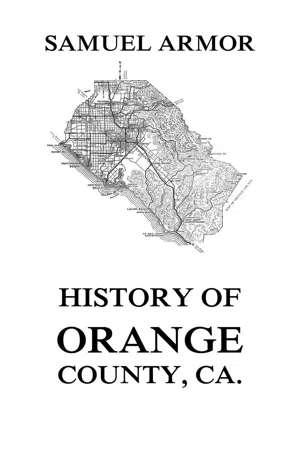
- 296 pages
- English
- ePUB (mobile friendly)
- Available on iOS & Android
eBook - ePub
History of Orange County, Ca.
About this book
Information
Subtopic
North American HistoryIndex
HistoryCHAPTER I - THE FORMATION AND DESCRIPTION OF ORANGE COUNTY
The state of California was created out of territory ceded to the United States by Mexico in the year 1848. It was admitted into the Union as a free state in 1850, with a population of 92,597. This population was located in a few little cities, with a small portion in the mining camps and scattered over the grazing lands adjacent to the water courses. The style of government inherited from Mexico might be characterized as feudal or patriarchal, each city or pueblo and the adjoining territory being governed by an alcalde or other officer appointed by the Mexican government. When the state was formed each of the principal towns with its tributary territory was created into a county; but, on account of the towns being far apart and the intervening territory sparsely settled, the area of the first counties was large and the population small. As the country settled up and other centers of population were formed efforts were made from time to time to form new counties by cutting off portions of the old ones; some of these efforts were successful and others failed.
With the growth of the communities in the southeastern part of Los Angeles County there sprang up the desire for a smaller county with a county seat nearer home. This feeling grew apace until finally an appeal was made to the legislature of 1889 for autonomy. The city of Santa Ana, which had outgrown the other cities in the proposed new county, took the lead in the struggle for county division. A lobby was maintained at Sacramento all winter at considerable expense, without being able to overcome the influence of Los Angeles against the bill for the new county. This bill was entitled "An Act to Create the County of Orange," the name Orange being selected partly on its own merits and partly to conciliate the city of that name, which also aspired to be county seat. Finally, late in the session, W. H. Spurgeon and James McFadden took up the matter in the legislature with better success. They found some members who were friendly to their project and others who were hostile to Los Angeles. There are sometimes a few members of the legislature who are looking for "Col. Mazuma" to come to the help or hindrance of much-desired legislation. Because the rich county of Los Angeles would not distribute a large defense fund among such members, they turned against that county. Then, too, San Francisco had begun to recognize in Los Angeles a possible rival, and was glad of the opportunity to deprive her of some of her territory. These various interests and antagonisms were so skillfully handled that the bill passed the legislature and was signed by Governor Waterman, March 11, 1889.
The struggle was then transferred to the territory involved. The first step in the formation of the new county was the appointment by the governor of a board of five commissioners to direct the work of organization. Following are the men who were appointed on this commission: J. W. Towner, of Santa Ana; J: H. Kellom, of Tustin; A. Cauldwell, of Orange; W. M. McFadden, of Placentia; and R. Q. Wickham, of Garden Grove. The commission organized March 22, by electing J. W. Towner president and R. Q. Wickham secretary.
An election was called for June 4th, to ratify or reject the action of the legislature, as provided for in the organic act. This provision was inserted in the bill to answer the objection urged, that a majority of the people in the proposed new county did not want to be set off from the old county. The most of the opposition to county division was at Anaheim, the people of that place contending that the line ought to have been located at the San Gabriel River instead of at Coyote Creek. They thought that if more territory had been taken in towards the west, Anaheim would have had a chance for the county seat; but notwithstanding this opposition, the election was carried in favor of county division by a vote of 2,509 to 500.
A second election was held on July 11, to decide the location of the county seat and to select the county officers, who would serve until the next regular election. Two cities contested for the county seat, Santa Ana and Orange. Anaheim, having no hope for herself, took little interest in the election; in fact, scores of people went to Los Angeles or elsewhere on election day to keep out of the way of the campaign workers. Orange, being thus deprived of some of the help she counted on, made rather a poor showing in the contest. On the other hand, the city of Santa Ana was not able to equal its county seat vote for six or eight years thereafter, notwithstanding it was growing all the time. The result of the election for county seat was 1,729 votes for Santa Ana and 775 for Orange.
There were three tickets in the field for county officers; a non-partisan ticket in the interest of Santa Ana for county seat, a non-partisan ticket in the interest of Orange for county seat, and a straight Republican ticket without reference to the county seat. All of the candidates of the Santa Ana non-partisan ticket were elected, except the candidate for supervisor of the Fourth District, who was defeated by a margin of four votes by the candidate on the other two tickets. The officers thus chosen were: Superior judge, J. W. Towner; district attorney, E. E. Edwards; county clerk, R. Q. Wickham; recorder and auditor, George E. Foster; sheriff and tax collector, R. T. Harris; treasurer, W. B. Wall; assessor, Fred C. Smythe; superintendent of schools, John P. Greeley; surveyor, S. O. Wood; coroner and public administrator, I. D. Mills; supervisors: first district, W. H. Spurgeon; second district, Jacob Ross; third district, Sheldon Littlefield, a holdover from Los Angeles; fourth district, Samuel Armor; fifth district, A. Guy Smith.
The supervisors organized August 5, 1889, by the election of W. H. Spurgeon as chairman of the board. Rooms for the county offices were furnished rent free for two years in the Billings and Congdon Blocks on East Fourth Street, by the residents in that vicinity. These rooms, with some changes, were retained by the county at a moderate rental until the new court house was ready for occupancy. The board of supervisors held frequent meetings during the first few months, getting the business of the new county properly started and adjusting the differences between the two counties. Los Angeles County resisted the separation in many ways. Some of her citizens brought suit against the new county on the ground that the organic act was unconstitutional, in that the legislature had delegated its powers to the people of the new county to decide whether they wanted county division or not. The supreme court sustained the constitutionality of the act. Meantime the two boards of supervisors appointed commissioners to adjust the differences between the counties and to determine the basis of settlement of claims for and against the new county. The two commissioners selected for Orange County were James McFadden and Richard Egan. These men by their shrewdness and tact secured a fair settlement with very little friction. The question of which county should be charged with the money spent in the new county, by the old, between the approval of the legislative act by the governor, March 11, and the organization of the new county, August 5, was left to the courts to determine. This money included the cost of the long bridge over the Santa Ana River at Olive, the expense of the justice courts, the care of the indigents and possibly other expenditures on behalf of Orange County. The courts held that this burden should be borne by the old county, since it voluntarily built the bridge after the Orange County bill was approved and it was its duty to keep the local government going until relieved by the new county.
The formative steps in the creation of Orange County having thus been narrated, the next thing in order is to describe the county; giving its area, boundaries, topography and general characteristics. As previously indicated the county was formed in the year 1889 by cutting off about forty miles in length from the southeastern portion of Los Angeles County, giving the new county about that length of coast line. The legislative act made Coyote Creek the dividing line between the two counties; but the surveyors commenced at the mouth of the creek and located the county line on the property lines, jogging over from time to time to keep near the channel, until they reached the southeast corner of section 13, township 3 south, range 11 west. From that point the line was run due north three miles to the township line and thence due east to the San Bernardino County line. The rest of the boundary line of the new county was left the same as that of the old county before division. The county is therefore bounded on the west, northwest and north by Los Angeles County j on the north and northeast by San Bernardino County; on the northeast and east by Riverside County; on the southeast and south by San Diego County; and on the south, southwest and west by the Pacific Ocean.
It is customary to speak of Orange County as one of the smallest counties in the state; but there are nine counties with less territory, forty-three with less population and forty-three with a smaller assessed valuation. Its area is given officially as 780 square miles; but the number of acres assessed (446,257) would indicate only 697 1/3 square miles. However, there may be sufficient government land within the county to make up the difference. Perhaps a third of this area is hilly and mountainous, while the remainder is comparatively level.
There is very little timber on the southern and western slopes of mountains exposed to many months of summer sun, like those in Orange County. Most of their surface, however, is covered with chaparral, sage brush, mesquite, manzanita and other hardy shrubs, which, with the cactus, provide food and shelter for considerable game and retard the run-off from the winter rains. In some of the ravines — especially those with a northern exposure — there are clumps of live oak trees; while in the canyons, near the water courses, there are groves of live oak, sycamore and other native trees of considerable size.
When the temperature cools off in the winter months, the mountains help to condense the moisture in the atmosphere and thereby increase the precipitation; they also act as a catchment-basin to collect the rainfall and drain it into the streams for use in the summer on the plains below. A considerable portion of the mountains and hills is adapted to grazing and bee culture. The hills on the north produce large quantities of oil, and oil has also been found under the hills along the coast. The hills and mountains on the east abound in minerals and. precious metals. Here, too, are extensive beds of coal of a fair quality.
The valleys and plains, which make up the larger part of the county, have a great variety of soils, among which may be mentioned the following: Adobe, alkali, clay, gravel, loam, peat, sand and perhaps others. Some of these soils are stronger than others, some are easier worked, some need irrigation and others need drainage, and some will retain the heat from the sun longer than others. When the latter kind of soil is found on the higher parts of the mesa near the foothills, it helps to make what is called "the frostless belt" in winter. Thus certain localities are better adapted to certain products than others are. For instance, the upper portion of the mesa near the foothills is suited to citrus and other semi-tropic fruits and winter vegetables; the lower portion of the mesa, bordering on the damp land, is adapted to deciduous fruits and walnuts; the damp land is favorable to the sugar beet and dairying; the peat land is almost synonymous with celery growing; while, with irrigation where needed and drainage where needed, all localities and kinds of soil are well adapted to general farming. Hence, as a whole, Orange County is well qualified to produce in merchantable quantities almost every kind of grain, grass, fruit, nut and vegetable grown in the temperate zones as well as many kinds indigenous to the torrid zone.
When the United States acquired possession of California by the treaty of Guadalupe Hidalgo between this government and Mexico in 1848, it was stipulated in said treaty that Mexicans in the territory acquired by the United States should be allowed to retain their property in such territory or to dispose of it and remove the proceeds at their option. Thus were the titles of the many large ranches, which were originally granted by Spain, confirmed to their owners, who have since transferred them to their successors in interest. So far as can be learned the following are the principal grants, beginning at the lower end of the county:
Mission Viejo or La Paz, containing 46,432.65 acres; Trabuco, confirmed to Juan Forster and containing 22,184.47 acres; Boca de La Playa; El Sobrante; Niguel; Canada de Los Misos, confirmed to Jose Serrano and containing 10,668.81 acres; Lomas de Santiago, which is now included in the San Joaquin; San Joaquin, of which 48,803.16 was confirmed to J. Sepulveda; Santiago de Santa Ana, confirmed to B. Yorba et al. and containing 62,516.57 acres; Bolsa Chico, confirmed to Joaquin Ruiz and containing 8,107.40 acres; Las Bolsas, confirmed to Ramon Yorba et al. and containing 34,486.53 acres; part of Los Alamitos, confirmed to Abel Stearns and containing 17,789.79 acres; part of Los Coyotes, confirmed to A. Pico et al. and containing 56,979.72 acres; San Juan Cajon de Santa Ana, confirmed to B. Yorba et al. and containing 13,328.53 acres; part of La Brea, confirmed to A. Pico et al. and containing all told 6,698.57 acres.
Many of these ranches have been subdivided and more or less of the acreage sold off in small tracts to different people, thereby increasing the population and settling up the county. Thus the ranch lines become indistinguishable from other boundary lines and even the names of the ranchos are lost sight of, except in the deeds transferring the property. There is still considerable room for the work of subdivision to be done before the comity will have reached the limit of its capacity. Li fact, the natural resources of Orange County are such that, if properly developed, they will support a population of 500,000 people instead of 61,375, as reported in the last federal census.
There are nine incorporated cities in the county, viz., Anaheim, Brea, Fullerton, Huntington Beach, Newport Beach, Orange, Santa Ana, Seal Beach and Stanton. In addition to these nine cities there are about forty towns with a varied number of residences and some business houses in each. Further along in this work a chapter will be devoted to each of the incorporated cities, while the unincorporated towns will be grouped together in a single chapter.
CHAPTER II - ORANGE COUNTY'S WATER SUPPLY AND WAY UTILIZED
It is generally understood that the original source of water supply for any given territory is the rainfall precipitated upon the entire surface of such territory. In a dry climate the rainfall is regarded as an asset that may be recorded and proclaimed as one of the natural advantages of the locality. There is also an indirect benefit from the rainfall that surrounding sections derive from the underground waters which are percolating through the gravel on their way from the higher elevations to the sea. Such water may be brought to the surface by pumping, or, on the lowlands near the ocean, it may be forced to the surface by the pressure from the higher elevations, whenever a boring is made for an artesian well.
The average annual rainfall at Orange for a third of a century has been 13.87 inches, the extremes being 5.32 inches in the winter of 1897-98 and over three feet in the winter of 1883-84. This is probably as low an average as anywhere in the county, since Orange is situated in the middle of a plain near the center of the county and the rainfall in the hills and mountains is greater than on the plains below. In fact, the rainfall in the San Bernardino Mountains, where the Santa Ana River has its source, averages nearly three feet of water per year. During the violent or long continued storms in winter, vast quantities of water rush down the steep slopes of the hills and mountains into the canyons and valleys, and unite, forming streams that carry the surplus to the sea. It is estimated that fully fifty per cent of the rainfall is lost by evaporation and run-off. The other fifty per cent sinks into the ground and percolates slowly through the porous soil, fructifying it and replenishing the underground reservoirs formed by pockets or strata of gravel at various depths below the surface. Gradually the excess of this underground water oozes into the channels of the streams at lower levels, thus continuing their flow throughout the year and even through a period of two or three dry years, like the one from 1897 to 1900, when the rainfall was 5.32-6.64-8.86 inches, respectively.
The streams of Orange County, that carry more or less water to the ocean in times of floods, are: Coyote Creek; Santa Ana River, including Santiago Creek and its branches; Laguna Canyon; Aliso Creek, and its tributaries; Trabuco Creek, which receives the waters from a half dozen canyons northwest of Capistrano; and a number of arroyos and lagoons which drain the plains between the streams and the lowlands near the ocean. Coyote Creek, forming the boundary between Orange County and Los Angeles County, draws its water from the adjoining plains in both counties. The Santa Ana River takes its rise in the San Bernardino Mountains, from seventy-five to one hundred miles distant, and is one of the most important streams for irrigating purposes in Southern California. The rest of the streams mentioned are wholly within the confines of Orange County.
The area of the catchment-basin of the Santa Ana River has been estimated by J. B. Lippincott, former resident hydrographer of the Federal Government, as follows: mountain section, 557 square miles; hill section, 382 square miles; valley section, 525 square miles; making a total of 1,464 square miles. From records of observers as widely scattered as possible over this area, it has been found that the average annual rainfall for a long period of years has been 33.84 inches in the mountains, 20 inches in the hills and 14.98 inches in the valleys. Applying these figures to the three classes of territory involved and adding the result, we find the average annual rainfall in the basin of the Santa Ana River amounts to the enormous sum of 79,819,529,856 cubic feet of water. If three-quarters of the rainfall in the mountains, two-thirds of that in the hills and half of that in the valleys be discarded for evaporation and run-off, and if the remainder be drawn into running water and distributed over the entire year, there would be 41,201 inches of perennial water still left within the basin of the stream. Probably not much over a quarter of that amount is actually available in the irrigating season and four-fifths of that quarter is appropriated before the stream reaches Orange County. However, a considerable portion of the underflow of the river finds its way into the county, thereby adding its quota to the underground water which the county gets from its own rainfall.
All the water entering Orange County through the Santa Ana River is equally divided between the two sides of the stream; that for the northwest side is distributed to the users by the Anaheim Union Water Company, and that for the southeast side by the Santa Ana Valley Irrigation Company.
The Anaheim Union Water Company, as its name indicates. Was formed by the union of the Anaheim Water ...
Table of contents
- CHAPTER I - THE FORMATION AND DESCRIPTION OF ORANGE COUNTY
- CHAPTER II - ORANGE COUNTY'S WATER SUPPLY AND WAY UTILIZED
- CHAPTER III - THE CITY OF ANAHEIM
- CHAPTER IV - THE CITY OF BREA
- CHAPTER V - THE CITY OF FULLERTON
- CHAPTER VI. - THE CITY OF HUNTINGTON BEACH
- CHAPTER VII - THE CITY OF NEWPORT BEACH
- CHAPTER VIII - THE CITY OF ORANGE
- CHAPTER IX - THE CITY OF SANTA ANA
- CHAPTER X - THE CITY OF SEAL BEACH
- CHAPTER XI - THE CITY OF STANTON
- CHAPTER XII - UNINCORPORATED TOWNS
- CHAPTER XIII - PUBLIC BUILDINGS AND SITES
- CHAPTER XIV - PLEASURE DRIVES AND RESORTS
- CHAPTER XV - ORANGE COUNTY'S GOOD ROADS
- CHAPTER XVI - THE COUNTY'S TRAFFIC FACILITIES
- CHAPTER XVII - A CHAPTER OF TRAGEDIES
- CHAPTER XXVIII - THE OIL INDUSTRY
- CHAPTER XIX - THE CITRUS INDUSTRY
- CHAPTER XX - BEET SUGAR INDUSTRY
- CHAPTER XXI - ORANGE COUNTY'S FRUITS, GRAINS AND VEGETABLES
- CHAPTER XXII - ORANGE COUNTY'S LIVESTOCK AND POULTRY
- CHAPTER XXIII - THE BEE INDUSTRY
- CHAPTER XXIII - SEMI-TROPIC FRUITS IN ORANGE COUNTY
- CHAPTER XXIV - FARM BUREAU REPORT
Trusted by 375,005 students
Access to over 1.5 million titles for a fair monthly price.
Study more efficiently using our study tools.
Frequently asked questions
Yes, you can cancel anytime from the Subscription tab in your account settings on the Perlego website. Your subscription will stay active until the end of your current billing period. Learn how to cancel your subscription
No, books cannot be downloaded as external files, such as PDFs, for use outside of Perlego. However, you can download books within the Perlego app for offline reading on mobile or tablet. Learn how to download books offline
Perlego offers two plans: Essential and Complete
- Essential is ideal for learners and professionals who enjoy exploring a wide range of subjects. Access the Essential Library with 800,000+ trusted titles and best-sellers across business, personal growth, and the humanities. Includes unlimited reading time and Standard Read Aloud voice.
- Complete: Perfect for advanced learners and researchers needing full, unrestricted access. Unlock 1.5M+ books across hundreds of subjects, including academic and specialized titles. The Complete Plan also includes advanced features like Premium Read Aloud and Research Assistant.
We are an online textbook subscription service, where you can get access to an entire online library for less than the price of a single book per month. With over 1.5 million books across 990+ topics, we’ve got you covered! Learn about our mission
Look out for the read-aloud symbol on your next book to see if you can listen to it. The read-aloud tool reads text aloud for you, highlighting the text as it is being read. You can pause it, speed it up and slow it down. Learn more about Read Aloud
Yes! You can use the Perlego app on both iOS and Android devices to read anytime, anywhere — even offline. Perfect for commutes or when you’re on the go.
Please note we cannot support devices running on iOS 13 and Android 7 or earlier. Learn more about using the app
Please note we cannot support devices running on iOS 13 and Android 7 or earlier. Learn more about using the app
Yes, you can access History of Orange County, Ca. by Samuel Armor in PDF and/or ePUB format, as well as other popular books in History & North American History. We have over 1.5 million books available in our catalogue for you to explore.