"The Life Of George Washington" is a monumental work on the life of one of the most famous American presidents. Originally published in five volumes between 1853 and 1859, it is a treasure chest of information on Washington and the Civil War. This work is presumeably the most intimate and fascinating biography of a man who worked his way from an Army commander to the first President of the United States. This is volume two out of five.
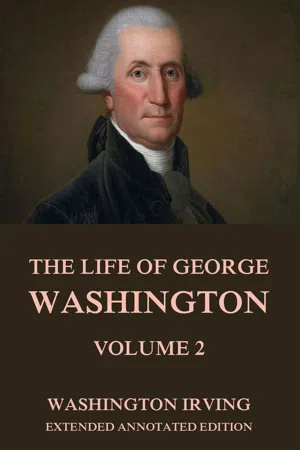
- 560 pages
- English
- ePUB (mobile friendly)
- Available on iOS & Android
eBook - ePub
The Life Of George Washington, Vol. 2
About this book
Information
The Life Of George Washington, Vol. 2
Washington Irving
Contents:
Washington Irving – A Biographical Primer
The Life Of George Washington, Vol. 2
Chapter I.
Chapter II.
Chapter III.
Chapter IV.
Chapter V.
Chapter VI.
Chapter VII.
Chapter VIII.
Chapter IX
Chapter X.
Chapter XI.
Chapter XII.
Chapter XIII.
Chapter XIV.
Chapter XV.
Chapter XVI.
Chapter XVII.
Chapter XVIII.
Chapter XIX.
Chapter XX.
Chapter XXI.
Chapter XXII.
Chapter XXIII.
Chapter XXIV.
Chapter XXV.
Chapter XXVI.
Chapter XXVII.
Chapter XXVIII.
Chapter XXIX.
Chapter XXX.
Chapter XXXI.
Chapter XXXII.
Chapter XXXIII.
Chapter XXXIV.
Chapter XXXV.
Chapter XXXVI.
Chapter XXXVII.
Chapter XXXVIII.
Chapter XXXIX.
Chapter XL.
Chapter XLI.
Chapter XLII.
Chapter XLIII.
Chapter XLIV.
Chapter XLV.
Chapter XLVI.
The Life Of George Washington, Vol. 2, W. Irving
Jazzybee Verlag Jürgen Beck
86450 Altenmünster, Loschberg 9
Germany
Edited and revised by Juergen Beck.
ISBN: 9783849642174
www.jazzybee-verlag.de
www.facebook.com/jazzybeeverlag
Washington Irving – A Biographical Primer
Washington Irving (1783-1859), American man of letters, was born at New York on the 3rd of April 1783. Both his parents were immigrants from Great Britain, his father, originally an officer in the merchant service, but at the time of Irving's birth a considerable merchant, having come from the Orkneys, and his mother from Falmouth. Irving was intended for the legal profession, but his studies were interrupted by an illness necessitating a voyage to Europe, in the course of which he proceeded as far as Rome, and made the acquaintance of Washington Allston. He was called to the bar upon his return, but made little effort to practice, preferring to amuse himself with literary ventures. The first of these of any importance, a satirical miscellany entitled Salmagundi, or the Whim-Whams and Opinions of Launcelot Langstaff and others, written in conjunction with his brother William and J. K. Paulding, gave ample proof of his talents as a humorist. These were still more conspicuously displayed in his next attempt, A History of New York from the Beginning of the World to the End of the Dutch Dynasty, by “Diedrich Knickerbocker” (2 vols., New York, 1809). The satire of Salmagundi had been principally local, and the original design of “Knickerbocker's” History was only to burlesque a pretentious disquisition on the history of the city in a guidebook by Dr Samuel Mitchell. The idea expanded as Irving proceeded, and he ended by not merely satirizing the pedantry of local antiquaries, but by creating a distinct literary type out of the solid Dutch burgher whose phlegm had long been an object of ridicule to the mercurial Americans. Though far from the most finished of Irving's productions, “Knickerbocker” manifests the most original power, and is the most genuinely national in its quaintness and drollery. The very tardiness and prolixity of the story are skillfully made to heighten the humorous effect.
Upon the death of his father, Irving had become a sleeping partner in his brother's commercial house, a branch of which was established at Liverpool. This, combined with the restoration of peace, induced him to visit England in 1815, when he found the stability of the firm seriously compromised. After some years of ineffectual struggle it became bankrupt. This misfortune compelled Irving to resume his pen as a means of subsistence. His reputation had preceded him to England, and the curiosity naturally excited by the then unwonted apparition of a successful American author procured him admission into the highest literary circles, where his popularity was ensured by his amiable temper and polished manners. As an American, moreover, he stood aloof from the political and literary disputes which then divided England. Campbell, Jeffrey, Moore, Scott, were counted among his friends, and the last-named zealously recommended him to the publisher Murray, who, after at first refusing, consented (1820) to bring out The Sketch Book of Geoffrey Crayon, Gent. (7 pts., New York, 1819-1820). The most interesting part of this work is the description of an English Christmas, which displays a delicate humor not unworthy of the writer's evident model Addison. Some stories and sketches on American themes contribute to give it variety; of these Rip van Winkle is the most remarkable. It speedily obtained the greatest success on both sides of the Atlantic. Bracebridge Hall, or the Humourists (2 vols., New York), a work purely English in subject, followed in 1822, and showed to what account the American observer had turned his experience of English country life. The humor is, nevertheless, much more English than American. Tales of a Traveller (4 pts.) appeared in 1824 at Philadelphia, and Irving, now in comfortable circumstances, determined to enlarge his sphere of observation by a journey on the continent. After a long course of travel he settled down at Madrid in the house of the American consul Rich. His intention at the time was to translate the Coleccion de los Viajes y Descubrimientos (Madrid, 1825-1837) of Martin Fernandez de Navarrete; finding, however, that this was rather a collection of valuable materials than a systematic biography, he determined to compose a biography of his own by its assistance, supplemented by independent researches in the Spanish archives. His History of the Life and Voyages of Christopher Columbus (London, 4 vols.) appeared in 1828, and obtained a merited success. The Voyages and Discoveries of the Companions of Columbus (Philadelphia, 1831) followed; and a prolonged residence in the south of Spain gave Irving materials for two highly picturesque books, A Chronicle of the Conquest of Granada from the MSS. of [an imaginary] Fray Antonio Agapida (2 vols., Philadelphia, 1829), and The Alhambra: a series of tales and sketches of the Moors and Spaniards (2 vols., Philadelphia, 1832). Previous to their appearance he had been appointed secretary to the embassy at London, an office as purely complimentary to his literary ability as the legal degree which he about the same time received from the university of Oxford.
Returning to the United States in 1832, after seventeen years' absence, he found his name a household word, and himself universally honored as the first American who had won for his country recognition on equal terms in the literary republic. After the rush of fêtes and public compliments had subsided, he undertook a tour in the western prairies, and returning to the neighborhood of New York built for himself a delightful retreat on the Hudson, to which he gave the name of “Sunnyside.” His acquaintance with the New York millionaire John Jacob Astor prompted his next important work — Astoria (2 vols., Philadelphia, 1836), a history of the fur-trading settlement founded by Astor in Oregon, deduced with singular literary ability from dry commercial records, and, without labored attempts at word-painting, evincing a remarkable faculty for bringing scenes and incidents vividly before the eye. The Adventures of Captain Bonneville (London and Philadelphia, 1837), based upon the unpublished memoirs of a veteran explorer, was another work of the same class. In 1842 Irving was appointed ambassador to Spain. He spent four years in the country, without this time turning his residence to literary account; and it was not until two years after his return that Forster's life of Goldsmith, by reminding him of a slight essay of his own which he now thought too imperfect by comparison to be included among his collected writings, stimulated him to the production of his Life of Oliver Goldsmith, with Selections from his Writings (2 vols., New York, 1849). Without pretensions to original research, the book displays an admirable talent for employing existing material to the best effect. The same may be said of The Lives of Mahomet and his Successors (New York, 2 vols., 1840-1850). Here as elsewhere Irving correctly discriminated the biographer's province from the historian's, and leaving the philosophical investigation of cause and effect to writers of Gibbon's caliber, applied himself to represent the picturesque features of the age as embodied in the actions and utterances of its most characteristic representatives. His last days were devoted to his Life of George Washington (5 vols., 1855-1859, New York and London), undertaken in an enthusiastic spirit, but which the author found exhausting and his readers tame. His genius required a more poetical theme, and indeed the biographer of Washington must be at least a potential soldier and statesman. Irving just lived to complete this work, dying of heart disease at Sunnyside, on the 28th of November 1859.
Although one of the chief ornaments of American literature, Irving is not characteristically American. But he is one of the few authors of his period who really manifest traces of a vein of national peculiarity which might under other circumstances have been productive. “Knickerbocker's” History of New York, although the air of mock solemnity which constitutes the staple of its humor is peculiar to no literature, manifests nevertheless a power of reproducing a distinct national type. Had circumstances taken Irving to the West, and placed him amid a society teeming with quaint and genial eccentricity, he might possibly have been the first Western humorist, and his humor might have gained in depth and richness. In England, on the other hand, everything encouraged his natural fastidiousness; he became a refined writer, but by no means a robust one. His biographies bear the stamp of genuine artistic intelligence, equally remote from compilation and disquisition. In execution they are almost faultless; the narrative is easy, the style pellucid, and the writer's judgment nearly always in accordance with the general verdict of history. Without ostentation or affectation, he was exquisi...
Table of contents
- Washington Irving – A Biographical Primer
Trusted by 375,005 students
Access to over 1.5 million titles for a fair monthly price.
Study more efficiently using our study tools.
Frequently asked questions
Yes, you can cancel anytime from the Subscription tab in your account settings on the Perlego website. Your subscription will stay active until the end of your current billing period. Learn how to cancel your subscription
No, books cannot be downloaded as external files, such as PDFs, for use outside of Perlego. However, you can download books within the Perlego app for offline reading on mobile or tablet. Learn how to download books offline
Perlego offers two plans: Essential and Complete
- Essential is ideal for learners and professionals who enjoy exploring a wide range of subjects. Access the Essential Library with 800,000+ trusted titles and best-sellers across business, personal growth, and the humanities. Includes unlimited reading time and Standard Read Aloud voice.
- Complete: Perfect for advanced learners and researchers needing full, unrestricted access. Unlock 1.5M+ books across hundreds of subjects, including academic and specialized titles. The Complete Plan also includes advanced features like Premium Read Aloud and Research Assistant.
We are an online textbook subscription service, where you can get access to an entire online library for less than the price of a single book per month. With over 1.5 million books across 990+ topics, we’ve got you covered! Learn about our mission
Look out for the read-aloud symbol on your next book to see if you can listen to it. The read-aloud tool reads text aloud for you, highlighting the text as it is being read. You can pause it, speed it up and slow it down. Learn more about Read Aloud
Yes! You can use the Perlego app on both iOS and Android devices to read anytime, anywhere — even offline. Perfect for commutes or when you’re on the go.
Please note we cannot support devices running on iOS 13 and Android 7 or earlier. Learn more about using the app
Please note we cannot support devices running on iOS 13 and Android 7 or earlier. Learn more about using the app
Yes, you can access The Life Of George Washington, Vol. 2 by Washington Irving in PDF and/or ePUB format, as well as other popular books in Politics & International Relations & Military Biographies. We have over 1.5 million books available in our catalogue for you to explore.