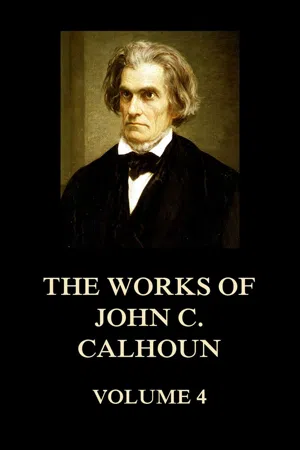
John C. Calhoun was the seventh Vice President of the United States from 1825 to 1832. He was a strong defendant of slavery and of Southern values versus Northern threats. His beliefs and warnings heavily influenced the South's secession from the Union in 1860–1861. This is volume four out of six of his works, this one containing a part of his speeches delivered in Congress (1841-1850).
- 648 pages
- English
- ePUB (mobile friendly)
- Available on iOS & Android
eBook - ePub
The Works of John C. Calhoun Volume 4
About this book
Information
SPEECH On Mr. Clay's Resolutions in relation to the Revenues and Expenditures of the Government; delivered in the Senate, March 16th, 1842.
MR. CALHOUN said: These resolutions are of a very mixed and contradictory character. They contain much that I approve, and much that I condemn. I approve of them, in the first place, because they recognize the Compromise Act, and profess to respect its provisions. I still more heartily approve of them because they assert that no duty ought to be laid but for revenue, and no revenue raised but what may be necessary for the economical administration of the Government; and, by consequence, they abandon the protective policy. I very decidedly approve of the preference which they give to the ad valorem, over specific duties, and the effective argument of the Senator (Mr. Clay), in support of this preference. And finally, I approve of the principle that the Government ought not to rely on loans or treasury notes, as a part of their ways and means in time of peace, except to meet a temporary deficit.
Having approved of so much, it may be asked for what do I condemn them? I condemn them for this; that they do not propose to carry out in practice, what they profess in principle; that while they profess to respect the Compromise Act, they violate it in every essential particular but one, — the ad valorem principle; and even this I fear it is intended to set aside by the juggle of home valuation. If there be any part of that act more sacred than another, it is that which provides that there shall be no duty imposed after the 30th of June next, except for revenue, and no revenue raised, but what may be necessary to the economical administration of the Government. It was for this the act was passed, and without which it would not have existed. If this was not apparent on the face of the act itself, the causes which led to its adoption would clearly prove it. It is sufficient, in this connection, to remind the Senate that the object of the act was to terminate the controversy between the State of South Carolina and this Government, growing out of the tariff of 1828. The object of the State, as far as she was individually concerned, was twofold—to put down the protective policy, and to protect herself against high duties, even for revenue, when it could be avoided by due regard to economy. To secure the former, the provision was inserted that no duty should be laid but for revenue; and the latter, that no revenue should be raised but what was necessary for the economical administration of the Government. Without these provisions, I, as her representative on this floor, would never have given my assent to the act; and, if I had, the State would never have acquiesced in it. I speak with perfect confidence; for even with these important provisions, she reluctantly assented to the compromise.
Besides these, there was another object in which the whole Union was deeply concerned, which influenced her in the step she then took; and that was, to guard against the dangerous consequences of an accumulation of a large surplus revenue in the treasury after the payment of the public debt. While defending herself, and the portion of the Union in which her lot is cast, against an unconstitutional and oppressive measure, she was not unmindful of her federal duties and obligations, nor did she permit her fidelity to the Union and the Government to be impaired in her resistance to oppression. She had the sagacity to see, long in advance, the corrupting and dangerous consequences of a large and permanent surplus, of which experience has since given such calamitous evidence; and has the merit of taking the most intrepid stand against it, while others were unheeding or indifferent to consequences. To guard against this danger, every article imported, that did not come in conflict with the protective policy, was made, by the Compromise Act, duty free to the 30th of June next, which, in the aggregate, equaled in value those on which the duties were retained; that is, one-half the duties was forthwith repealed, but to prevent the possibility of abuse, and to guard, in the most effectual manner, the two leading provisions of the act, it was expressly provided that, after that time, all articles of imports, except a small list contained in the 5th section, should be subject to duty, and that no duty should thereafter exceed 20 per cent. ad valorem. The intention of the former provision was to prevent the enlargement of the free list, and thereby raising the duties proportionally higher on the dutied articles; and of the latter, that, under no pretext whatever, for protection or revenue, should duties be raised above 20 per cent, which was regarded as the extreme limits to which they ought ever to be carried for revenue. These were the guards on which I relied to prevent a return to the protective policy, or the raising of the revenue beyond what the necessary and economical wants of the Government might require, and which, if they should be respected, will prove all-sufficient for the purpose intended. Having secured these essential points, as far as the State and the Union at large were concerned, the next object was, so to reduce the duties on the protected articles, as to prevent any shock to the manufacturing interests. The State waged no war against them. Her opposition was to the unconstitutional and oppressive means by which it was sought to promote them at the expense of the other great interests of the community. She wished the manufacturers well; and in proposing to bring down the duties gradually, through a slow process of many years, to the revenue point, Ibut faithfully represented her feelings. My first proposition was, to allow seven years, and to take one-seventh annually off; but, finally, I acquiesced in extending the time two years more, and to reduce the duties as provided for by the act.
So far from being an opponent to manufacturing industry, there is not one within the reach of my voice, who puts a higher estimate on those arts, mechanical and chemical, by which matter is subjected to the dominion of mind. I regard them as the very basis of civilization, and the principal means designed by Providence for the future progress and improvement of our race. They will be found in progress to react on the moral and political world, — thereby producing greater and more salutary changes in both, than all other causes combined.
Such were the leading objects of the Compromise Act. It is admitted on all hands, that the provisions in favor of the manufacturing interest have been faithfully observed on our part. We have patiently waited the nine years of slow reduction, and resisted every attempt to make changes against the manufacturing interest, even when they would have operated in our favor, — and for which we have received the thanks of those who represented it on this floor. And now, that the time has arrived, when it is our turn to enjoy its benefits, they who called on us to adhere to the act, when the interest of the manufacturers was at stake, and commended us for our fidelity to the compromise, turn round, when it suits their interest, and coolly and openly violate every provision in our favor, with the single exception already noticed, —as I shall next proceed to show.
For this purpose it will be necessary to go back to the extraordinary session—for then the violation commenced.
Going then back, and passing over minor points, I charge upon the Senator and his friends, in the first place, a palpable infraction of the compromise, in raising the duties without making the least effort to reduce the expenditures of the Government, to what is necessary to its economical administration. The act is positive, that no more revenue should be raised than what such administration might require; a provision just as essential as that which requires that no duty should be imposed but for revenue. Acting, then, in the spirit of the act, the first step towards a revision of the duties should have been to ascertain what amount of revenue would be required for the economical administration of the Government. Was that done? Nothing like it; but the very reverse. Not an effort was made to ascertain what the wants of the treasury required; not one to reduce the expenditures, although the Senator and his party had come in on a solemn pledge to make a great reduction. Instead of this, every effort was made to increase the expenditures and add to the loans, — forgetful alike of the compromise and pledges to the people, and at the same time, to reduce the revenue by giving away the income from the lands, with the intention of increasing the duties on the imports.
The next charge I make is a great enlargement of the list of free articles by the act increasing the duties passed at the same session, in direct violation of the fifth section of the Compromise Act. Foreseeing that the protective system might again be renewed, and high duties imposed, simply by extending the list of free articles, and throwing the whole burden of supporting the Government on the articles selected for protection, that section enumerates a short list of articles which should be duty free after the 30th June next, and provided that all which were not enumerated should be subject to duties after that period, in order to guard against such abuses. In the face of this provision, the act alluded to increased the list of free articles many-fold, taking the amount stated by the Senator, as contained in that list, to be correct.
Such were the infractions of the act during that session; and it is now proposed by these resolutions to give the finishing blow by raising the duties, on an average, to thirty per centum on all articles not made free, in express violation of the main provision in the compromise, that no duty should be laid above 20 per cent, after the 30th of June next. The Senator admits this to be an infraction, but pleads necessity.
Now, Sir, I admit, if there be indeed a necessity—if, after reducing the expenditures of the Government to its just and economical wants, and the list of free articles to that provided for in the act, and returning the revenue from the lands to the treasury, there should be a deficit, which could not be met, without going beyond the 20 per cent., a case would be made out that might justify it. But I utterly deny, in the first place, that, if all had been done which ought to have been, there would be any such necessity; and in the next, the right to plead a necessity of his own creating.
I go further, and call on him to explain how he can, in fairness or honor, after what occurred at the extraordinary session, propose, as he has in these resolutions, to repeal the provision in the Distribution Act which makes it void, if the duties should be raised above 20 per cent. It is well known to all, that it could not have passed without the insertion of that provision, and that on its passage depended that of the Bankrupt Bill. Now I ask him how, after having secured the passage of two such important measures, can he reconcile it with what is fair or honorable, to turn round and propose to repeal the very provision by which their passage was effected?
But the Senator denies that the necessity is of his creating, and insists that if the revenue from the land were restored, rigid economy enforced, and all the provisions of the compromise respected, there would not be sufficient income to meet the necessary and economical wants of the Government. I take issue with him on the fact, and shall now proceed to show, that even on his own data, there would be ample revenue without raising the duties above 20 per cent.
According to the estimates of the Senator, the whole amount of appropriations, excluding public debt required for the service of the year, permanent and current, under the various heads of civil list and miscellaneous, army and navy in all their branches, is twenty millions five hundred thousand dollars. To which he adds for other appropriations, not included in these, one million five hundred thousand dollars, — which can mean nothing but contingent, unforeseen expenditures; and for the debt, two millions of dollars, making in the aggregate twenty-four millions of dollars. To this he proposes to add two millions more annually, as a reserved fund to meet contingencies, to which I object, on the ground that the object is already provided for by the one million five hundred thousand dollars for appropriations not included in the twenty millions five hundred thousand.
There can be no demand on the treasury but through appropriations, and there can be no meaning attached to contingent appropriations, but such unforeseen expenditures as are not usually included under the various heads of civil list, miscellaneous, army and navy. The Senator has clearly attempted to make a distinction that does not exist, — and in consequence, made a double provision for the same object.
Of the two, I take the less sum, as I regard it ample as a permanent contingent fund, which will make his estimate for the year, thus corrected, to be twenty-four millions of dollars —a sum surely amply large.
Let us now turn to the ways and means to meet this large demand on the treasury. The first item is the revenue from the lands, which ought to yield, under proper management an average of at least three millions five hundred thousand dollars for the next five years, and which would reduce the amount to be provided for from the imposts to twenty millions five hundred thousand dollars. From this there ought to be deducted at least five hundred thousand dollars from savings that may be made in the collection of the customs, which the Senator estimates at one million six hundred thousand. I find, taking a series of years, under the tariff of 1828, with its exorbitant duties, and the consequent great increase of expenditures to guard against smuggling and frauds, that the collection of about an equal sum cost 4.12 per cent. Allowing the same rate under the more simple and moderate system of duties, according even to the scheme of the Senator, and the cost of collection, instead of the sum proposed, would be about eight hundred and fifty thousand dollars, making a difference of seven hundred and fifty thousand; but for the facility of counting, and to be liberal, I allow but half a million for saving. That would reduce the sum to be provided for by duties, to twenty millions of dollars; and the next question is, What rate of duty will be necessary to meet this amount? Here, again, I will take the estimate of the Senator as the basis of my calculation. He bases his estimates of the imports, on the probable amount of the exports, adding fifteen per cent. to the former for the profits of freight and
trade. On this basis he estimates the probable amount of imports at one hundred and nineteen millions of dollars—a sum probably too low, taking the average of the next five years, provided the duties shall be moderate, and no adverse unforeseen cause should intervene. From this sum he deducted ten millions to meet the interest abroad, on account of the debts of the States; a sum, for the reason assigned by the Senator from New Hampshire behind me, too large at least by three millions of dollars. Deduct seven millions on that account, and there would be left one hundred and twelve millions. The Senator next deducted eighteen millions for articles made free by the act of the extra session, not including coffee and tea, which he estimates at twelve millions.
I cannot assent to the deduction to the extent stated, — as it is clearly against the provisions of the Compromise Act, and beyond the permanent free list provided for by that act.
What would be the amount within its limits I have not been able to ascertain; but on the best data I have been able to obtain, I would not suppose that it would much if any exceed three millions five hundred thousand dollars, not including gold and silver. I exclude these because they are constantly flowing in and out, according to the demands of trade, — the imports of one year becoming the exports of the next, and the reverse, except the small amount that may be permanently added to the circulation or be used in the country. The sum of three millions five hundred thousand dollars deducted from the hundred and twelve millions, would leave, on the data assumed, a hundred and eight millions five hundred thousand as the probable annual amount of dutiable articles, that would be imported for home consumption.
Twenty per cent, on that sum would give twenty-one million seven hundred thousand dollars, a sum ample to meet the amount estimated, and cover the necessary expenses of collection, and pay the bounties and premiums properly chargeable on the treasury. But in making these calculations, I by no means wish to be understood as acquiescing in the estimates which the Senator has made of what ought to be the expenditures of the Government. I hold them much too high. With an efficient system of administration, actuated by a true spirit of economy, seventeen millions would be ample to meet all expenses, without impairing the efficiency of the Government, as I have shown on a former occasion; to raise which an average duty of twelve or fifteen per cent. instead of twenty, would, with the aid of the revenue from the lands, be abundantly sufficient.
Having now shown that, while the Senator professes to respect the compromise, he has, in fact, violated, or proposes to violate, all the essential provisions of the act, — and that his plea of necessity for proposing to raise the duties above the twenty per cent, utterly fails him, it may be asked, How is this contradiction in his course to be explained? Is he deluded, or does he intend to delude others? To suppose the latter would impeach his sincerity, which I do not intend to question. But how is delusion to be accounted for? It results from his position.
He is a tariff man, decidedly opposed to free trade. We have his own authority for the assertion. According to his views, free trade is among the greatest curses that could befall the country, and a high protective tariff among the greatest blessings. While he thus thinks and feels, circumstances not necessary to be explained, have placed him in such relation to the Compromise Act, that he is sincerely desirous to respect its provisions; but the misfortune is, that his respect for...
Table of contents
- SPEECH On the Loan Bill, delivered in the Senate, July 19th, 1841.
- SPEECH On the Distribution Bill, delivered in the Senate, August 24, 1841.
- SPEECH On the Treasury Note Bill, delivered in the Senate, January 25th, 1842.
- SPEECH On the Veto Power, delivered in the Senate, February 28th, 1842.
- SPEECH On Mr. Clay's Resolutions in relation to the Revenues and Expenditures of the Government; delivered in the Senate, March 16th, 1842.
- SPEECH On the Loan Bill, delivered in the Senate, April 12th, 1842.
- REMARKS On the Bill providing for further remedial justice in the District Courts of the United States, made in the Senate, July 8th, 1842.
- SPEECH On the Passage of the Tariff Bill, delivered in the Senate, August 5th, 1842.
- SPEECH On the Tariff Bill, delivered in the Senate, August 27th, 1842.
- SPEECH On the Treaty of Washington, delivered in the Senate, August 28th, 1842.
- SPEECH On the Oregon Bill, delivered in the Senate, January 24th, 1843.
- SPEECH On the Resolutions giving notice to Great Britain of the Abrogation of the Convention of Joint Occupancy; delivered in the Senate, March 16th, 1846.
- REMARKS On the Bill making alterations in the Pay Department of the Army, &c.; made in the Senate, May 14th, 1846.
- SPEECH On the Bill making further appropriation to bring the existing war with Mexico to a speedy and honorable conclusion, called “The Three Million Bill;” delivered in the Senate, February 9th, 1847.
- SPEECH In reply to Mr. Turney of Tennessee, delivered in the Senate, February 12th, 1847.
- REMARKS On presenting his Resolutions on the Slave Question, made in the Senate, February 19th, 1847.
- REMARKS In reply to Mr. Simmons, on his Resolutions; made in the Senate, February 20th, 1847.
- SPEECH In Reply to Mr. Benton, of Missouri; delivered in the Senate, February 24, 1847.
- REMARKS Made at the Meeting of the Citizens of Charleston, Tuesday evening, March 9th, 1847.
- SPEECH On his Resolutions in reference to the War with Mexico, delivered in the Senate, January 4th, 1848.
- SPEECHES On the Ten Regiment Bill, and in reply to Mr. Davis of Mississippi, and Mr. Cass; delivered in the Senate, March 16th and 17th, 1848.
- REMARKS On the Resolutions of Mr. Allen of Ohio, congratulating the French Nation on the success of their Revolutionary Struggle; made in the Senate, March 30th, 1848.
- SPEECH On the Oregon Bill, delivered in the Senate, June 27th, 1848.
- SPEECH On the Amendment offered to the Bill from the House of Representatives, establishing a Territorial Government for Oregon, and proposing to extend the Missouri Compromise Line to the Pacific Ocean; delivered in the Senate, August 12th, 1849.
- REMARKS On the Proposition to establish Territorial Governments in New Mexico and California, made in the Senate, February 24th, 1849.
- SPEECH On the Slavery Question, delivered in the Senate, March 4th, 1850.
- REMARKS In reply to Mr. Foote, made in the Senate, March 5th, 1850.
Trusted by 375,005 students
Access to over 1.5 million titles for a fair monthly price.
Study more efficiently using our study tools.
Frequently asked questions
Yes, you can cancel anytime from the Subscription tab in your account settings on the Perlego website. Your subscription will stay active until the end of your current billing period. Learn how to cancel your subscription
No, books cannot be downloaded as external files, such as PDFs, for use outside of Perlego. However, you can download books within the Perlego app for offline reading on mobile or tablet. Learn how to download books offline
Perlego offers two plans: Essential and Complete
- Essential is ideal for learners and professionals who enjoy exploring a wide range of subjects. Access the Essential Library with 800,000+ trusted titles and best-sellers across business, personal growth, and the humanities. Includes unlimited reading time and Standard Read Aloud voice.
- Complete: Perfect for advanced learners and researchers needing full, unrestricted access. Unlock 1.5M+ books across hundreds of subjects, including academic and specialized titles. The Complete Plan also includes advanced features like Premium Read Aloud and Research Assistant.
We are an online textbook subscription service, where you can get access to an entire online library for less than the price of a single book per month. With over 1.5 million books across 990+ topics, we’ve got you covered! Learn about our mission
Look out for the read-aloud symbol on your next book to see if you can listen to it. The read-aloud tool reads text aloud for you, highlighting the text as it is being read. You can pause it, speed it up and slow it down. Learn more about Read Aloud
Yes! You can use the Perlego app on both iOS and Android devices to read anytime, anywhere — even offline. Perfect for commutes or when you’re on the go.
Please note we cannot support devices running on iOS 13 and Android 7 or earlier. Learn more about using the app
Please note we cannot support devices running on iOS 13 and Android 7 or earlier. Learn more about using the app
Yes, you can access The Works of John C. Calhoun Volume 4 by John C. Calhoun in PDF and/or ePUB format, as well as other popular books in Politics & International Relations & Political Biographies. We have over 1.5 million books available in our catalogue for you to explore.