This first major work of the famous author is a travelogue of his journeys to Europe. It is a form, which, as every reader knows, has been recommended by the high example and success of Mr. Irving; and, in recording only such circumstances as suit his fancy, an accomplished traveller is certainly more likely to preserve the proper measure of spirit and freshness, than when he enters on the task of preparing an elaborate and formal narrative. It must not be supposed, that, in adopting the form of Mr. Irving, Longfellow has been guilty of any other imitation. They have both entered on the same field, in different directions.The Pays à Outre-Mer was the name, by which the Holy Land was known to the pilgrims and crusaders; and the author describes himself as a pilgrim of the Land beyond the Sea. This land filled the visions of his youthful fancy, and when he first beheld its shores, it was with the same emotions, with which the wandering palmer used to hail the bounds of Palestine. It does not appear, however, that in roaming over classic ground, he felt as if he were undergoing penance; on the contrary, he seems to have pursued his journey with a tolerably cheerful spirit, and when it was fairly over, to have sat down to embody and preserve the recollection of the scenes he had passed through.
- 148 pages
- English
- ePUB (mobile friendly)
- Available on iOS & Android
eBook - ePub
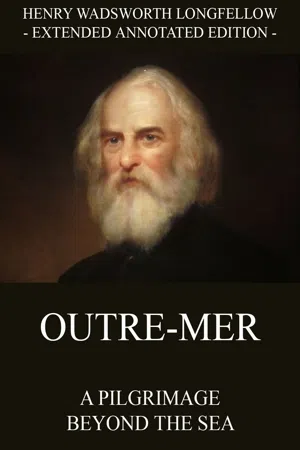
Outre-Mer - A Pilgrimage Beyond The Sea
About this book
Trusted by 375,005 students
Access to over 1.5 million titles for a fair monthly price.
Study more efficiently using our study tools.
Information
Topic
Personal DevelopmentSubtopic
TravelOutre-Mer - A Pilgrimage Beyond The Sea
Henry Wadsworth Longfellow
Contents:
Henry Wadsworth Longfellow – A Primer
Introductory Note To Outre-Mer
Outre-Mer - A Pilgrimage Beyond The Sea
No I.
The Epistle Dedicatory.
1. The Pilgrim Of Outre-Mer.
2. The Norman Diligence.
3. The Golden Lion Inn, At Rouen.
4. Martin Franc And The Monk Of Saint Anthony.
5. The Village Of Auteuil.
6. Jacqueline.
7. The Sexagenarian, A Sketch Of Character.
8. Père La Chaise.
No. Ii.
1. The Valley Of The Loire.
2. The Ancient Lyric Poetry Of The North Of France.
3. The Baptism Of Fire.
4. Coq-A-L' Ane.
5. The Journey Into Spain.
Outre-Mer - A Pilgrimage Beyond The Sea, H. W.Longfellow
Jazzybee Verlag Jürgen Beck
86450 Altenmünster, Loschberg 9
Germany
www.jazzybee-verlag.de
www.facebook.com/jazzybeeverlag
Henry Wadsworth Longfellow – A Primer
By Thomas Davidson
H. W. Longfellow was an American poet, born on the 27th of February 1807, at Portland, Maine. His ancestor, William Longfellow, had immigrated to Newbury, Massachusetts, in 1676, from Yorkshire, England. His father was Stephen Longfellow, a lawyer and United States congressman, and his mother, Zilpha Wadsworth, a descendant of John Alden and of “Priscilla, the Puritan maiden.”
Longfellow's external life presents little that is of stirring interest. It is the life of a modest, deep-hearted gentleman, whose highest ambition was to be a perfect man, and, through sympathy and love, to help others to be the same. His boyhood was spent mostly in his native town, which he never ceased to love, and whose beautiful surroundings and quiet, pure life he has described in his poem “My Lost Youth.” Here he grew up in the midst of majestic peace, which was but once broken, and that by an event which made a deep impression on him — the War of 1812. He never forgot
“the sea-fight far away,
How it thundered o'er the tide,
And the dead captains as they lay
In their graves o'erlooking the tranquil bay,
Where they in battle died.”
The “tranquil bay” is Casco Bay, one of the most beautiful in the world, studded with bold, green islands, well fitted to be the Hesperides of a poet's boyish dreams. At the age of fifteen Longfellow entered Bowdoin College at Brunswick, a town situated near the romantic falls of the Androscoggin river, about 25 m. from Portland, and in a region full of Indian scenery and legend. Here he had among his classfellows Nathaniel Hawthorne, George B. Cheever and J. S. C. Abbott. During the latter years of his college life he contributed to the United States Literary Gazette some half-dozen poems, which are interesting for two reasons — (1) as showing the poet's early, book-mediated sympathy with nature and legendary heroisms, and (2) as being almost entirely free from that supernatural view of nature which his subsequent residence in Europe imparted to him. He graduated in 1825, at the age of eighteen, with honours, among others that of writing the “class poem” — taking the fourth place in a class of thirty-eight. He then entered his father's law office, without intending, however, it would appear, to devote himself to the study of the law. For this profession he was, both by capacity and tastes, utterly unfitted, and it was fortunate that, shortly after his graduation, he received an offer of a professorship of modern languages at Bowdoin College. In order the better to qualify himself for this appointment, he went to Europe (May 15th, 1826) and spent three years and a half travelling in France, Italy, Spain, Germany, Holland and England, learning languages, for which he had unusual talent, and drinking in the spirit of the history and life of these countries. The effect of Longfellow's visit was twofold. On the one hand, it widened his sympathies, gave him confidence in himself and supplied him with many poetical themes; on the other, it traditionalized his mind, coloured for him the pure light of nature and rendered him in some measure unfit to feel or express the spirit of American nature and life. His sojourn in Europe fell exactly in the time when, in England, the reaction against the sentimental atheism of Shelley, the pagan sensitivity of Keats, and the sublime, Satanic outcastness of Byron was at its height; when, in the Catholic countries, the negative exaggerations of the French Revolution were inducing a counter current of positive faith, which threw men into the arms of a half-sentimental, half-aesthetic medievalism; and when, in Germany, the aristocratic paganism of Goethe was being swept aside by that tide of dutiful, romantic patriotism which flooded the country, as soon as it began to feel that it still existed after being run over by Napoleon's war-chariot. He returned to America in 1829, and remained six years at Bowdoin College (1829-1835), during which he published various text-books for the study of modern languages. In his twenty-fourth year (1831) he married Miss Mary Story Potter, one of his “early loves.” In 1833 he made a series of translations from the Spanish, with an essay on the moral and devotional poetry of Spain, and these were incorporated in 1835 in Outre-mer: a Pilgrimage beyond the Sea.
In 1835 Longfellow was chosen to succeed George Ticknor as professor of modern languages and belles-lettres in Harvard. On receiving this appointment, he paid a second visit of some fifteen months to Europe, this time devoting special attention to the Scandinavian countries and Switzerland. During this visit he lost his wife, who died at Rotterdam, on the 29th of November 1835.
On his return to America in December 1836, Longfellow took up his residence in Cambridge, and began to lecture at Harvard and to write. In his new home he found himself amid surroundings entirely congenial to him. Its spaciousness and free rural aspect, its old graveyards and towering elms, its great university, its cultivated society and its vicinity to humane, substantial, busy Boston, were all attractions for such a man. In 1837-1838 several essays of Longfellow's appeared in the North American Review, and in 1839 he published Hyperion: a Romance, and his first volume of original poetry, entitled Voices of the Night. Hyperion, a poetical account of his travels, had, at the time of its publication, an immense popularity, due mainly to its sentimental romanticism. At present few persons beyond their teens would care to read it through, so unnatural and stilted is its language, so thin its material and so consciously mediated its sentiment. Nevertheless it has a certain historical importance, for two reasons — (1) because it marks that period in Longfellow's career when, though he had left nature, he had not yet found art, and (2) because it opened the sluices through which the flood of German sentimental poetry flowed into the United States. The Voices of the Night contains some of his best minor poems, e.g. “The Psalm of Life” and “Footsteps of Angels.” In 1842 Longfellow published a small volume of Ballads...
Table of contents
- Henry Wadsworth Longfellow – A Primer
- INTRODUCTORY NOTE TO OUTRE-MER
- OUTRE-MER - A PILGRIMAGE BEYOND THE SEA
- No I.
- No. II.
Frequently asked questions
Yes, you can cancel anytime from the Subscription tab in your account settings on the Perlego website. Your subscription will stay active until the end of your current billing period. Learn how to cancel your subscription
No, books cannot be downloaded as external files, such as PDFs, for use outside of Perlego. However, you can download books within the Perlego app for offline reading on mobile or tablet. Learn how to download books offline
Perlego offers two plans: Essential and Complete
- Essential is ideal for learners and professionals who enjoy exploring a wide range of subjects. Access the Essential Library with 800,000+ trusted titles and best-sellers across business, personal growth, and the humanities. Includes unlimited reading time and Standard Read Aloud voice.
- Complete: Perfect for advanced learners and researchers needing full, unrestricted access. Unlock 1.5M+ books across hundreds of subjects, including academic and specialized titles. The Complete Plan also includes advanced features like Premium Read Aloud and Research Assistant.
We are an online textbook subscription service, where you can get access to an entire online library for less than the price of a single book per month. With over 1.5 million books across 990+ topics, we’ve got you covered! Learn about our mission
Look out for the read-aloud symbol on your next book to see if you can listen to it. The read-aloud tool reads text aloud for you, highlighting the text as it is being read. You can pause it, speed it up and slow it down. Learn more about Read Aloud
Yes! You can use the Perlego app on both iOS and Android devices to read anytime, anywhere — even offline. Perfect for commutes or when you’re on the go.
Please note we cannot support devices running on iOS 13 and Android 7 or earlier. Learn more about using the app
Please note we cannot support devices running on iOS 13 and Android 7 or earlier. Learn more about using the app
Yes, you can access Outre-Mer - A Pilgrimage Beyond The Sea by Henry Wadsworth Longfellow in PDF and/or ePUB format, as well as other popular books in Personal Development & Travel. We have over 1.5 million books available in our catalogue for you to explore.