This edition includes the two books that St. Augustine wrote as explanations on the Sermon On The Mount which our Lord delivered and which are written down in Matthew 5-7.
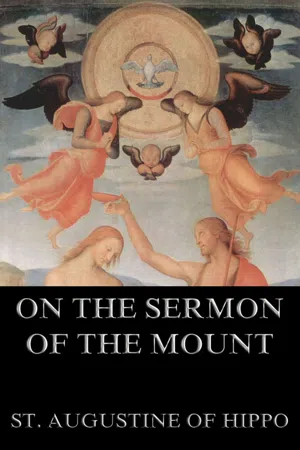
- 135 pages
- English
- ePUB (mobile friendly)
- Available on iOS & Android
eBook - ePub
On the Sermon On The Mount
About this book
Information
On the Sermon On The Mount
St. Augustine of Hippo
Contents:
Saint Augustine – A Biography
Introductory Essay. St. Augustin as an Exegete.
Our Lord’s Sermon on the Mount.
Book I.
Chapter I.
Chapter II.
Chapter III.
Chapter IV.
Chapter V.
Chapter VI.
Chapter VII.
Chapter VIII.
Chapter IX.
Chapter X.
Chapter XI.
Chapter XII.
Chapter XIII.
Chapter XIV.
Chapter XV.
Chapter XVI.
Chapter XVII.
Chapter XVIII.
Chapter XIX.
Chapter XX.
Chapter XXI.
Chapter XXII.
Chapter XXIII.
Book II.
Chapter I.
Chapter II.
Chapter III.
Chapter IV.
Chapter V.
Chapter VI.
Chapter VII.
Chapter VIII.
Chapter IX.
Chapter X.
Chapter XI.
Chapter XII.
Chapter XIII.
Chapter XIV.
Chapter XV.
Chapter XVI.
Chapter XVII.
Chapter XVIII.
Chapter XIX.
Chapter XX.
Chapter XXI.
Chapter XXII.
Chapter XXIII.
Chapter XXIV.
Chapter XXV.
On the Sermon On The Mount, St. Augustine
Jazzybee Verlag Jürgen Beck
86450 Altenmünster, Germany
ISBN: 9783849621070
www.jazzybee-verlag.de
Saint Augustine – A Biography
Augustine (Aurelius Augustinus) was a Saint, a doctor of the Latin church, born at Tagaste, a small town of Numidia in Africa, not far from Carthage, Nov. 13, 354, died Aug. 28, 430. His father, Patricius, was a pagan nobleman of moderate 'fortune, while his mother, Monica, who has been canonized by the church, was an earnest Christian. Augustine was sent to the best schools of Madaura and Carthage. His own "Confessions" tell us that his conduct at this period of his life was far from exemplary. His studies, chiefly in the heathen poets, were more favorable to the development of his fancy and his style than to his Christian growth. The death of his father, which threw him upon his own resources, and the influence of some philosophical works, especially the Hortensius of Cicero, roused him to a diligent search after truth. Unable to find this in the writings of the Greek and Roman sages, and dissatisfied with what seemed to him the crude and fragmentary teachings of the Jewish and Christian Scriptures, he adopted the dualism of the Manichgeans. At the age of 29 he went to Rome. There his reputation as a teacher of eloquence soon rivaled that of Symmachus, then at the height of his renown. On the recommendation of that orator, he was called to Milan as a teacher of rhetoric.
Ambrose was then bishop of Milan, and Augustine's first care was to know so famous a preacher. After repeated interviews with Ambrose, the conversion of his own illegitimate son, and the entreaties of his mother, he resolved to embrace Christianity. The history of his conversion forms the most striking chapter in his "Confessions." After eight months of seclusion, which he spent with his mother and brother and son, preparing for his confirmation in the church, and maturing his plans for the future, Augustine in the Easter week of 387 was baptized, together with his son and brother, by the hand of Ambrose. He at once set out on his return to Africa. On the way his mother died, and a small chapel among the ruins of Ostia marks the traditional spot of her burial. The death of his son, which took place soon after his return, confirmed his inclination to the monastic life. He retired to Tagaste, and passed nearly three years in studious seclusion, varied only by occasional visits to the neighboring towns. On one of these visits, when he was present at the church in Hippo, a sermon which the bishop Valerius delivered, asking for a priest to assist him in his church, turned all eyes toward this famous scholar. No refusals were allowed, and Augustine was ordained.
Preaching was soon added to his duties, an exception being made in his case to the usual rule, and the periods of the African orator, in harsh Latin or the harsher Punic tongue, were received with vehement applause. He was soon called to be assistant bishop, and then, on the death of the elder prelate, the whole charge of the church of Hippo was entrusted to his care. He retained the office until his death, a period of 35 years. The details of his episcopal life are minutely related by his friend Possidius. He preached every day and sometimes twice in the day; was frugal in his domestic arrangements, being a strict ascetic, and requiring of his attendant priests and deacons an equal simplicity of diet and dress; given to hospitality, yet without display; warmly interested in every kind of charity; courteous in his bearing, welcoming even infidels to his table; bold against all wickedness and wrong, whatever the rank of the transgressor; and untiring in his visits to widows and orphans, to the sick and the afflicted. He disputed with Manichajans, Arians, the followers of Priscillian, of Origen, and Tertullian, the Donatists, and the Pelagians, and allowed no doubtful utterance of doctrine to pass without his questioning.
To his industry in controversy must be added his vast correspondence with emperors, nobles, doctors, missionaries, bishops, in every quarter of the globe, on questions of dogma, of discipline, and of policy his solid works of commentary, criticism, morality, philosophy, and theology, and even his poetry, for to him are attributed several of the sweetest hymns of the Catholic anthology. The titles alone of the works of Augustine make a long catalogue. The single volume of "Sermons" contains nearly 700 pieces, shorter indeed and less ornate than the celebrated sermons of Basil and Chrysostom, but justifying Augustine's reputation for sacred oratory. The volume of "Commentaries on the Psalms" is more rich in practical remarks than in accurate learning. His remarks upon the "Four Gospels" are more valuable. His work on the "Care that should be taken for the Dead" contains some striking views concerning the relation of the living to disembodied souls. The volume of his "Epistles" is remarkable, as illustrating his best style and the finest traits in his character.
The name of Augustine, in the dogmatic history of the church, is best known in connection with the heresy of Pelagius; but his works which are most widely known are the "Confessions" and "The City of God." In the former, written just after his conversion, he gives a history of his life up to that time, not so much in its outward circumstance as in its inward experience and change. It has been translated into every Christian tongue, and is classed with the choicest memorials of devotion, both in Catholic and Protestant oratories. His treatise on "The City of God" (De Civitate Dei) is the monument of highest genius in the ancient church, and in its kind has never been surpassed. Its immediate purpose was to vindicate the faith of the gospel against the pagans, who had just devastated Rome. The first five books confute the heathen thesis that the worship of the ancient gods is essential to human prosperity, and that miseries have only come since the decline of this worship. The five following books refute those who maintain that the worship of pagan deities is useful for the spiritual life.
The remaining twelve books are employed in setting forth the doctrines of the Christian religion, under the somewhat fanciful form of "two cities," the city of the world and the city of God. The influence of Augustine upon his own age, and upon all succeeding ages of Christian history, cannot be exaggerated. It is believed that he was at once one of the purest, the wisest, and the holiest of men; he was equally mild and firm, prudent and fearless; at once a philosopher and a mystic, a student and a ruler. Of his singular humility manifold instances are recorded. His severe self-discipline matches the strictest instances of the hermit life. In his " Retractations," begun after the close of his 70th year, he reviews his writings, taking back whatever is doubtful or extravagant, and harmonizing discordant opinions. The aid of a coadjutor relieved Augustine in his latter years of a portion of his responsibility; yet questions of conscience were constantly presented to him. When Genseric and his Vandals showed themselves on the coasts of Africa, the question was put to him if it were lawful for a bishop at such a season to fly and leave his flock. The answer which he made was illustrated by his own course.
He calmly waited for the threatened approach, and when the fleet of the foe was in the bay of Hippo, and the army was encamped before the walls, exerted himself only to quiet the fears and sustain the faith of his brethren. He died of fever before the catastrophe. The bishop Possidius, who watched at his bedside, gives an edifying account of his last days, and of the grief of the people at his loss. His relics were transported to Italy, and mostly rest at present in the cathedral of Pavia. Within the present century the bone of his right arm has, with solemn pomp, been returned to the church of Bona in Algeria, which occupies the site of ancient Hippo. The best edition of Augustine's works is that of the Benedictines, published at Paris and at Antwerp' at the close of the 17th century, in 11 vols, folio. An edition in 11 volumes was also published in Paris in 1836-'9. An additional volume of sermons, before unpublished, found at Monte Casino and Florence, was published at Paris in 1842. An English translation by various hands has been undertaken at Edinburgh, under the editorship of the Rev. Marcus Dods, the 3rd and 4th volumes of which appeared in 1872.
Introductory Essay. St. Augustin as an Exegete.
By the Rev. David Schley Schaff.
The exegetical writings of Augustin are commentaries on Genesis (first three chapters), the Psalms, the Gospel and First Epistle of John, the Sermon on the Mount, the Epistles to the Romans and Galatians, and a Harmony of the Gospels. Many of his commentaries, like those of Chrysostom, are expository homilies preached to his congregation at Hippo; all are practical rather than grammatical and critical. He only covered the first five verses of the first chapter of Romans, and found his comments so elaborate, that, from fear of the immense proportions a commentary on the whole Epistle would assume, he drew back from the task. Augustin’s other writings abound in quotations from Scripture, and pertinent expositions. His controversies with the Manichaeans and Donatists were particularly adapted to render him thorough in the knowledge of the Bible, and skilled in its use.
The opinions of Augustin’s ability as an exegete, and the worth of his labors in the department of connected Biblical exposition, have greatly differed. Some not only represent him at his weakest in this capacity, but disparage his exegesis as of inferior merit. Others have given him, and some at the present time still give him, a very high rank among the chief commentators of the early Church. Père Simon, as quoted by Archbishop Trench (Sermon on the Mount, p. 65), says, “One must needs read a vast deal in the exegetical writings of Augustin to light on any thing which is good.” Reuss expresses himself thus: “The fact is, that his exegesis was the weak side of the great man” (Gesch. d. heil. Schriften N. T. p. 263). Farrar, in his History of Interpretation (p. 24), declares his comments to be “sometimes painfully beside the mark,” and in general depreciates the value of Augustin’s expository writings.
On the other hand, the student is struck with the profound esteem in which Augustin was held as an interpreter of Scripture during the Middle Ages. His exposition was looked upon as the highest authority; and a saying was current, that, if one had Augustin on his side, it was sufficient (Si Augustinus. adest, sufficit ipse tibi). So powerful was his influence, that Rupert of Deutz, in the preface to his Commentary on St. John, deemed it necessary to state, in part in vindication of his own effort, that, though the eagle wings of the Bishop of Hippo overshadowed the Gospel, he did not exhaust the right of all Christians to handle the Gospel. The Reformers quote Augustin more frequently than any Father, and were greatly indebted to his writings, especially for their views on sin and grace. Among modern opinions according to him a high rank in this department may be mentioned two. The Rev. H. Browne, in the preface to the translation of Augustin’s Homilies on St. John, in the Oxford Library of the Fathers (I. vi.), is somewhat extravagant in his praise, when he says, that, “as an interpreter of the Word of God, St. Augustin is acknowledged to stand at an elevation which few have reached, none surpassed.” Archbishop Trench, in the essay on Augustin as an interpreter of Scripture, prefixed to his edition of the Sermon on the Mount, accords equal praise, and speaks specifically of the “tact and skill with which he unfolded to others the riches which the Word contains” (p. 133).
The truth certainly is not with those who minimize Augustin’s services in the department of exposition. Whether we compare him with ancient or modern commentators, he will fall behind the greatest in some particulars; but in profundity of insight into the meaning of the text, in comprehensive knowledge of the whole Scriptures, in simplicity of spiritual aim, he stands in the first rank. It is as a contributor to theological and religious thought that he asserts his eminence. Exposition is something more than bald textual and lexicographical comment: it aims also at a spiritual perception of the truth as it is in Christ, and requires a capacity to extract, for the spiritual nutriment of the reader, the vital forces of the Scriptures. In this sense Augustin is eminently worthy of study. Of textual details, he gives only the barest minimum of any value. His mistakes, arising out of his slender philological appa...
Table of contents
- Saint Augustine – A Biography
- Book II.
Trusted by 375,005 students
Access to over 1.5 million titles for a fair monthly price.
Study more efficiently using our study tools.
Frequently asked questions
Yes, you can cancel anytime from the Subscription tab in your account settings on the Perlego website. Your subscription will stay active until the end of your current billing period. Learn how to cancel your subscription
No, books cannot be downloaded as external files, such as PDFs, for use outside of Perlego. However, you can download books within the Perlego app for offline reading on mobile or tablet. Learn how to download books offline
We are an online textbook subscription service, where you can get access to an entire online library for less than the price of a single book per month. With over 1.5 million books across 990+ topics, we’ve got you covered! Learn about our mission
Look out for the read-aloud symbol on your next book to see if you can listen to it. The read-aloud tool reads text aloud for you, highlighting the text as it is being read. You can pause it, speed it up and slow it down. Learn more about Read Aloud
Yes! You can use the Perlego app on both iOS and Android devices to read anytime, anywhere — even offline. Perfect for commutes or when you’re on the go.
Please note we cannot support devices running on iOS 13 and Android 7 or earlier. Learn more about using the app
Please note we cannot support devices running on iOS 13 and Android 7 or earlier. Learn more about using the app
Yes, you can access On the Sermon On The Mount by St. Augustine of Hippo in PDF and/or ePUB format, as well as other popular books in Theology & Religion & Biblical Criticism & Interpretation. We have over 1.5 million books available in our catalogue for you to explore.