Book I. The treatise opens with a short statement on the subject of the authority of the Evangelists, their number, their order, and the different plans of their narratives. Augustine then prepares for the discussion of the questions relating to their harmony, by joining issue in this book with those who raise a difficulty in the circumstance that Christ has left no writing of His own, or who falsely allege that certain books were composed by Him on the arts of magic. He also meets the objections of those who, in opposition to the evangelical teaching, assert that the disciples of Christ at once ascribe more to their Master than He really was, when they affirmed that He was God, and inculcated what they had not been instructed in by Him, when they interdicted the worship of the gods. Against these antagonists he vindicates the teaching of the Apostles, by appealing to the utterances of the Prophets, and by showing that the God of Israel was to be the sole object of worship, who also, although He was the only Deity to whom acceptance was denied in former times by the Romans, and that for the very reason that He prohibited them from worshipping other gods along with Himself, has now in the end made the Empire of Rome subject to His Name, and among all nations has broken their idols in pieces through the preaching of the Gospel, as He had promised by His prophets that the event should be.Book II. In this book Augustine undertakes an orderly examination of the Gospel according to Matthew, on to the narrative of the Supper, and institutes a comparison between it and the other Gospels by Mark, Luke, and John, with the view of demonstrating a complete harmony between the four Evangelists throughout all these sections.Book III.
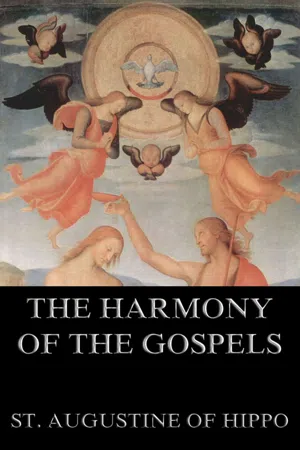
- 373 pages
- English
- ePUB (mobile friendly)
- Available on iOS & Android
eBook - ePub
The Harmony Of The Gospels
About this book
Information
The Harmony Of The Gospels
St. Augustine of Hippo
Contents:
Saint Augustine – A Biography
Introductory Essay. St. Augustin as an Exegete.
The Harmony of the Gospels
Introductory Essay.
Translator’s Introductory Notice.
Book I.
Chapter I.—On the Authority of the Gospels.
Chapter II.—On the Order of the Evangelists, and the Principles on Which They Wrote.
Chapter III.—Of the Face that Matthew, Together with Mark, Had Specially in View the Kingly Character of Christ, Whereas Luke Dealt with the Priestly.
Chapter IV.—Of the Fact that John Undertook the Exposition of Christ’s Divinity.
Chapter V.—Concerning the Two Virtues, of Which John is Conversant with the Contemplative, the Other Evangelists with the Active.
Chapter VI.—Of the Four Living Creatures in the Apocalypse, Which Have Been Taken by Some in One Application, and by Others in Another, as Apt Figures of the Four Evangelists.
Chapter VII.—A Statement of Augustin’s Reason for Undertaking This Work on the Harmony of the Evangelists, and an Exampleof the Method in Which He Meets Those Who Allege that Christ Wrote Nothing Himself, and that His Disciples Made an Unwarranted Affirmation in Proclaiming Him to Be God.
Chapter VIII.—Of the Question Why, If Christ is Believed to Have Been the Wisest of Men on the Testimony of Common Narrative Report, He Should Not Be Believed to Be God on the Testimony of the Superior Report of Preaching.
Chapter IX.—Of Certain Persons Who Pretend that Christ Wrote Books on the Arts of Magic.
Chapter X.—Of Some Who are Man Enough to Suppose that the Books Were Inscribed with the Names of Peter and Paul.
Chapter XI.—In Opposition to Those Who Foolishly Imagine that Christ Converted the People to Himself by Magical Arts.
Chapter XII.—Of the Fact that the God of the Jews, After the Subjugation of that People, Was Still Not Accepted by the Romans, Because His Commandment Was that He Alone Should Be Worshipped, and Images Destroyed.
Chapter XIII.—Of the Question Why God Suffered the Jews to Be Reduced to Subjection.
Chapter XIV.—Of the Fact that the God of the Hebrews, Although the People Were Conquered, Proved Himself to Be Unconquered, by Overthrowing the Idols,and by Turning All the Gentiles to His Own Service.
Chapter XV.—Of the Fact that the Pagans, When Constrained to Laud Christ, Have Launched Their Insults Against His Disciples.
Chapter XVI.—Of the Fact That, on the Subject of the Destruction of Idols, the Apostles Taught Nothing Different from What Was Taught by Christ or by the Prophets.
Chapter XVII.—In Opposition to the Romans Who Rejected the God of Israel Alone.
Chapter XVIII.—Of the Fact that the God of the Hebrews is Not Received by the Romans, Because His Will is that He Alone Should Be Worshipped.
Chapter XIX.—The Proof that This God is the True God.
Chapter XX.—Of the Fact that Nothing is Discovered to Have Been Predicted by the Prophets of the Pagans in Opposition to the God of the Hebrews.
Chapter XXI.—An Argument for the Exclusive Worship of This God, Who, While He Prohibits Other Deities from Being Worshipped, is Not Himself Interdicted by Other Divinities from Being Worshipped.
Chapter XXII.—Of the Opinion Entertained by the Gentiles Regarding Our God.
Chapter XXIII.—Of the Follies Which the Pagans Have Indulged in Regarding Jupiter and Saturn.
Chapter XXIV.—Of the Fact that Those Persons Who Reject the God of Israel, in Consequence Fail to Worship All the Gods; And, on the Other Hand, that Those Who Worship Other Gods, Fail to Worship Him.
Chapter XXV.—Of the Fact that the False Gods Do Not Forbid Others to Be Worshipped Along with Themselves. That the God of Israel is the True God, is Proved by His Works, Both in Prophecy and in Fulfilment.
Chapter XXVI.—Of the Fact that Idolatry Has Been Subverted by the Name of Christ, and by the Faith of Christians According to the Prophecies.
Chapter XXVII.—An Argument Urging It Upon the Remnant of Idolaters that They Should at Length Become Servants of This True God, Who Everywhere is Subverting Idols.
Chapter XXVIII.—Of the Predicted Rejection of Idols.
Chapter XXIX.—Of the Question Why the Heathen Should Refuse to Worship the God of Israel; Even Although They Deem Him to Be Only the Presiding Divinity of the Elements?
Chapter XXX.—Of the Fact That, as the Prophecies Have Been Fulfilled, the God of Israel Has Now Been Made Known Everywhere.
Chapter XXXI.—The Fulfilment of the Prophecies Concerning Christ.
Chapter XXXII.—A Statement in Vindication of the Doctrine of the Apostles as Opposed to Idolatry, in the Words of the Prophecies.
Chapter XXXIII.—A Statement in Opposition to Those Who Make the Complaint that the Bliss of Human Life Has Been Impaired by the Entrance of Christian Times.
Chapter XXXIV.—Epilogue to the Preceding.
Chapter XXXV.—Of the Fact that the Mystery of a Mediator Was Made Known to Those Who Lived in Ancient Times by the Agency of Prophecy, as It is Now Declared to Us in the Gospel.
Book II.
The Prologue.
Chapter I.—A Statement of the Reason Why the Enumeration of the Ancestors of Christ is Carried Down to Joseph, While Christ Was Not Born of that Man’s Seed, But of the Virgin Mary.
Chapter II.—An Explanation of the Sense in Which Christ is the Son of David, Although He Was Not Begotten in the Way of Ordinary Generation by Joseph the Son of David.
Chapter III.—A Statement of the Reason Why Matthew Enumerates One Succession of Ancestors for Christ, and Luke Another.
Chapter IV.—Of the Reason Why Forty Generations (Not Including Christ Himself) are Found in Matthew, Although He Divides Them into Three Successions of Fourteen Each.
Chapter V.—A Statement of the Manner in Which Luke’s Procedure is Proved to Be in Harmony with Matthew’s in Those Matters Concerning the Conception and the Infancy or Boyhood of Christ, Which are Omitted by the One and Recorded by the Other.
Chapter VI.—On the Position Given to the Preaching of John the Baptist in All the Four Evangelists.
Chapter VII.—Of the Two Herods.
Chapter VIII.—An Explanation of the Statement Made by Matthew, to the Effect that Joseph Was Afraid to Go with the Infant Christ into Jerusalem on Account of Archelaus, and Yet Was Not Afraid to Go into Galilee, Where Herod, that Prince’s Brother, Was Tetrarch.
Chapter IX.—An Explanation of the Circumstance that Matthew States that Joseph’s Reason for Going into Galilee with the Child Christ Was His Fear of Archelaus, Who Was Reigning at that Time in Jerusalem in Place of His Father, While Luke Tells Us that the Reason for Going into Galilee Was the Fact that Their City Nazareth Was There.
Chapter X.—A Statement of the Reason Why Luke Tells Us that “His Parents Went to Jerusalem Every Year at the Feast of the Passover” Along with the Boy; While Matthew Intimates that Their Dread of Archelaus Made Them Afraid to Go There on Their Return from Egypt.
Chapter XI.—An Examination of the Question as to How It Was Possible for Them to Go Up, According to Luke’s Statement, with Him to Jerusalem to the Temple, When the Days of the Purification of the Mother of Christ Were Accomplished, in Order to Perform the Usual Rites, If It is Correctly Recorded by Matthew, that Herod Had Already Learned from the Wise Men that the Child Was Born in Whose Stead, When He Sought for Him, He Slew So Many Children.
Chapter XII.—Concerning the Words Ascribed to John by All the Four Evangelists Respectively.
Chapter XIII.—Of the Baptism of Jesus.
Chapter XIV.—Of the Words or the Voice that Came from Heaven Upon Him When He Had Been Baptized.
Chapter XV.—An Explanation of the Circumstance That, According to the Evangelist John, John the Baptist Says, “I Knew Him Not;” While. According to the Others, It is Found that He Did Already Know Him.
Chapter XVI.—Of the Temptation of Jesus.
Chapter XVII.—Of the Calling of the Apostles as They Were Fishing.
Chapter XVIII.—Of the Date of His Departure into Galilee.
Chapter XIX.—Of the Lengthened Sermon Which, According to Matthew, He Delivered on the Mount.
Chapter XX.—An Explanation of the Circumstance that Matthew Tells Us How the Centurion Came to Jesus on Behalf of His Servant, While Luke’s Statement is that the Centurion Despatched Friends to Him.
Chapter XXI.—Of the Order in Which the Narrative Concerning Peter’s Mother-In-Law is Introduced.
Chapter XXII.—Of the Order of the Incidents Which are Recorded After This Section and of the Question Whether Matthew Mark, and Luke are Consistent with Each Other in These.
Chapter XXIII.—Of the Person Who Said to the Lord, “I Will Follow Thee Whithersoever Thou Goest;” And of the Other Things Connected Therewith, and of the Order in Which They are Recorded by Matthew and Luke.
Chapter XXIV.—Of the Lord’s Crossing the Lake on that Occasion on Which He Slept in the Vessel, and of the Casting Out of Those Devils Whom He Suffered to Go into the Swine; And of the Consistency of the Accounts Given by Matthew, Mark, and Luke of All that Was Done and Said on These Occasions.
Chapter XXV.—Of the Man Sick of the Palsy to Whom the Lord Said, “Thy Sins are Forgiven Thee,” And “Take Up Try Bed;” And in Especial, of the Question Whether Matthew and Mark are Consistent with Each Other in Their Notice of the Place Where This Incident Took Place, in So Far as Matthew Says It Happened “In His Own City,” While Mark Says It Was in Capharnaum.
Chapter XXVI.—Of the Calling of Matthew, and of the Question Whether Matthew’s Own Account is in Harmony with Those of Mark and Luke When They Speak of Levi the Son of Alphaeus.
Chapter XXVII.—Of the Feast at Which It Was Objected at Once that Christ Ate with Sinners, and that His Disciples Did Not Fast; Of the Circumstance that the Evangelists Seem to Give Different Accounts of the Parties by Whom These Objections Were Alleged; And of the Question Whether Matthew and Mark and Luke are Also in Harmony with Each Other in the Reports Given of the Words of These Persons, and of the Replies Returned by the Lord.
Chapter XXVIII.—Of the Raising of the Daughter of the Ruler of the Synagogue, and of the Woman Who Touched the Hem of His Garment; Of the Question, Also, as to Whether the Order in Which These Incidents are Narrated Exhibits Any Contradiction in Any of the Writers by Whom They are Reported; And in Particular, of the Words in Which the Ruler of the Synagogue Addressed His Request to the Lord.
Chapter XXIX.—Of the Two Blind Men and the Dumb Demoniac Whose Stories are Related Only by Matthew.
Chapter XXX.—Of the Section Where It is Recorded, that Being Moved with Compassion for the Multitudes, He Sent His Disciples, Giving Them Power to Work Cures, and Charged Them with Many Instructions, Directing Them How to Live; And of the Question Concerning the Proof of Matthew’s Harmony Here with Mark and Luke, Especially on the Subject of the Staff, Which Matthew Says the Lord Told Them They Were Not to Carry, While According to Mark It is the Only Thing They Were to Carry; And Also of the Wearing of the Shoes and Coats.
Chapter XXXI.—Of the Account Given by Matthew and Luke of the Occasion When John the Baptist Was in Prison, and Despatched His Disciples on a Mission to the Lord.
Chapter XXXII.—Of the Occasion on Which He Upbraided the Cities Because They Repented Not, Which Incident is Recorded by Luke as Well as by Matthew; And of the Question Regarding Matthew’s Harmony with Luke in the Matter of the Order.
Chapter XXXIII.—Of the Occasion on Which He Calls Them to Take His Yoke and Burden Upon Them, and of the Question as to the Absence of Any Discrepancy Between Matthew and Luke in the Order of Narration.
Chapter XXXIV.—Of the Passage in Which It is Said that the Disciples Plucked the Ears of Corn and Ate Them; And of the Question as to How Matthew, Mark, and Luke are in Harmony with Each Other with Respect to the Order of Narration There.
Chapter XXXV.—Of the Man with the Withered Hand, Who Was Restored on the Sabbath-Day; And of the Question as to How Matthew’s Narrative of This Incident Can Be Harmonized with Those of Mark and Luke, Either in the Matter of the Order of Events, or in the Report of the Words Spoken by the Lord and by the Jews.
Chapter XXXVI.—Of Another Question Which Demands Our Consideration, Namely, Whether, in Passing from the Account of the Man Whose Withered Hand Was Restored, These Three Evangelists Proceed to Their Next Subjects in Such a Way as to Create No Contradictions in Regard to the Order of Their Narrations.
Chapter XXXVII.—Of the Consistency of the Accounts Given by Matthew and Luke Regarding the Dumb and Blind Man Who Was Possessed with a Devil.
Chapter XXXVIII.—Of the Occasion on Which It Was Said to Him that He Cast Out Devils in the Power of Beelzebub, and of the Declarations Drawn Forth from Him by that Circumstance in Regard to the Blasphemy Against the Holy Spirit, and with Respect to the Two Trees; And of the Question Whether There is Not Some Discrepancy in These Sections Between Matthew and the Other Two Evangelists, and Particularly Between Matthew and Luke.
Chapter XXXIX.—Of the Question as to the Manner of Matthew’s Agreement with Luke in the Accounts Which are Given of the Lord’s Reply to Certain Persons Who Sought a Sign, When He Spoke of Jonas the Prophet, and of the Ninevites, and of the Queen of the S...
Table of contents
- Saint Augustine – A Biography
- Book II.
- Book III
- Book IV.
Trusted by 375,005 students
Access to over 1.5 million titles for a fair monthly price.
Study more efficiently using our study tools.
Frequently asked questions
Yes, you can cancel anytime from the Subscription tab in your account settings on the Perlego website. Your subscription will stay active until the end of your current billing period. Learn how to cancel your subscription
No, books cannot be downloaded as external files, such as PDFs, for use outside of Perlego. However, you can download books within the Perlego app for offline reading on mobile or tablet. Learn how to download books offline
Perlego offers two plans: Essential and Complete
- Essential is ideal for learners and professionals who enjoy exploring a wide range of subjects. Access the Essential Library with 800,000+ trusted titles and best-sellers across business, personal growth, and the humanities. Includes unlimited reading time and Standard Read Aloud voice.
- Complete: Perfect for advanced learners and researchers needing full, unrestricted access. Unlock 1.5M+ books across hundreds of subjects, including academic and specialized titles. The Complete Plan also includes advanced features like Premium Read Aloud and Research Assistant.
We are an online textbook subscription service, where you can get access to an entire online library for less than the price of a single book per month. With over 1.5 million books across 990+ topics, we’ve got you covered! Learn about our mission
Look out for the read-aloud symbol on your next book to see if you can listen to it. The read-aloud tool reads text aloud for you, highlighting the text as it is being read. You can pause it, speed it up and slow it down. Learn more about Read Aloud
Yes! You can use the Perlego app on both iOS and Android devices to read anytime, anywhere — even offline. Perfect for commutes or when you’re on the go.
Please note we cannot support devices running on iOS 13 and Android 7 or earlier. Learn more about using the app
Please note we cannot support devices running on iOS 13 and Android 7 or earlier. Learn more about using the app
Yes, you can access The Harmony Of The Gospels by St. Augustine of Hippo, Stewart Dyngwall Fordyce Salmond in PDF and/or ePUB format, as well as other popular books in Theology & Religion & Biblical Criticism & Interpretation. We have over 1.5 million books available in our catalogue for you to explore.