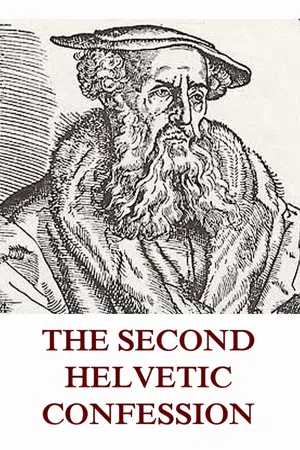
Helvetic Confessions, the name of two documents expressing the common belief of the Reformed churches of Switzerland. The Second Helvetic Confession (Latin: Confessio Helvetica posterior) was written by Bullinger in 1562 and revised in 1564 as a private exercise. It came to the notice of Elector Palatine Frederick III, who had it translated into German and published. It gained a favorable hold on the Swiss churches, who had found the First Confession too short and too Lutheran. It was adopted by the Reformed Church not only throughout Switzerland but in Scotland (1566), Hungary (1567), France (1571), Poland (1578), and next to the Heidelberg Catechism is the most generally recognized confession of the Reformed Church. (courtesy of wikipedia.com)
- 94 pages
- English
- ePUB (mobile friendly)
- Available on iOS & Android
eBook - ePub
The Second Helvetic Confession
About this book
Information
Topic
Teologia e religioneSubtopic
Denominazioni cristianeThe Second Helvetic Confession
Contents:
Reformed Churches – A Primer
Of The Holy Scripture Being The True Word of God
Of Interpreting The Holy Scripture; and of Fathers, Councils, and Traditions
Of God, His Unity and Trinity
Of Idols or Images of God, Christ and The Saints
Of The Adoration, Worship and Invocation of God Through The Only Mediator Jesus Christ
Of the Providence of God
Of The Creation of All Things: Of Angels, the Devil, and Man
Of Man's Fall, Sin and the Cause of Sin
Of Free Will, and Thus of Human Powers
Of the Predestination of God and the Election of the Saints
Of Jesus Christ, True God and Man, the Only Savior of the World
Of the Law of God
Of the Gospel of Jesus Christ, of the Promises, and of the Spirit and Letter
Of Repentance and the Conversion of Man
Of the True Justification of the Faithful
Of Faith and Good Works, and of Their Reward, and of Man's Merit
Of The Catholic and Holy Church of God, and of The One Only Head of The Church
Of The Ministers of The Church, Their Institution and Duties
Of the Sacraments of the Church of Christ
Of Holy Baptism
Of the Holy Supper of the Lord
Of Religious and Ecclesiastical Meetings
Of the Prayers of the Church, of Singing, and of Canonical Hours
Of Holy Days,
Fasts and the Choice of Foods
Of Catechizing and of Comforting and Visiting the Sick
Of the Burial of the Faithful, and of the Care to Be Shown for the Dead; of Purgatory, and the Appearing of Spirits
Of Rites, Ceremonies and Things Indifferent
Of the possessions of the Church
Of Celibacy, Marriage and the Management of Domestic Affairs
Of the Magistracy
The Second Helvetic Confession
Jazzybee Verlag Jürgen Beck
86450 Altenmünster, Germany
ISBN: 9783849620325
www.jazzybee-verlag.de
Reformed Churches – A Primer
The name given to Protestant bodies which adopted the tenets of Zwingli and, later, the doctrinal principles of Calvin. This distinctive title originated in 1561 at the colloquy of Poissy. Initiated in Switzerland, the movement from which the Churches sprang gained ground at an early date in France, some German states, the Netherlands, England, Scotland, Hungary, and Poland. Later, emigration and colonization secured a still wider diffusion of the Calvinistic system. Some of the denominations which adopted it go to-day under a special name, e.g. Presbyterianism: they receive separate treatment in this work. Others became national churches and are mentioned under the name of the country in which they exist. The denomination known as "The Reformed Protestant Dutch Church in North America" until 1867, when the present name was adopted, asserts with Protestants generally the sole sufficiency of the Scriptures as a rule of faith. Its recognized theological standards are the Apostles', Nicene, and Athanasian Creeds, the Belgic Confession, the Heidelberg Catechism, and the Canons of the Synod of Dort. It believes in the spiritual reception of Jesus Christ by the believer in the Lord's Supper, and also accepts the distinctively Calvinistic doctrine of a limited election to salvation. The liturgy is characterized by great simplicity; its forms are optional, except in the administration of the sacraments. In policy, the Church is Presbyterian; the constitution recognizes four kinds of officers: ministers of the word, professors of theology, elders, and deacons. The elders exerecise spiritual functions and the deacons are in charge of temporal interests. At the head of individual congregations is the Consistory, which is composed of minister, elders, and deacons. The authority over a district is vested in the Classis which is itself under the jurisdiction of the Particular Synod. The General Synod exercises supreme control in the Church. The elders and deacons are elected to office for two years, after which they may be re-elected. Former elders and deacons may be called together for consultation in what is known as the "Great Consistory". The other Reformed Churches especially treated in this article are similarly constituted and organized.
CHAPTER I
Of The Holy Scripture Being The True
Word of God
CANONICAL SCRIPTURE. We believe and confess the canonical Scriptures of the holy prophets and apostles of both Testaments to be the true Word of God, and to have sufficient authority of themselves, not of men. For God himself spoke to the fathers, prophets, apostles, and still speaks to us through the Holy Scriptures.
And in this Holy Scripture, the universal Church of Christ has the most complete exposition of all that pertains to a saving faith, and also to the framing of a life acceptable to God; and in this respect it is expressly commanded by God that nothing be either added to or taken from the same.
SCRIPTURE TEACHES FULLY ALL GODLINESS. We judge, therefore, that from these Scriptures are to be derived true wisdom and godliness, the reformation and government of churches; as also instruction in all duties of piety; and, to be short, the confirmation of doctrines, and the rejection of all errors, moreover, all exhortations according to that word of the apostle, "All scripture is inspired by God and profitable for teaching, for reproof," etc. (II Timothy 3:16-17). Again, "I am writing these instructions to you," says the apostle to Timothy, "So that you may know how one ought to behave in the household of God," etc. (I Timothy 3:14-15). SCRIPTURE IS THE WORD OF GOD. Again, the selfsame apostle to the Thessalonians: "When," says he, "You received the word of God which you heard from us, you accepted it, not as the word of men but as what it really is, the Word of God," etc. (I Thess. 2:13) For the Lord himself has said in the gospel, "It is not you who speak, but the Spirit of my Father speaking through you"; therefore "He who hears you hears me, and he who rejects me rejects him who sent me" (Matt. 10:20; Luke 10:16; John 13:20)
THE PREACHING OF THE WORD OF GOD IS THE WORD OF GOD. Wherefore when this Word of God is now preached in the church by preachers lawfully called, we believe that the very Word of God is proclaimed, and received by the faithful; and that neither any other Word of God is to be invented nor is to be expected from heaven: and that now the Word itself which is preached is to be regarded, not the minister that preaches; for even if he be evil and a sinner, nevertheless the Word of God remains still true and good.
Neither do we think that therefore the outward preaching is to be thought as fruitless because the instruction in true religion depends on the inward illumination of the Spirit, or because it is written "And no longer shall each man teach his neighbor..., for they shall all know me" (Jer. 31:34), And "Neither he who plants nor he that waters is anything, but only God who gives the growth" (I Cor. 3:7). For although "No one can come to Christ unless he be drawn by the Father" (John 6:44), And unless the Holy Spirit inwardly illumines him, yet we know that it is surely the will of God that his Word should be preached outwardly also. God could indeed, by his Holy Spirit, or by the ministry of an angel, without the ministry of St. Peter, have taught Cornelius in the Acts; but, nevertheless, he refers him to Peter, of whom the angel speaking says, "He shall tell you what you ought to do."
INWARD ILLUMINATION DOES NOT ELIMINATE EXTERNAL PREACHING. For he that illuminates inwardly by giving men the Holy Spirit, the same one, by way of commandment, said unto his disciples, "Go into all the world, and preach the gospel to the whole creation" (Mark 16:15). And so in Phillippi, Paul preached the word outwardly to Lydia, a seller of purple goods; but the Lord inwardly opened the woman's heart (Acts 16:14). And the same Paul, after a beautiful development of his thought, in Romans 10:17 at length comes to the conclusion, "So faith comes from hearing and hearing from the Word of God by the preaching of Christ."
At the same time we recognize that God can illuminate whom and when he will, Even without the external ministry, for that is in his power; but we speak of the usual way of instructing men, delivered unto us from God, both by commandment and examples.
HERESIES. We therefore detest all the heresies of Artemon, the Manichaeans, the Valentinians, of Cerdon, and the Marcionites, who deny that the Scriptures proceeded from the Holy Spirit; or did not accept some parts of them, or interpolated and corrupted them.
APOCRYPHA. And yet we do not conceal the fact that certain books of the Old Testament were by the ancient authors called apocryphal, and by the others ecclesiastical; in as much as some would have them read in the churches, but not advanced as an authority from which the faith is to be established. As Augustine also, in his De Civitate Dei, book 18, ch. 38, remarks that "In the books of the Kings, the names and books of certain prophets are cited"; but he adds that "They are not in the canon"; and that "those books which we have suffice unto godliness."
###
CHAPTER II
Of Interpreting The Holy Scripture;
and of Fathers, Councils, and Traditions
THE TRUE INTERPRETATION OF SCRIPTURE. The apostle peter has said that the Holy Scriptures are not of private interpretation (2 Pet. 1:20), and thus we do not allow all possible interpretations. Nor consequently do we acknowledge as the true or genuine interpretation of the Scriptures what is called the conception of the Roman Church, that is, what the defenders of the Roman Church plainly maintain should be thrust upon all for acceptance. But we hold that the interpretation of the Scripture to be orthodox and genuine which is gleaned from the Scriptures themselves (from the nature of the language in which they were written, likewise according to the circumstances in which they were set down, and expounded in the light of and unlike passages and of ...
Table of contents
- Reformed Churches – A Primer
Trusted by 375,005 students
Access to over 1.5 million titles for a fair monthly price.
Study more efficiently using our study tools.
Frequently asked questions
Yes, you can cancel anytime from the Subscription tab in your account settings on the Perlego website. Your subscription will stay active until the end of your current billing period. Learn how to cancel your subscription
No, books cannot be downloaded as external files, such as PDFs, for use outside of Perlego. However, you can download books within the Perlego app for offline reading on mobile or tablet. Learn how to download books offline
Perlego offers two plans: Essential and Complete
- Essential is ideal for learners and professionals who enjoy exploring a wide range of subjects. Access the Essential Library with 800,000+ trusted titles and best-sellers across business, personal growth, and the humanities. Includes unlimited reading time and Standard Read Aloud voice.
- Complete: Perfect for advanced learners and researchers needing full, unrestricted access. Unlock 1.5M+ books across hundreds of subjects, including academic and specialized titles. The Complete Plan also includes advanced features like Premium Read Aloud and Research Assistant.
We are an online textbook subscription service, where you can get access to an entire online library for less than the price of a single book per month. With over 1.5 million books across 990+ topics, we’ve got you covered! Learn about our mission
Look out for the read-aloud symbol on your next book to see if you can listen to it. The read-aloud tool reads text aloud for you, highlighting the text as it is being read. You can pause it, speed it up and slow it down. Learn more about Read Aloud
Yes! You can use the Perlego app on both iOS and Android devices to read anytime, anywhere — even offline. Perfect for commutes or when you’re on the go.
Please note we cannot support devices running on iOS 13 and Android 7 or earlier. Learn more about using the app
Please note we cannot support devices running on iOS 13 and Android 7 or earlier. Learn more about using the app
Yes, you can access The Second Helvetic Confession by Heinrich Bullinger, Philipp Schaff in PDF and/or ePUB format, as well as other popular books in Teologia e religione & Denominazioni cristiane. We have over 1.5 million books available in our catalogue for you to explore.