This book is intended to give the reader an account of the principal ideas and beliefs held by the ancient Egyptians concerning the resurrection and the future life, which is derived wholly from native religious works. The literature of Egypt which deals with these subjects is large and, as was to be expected, the product of different periods which, taken together, cover several thousands of years; and it is exceedingly difficult at times to reconcile the statements and beliefs of a writer of one period with those of a writer of another. Up to the present no systematic account of the doctrine of the resurrection and of the future life has been discovered, and there is no reason for hoping that such a thing will ever be found, for the Egyptians do not appear to have thought that it was necessary to write a work of the kind. This book sums up all thought, beliefs and myths concerning future life in ancient Egypt.
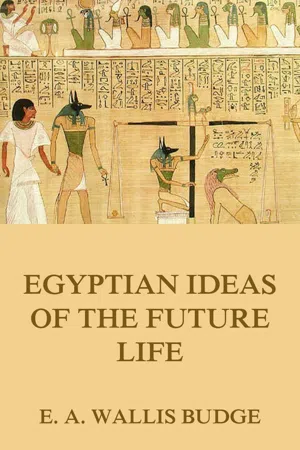
- 131 pages
- English
- ePUB (mobile friendly)
- Available on iOS & Android
eBook - ePub
Egyptian Ideas Of The Future Life
About this book
Information
Subtopic
Egyptian Ancient HistoryIndex
HistoryEgyptian Ideas Of The Future Life
E. A. Wallis Budge,
Contents:
Ancient Egyptian Religion
Egyptian Ideas Of The Future Life
Preface.
Chapter I. The Belief In God Almighty.
I. From The Papyrus Of Ani.
II. From The Papyrus Of Hunefer.
III. From The Papyrus Of Ani.
Chapter II Osiris The God Of The Resurrection.
Chapter III. The "Gods" Of The Egyptians.
Chapter IV. The Judgment Of The Dead.
Chapter V. The Resurrection And Immortality.
Footnotes
Egyptian Ideas Of The Future Life, E. A. Wallis Budge
Jazzybee Verlag Jürgen Beck
86450 Altenmünster, Loschberg 9
Germany
ISBN: 9783849641306
www.jazzybee-verlag.de
www.facebook.com/jazzybeeverlag
Ancient Egyptian Religion
An Essay by Eugène Hyvernat (1858 – 1941)
God and man, those two essential terms of every religion, are but imperfectly reflected in the Egyptian religious monuments. A book similar in scope to our Bible certainly never existed in Egypt, and if their different theological schools, or the priests of some particular theological school, ever agreed on certain truths about God and man, which they consigned to official didactic writings, such writings have not reached us. Nor is the vast body of religious monuments bequeathed to us by ancient Egypt of such a nature as to compensate for this lack of positive and systematic information. The figured and inscribed monuments discovered in the temples, and especially in the tombs, acquaint us with the names and external aspects of numerous deities, with the material side of the funerary rites, from which we may safely conclude that they admitted the dependency of man on superior beings, and a certain survival of man after death. But as to the essence of those gods, their relation to the world and man as expressed by the worship of which they were the objects, the significance and symbolism of the rites of the dead, the nature of the surviving principle in man, the nature and modes of the survival itself as depending on earthly life, and the like, the monuments are either silent about or offer us such contradictory and incongruous notions that we are forced to conclude that the Egyptians never evolved a clear and complete system of religious views. What light can be brought out of this chaos we shall concentrate on two chief points:
The Pantheon, corresponding to the term God; and
The Future Life, as best representing the term Man.
(a) The Egyptian Pantheon.—By this word we understand such gods as were officially worshipped in one or more of the various nomes, or in the country at large. We exclude, therefore, the multitude of daemons or spirits which animated almost everything man came in contact with—stones, plants, animals—and the lesser deities which presided over every stage of human life—birth, naming, etc. The worship they received was of an entirely local and private nature, and we know almost nothing of it.
Each nome had its own chief deity or divine lord, male or female, apparently inherited from the ancient tribes. With each deity an animal, as a rule, but sometimes also a tree or mineral, was associated. Thus Osiris of Busiris was associated with a pillar, or the trunk of a tree; Hathor of Denderah, with a sycamore; Osiris of Mendes, with a goat; Set of Tanis, with an ass; Buto of the city of the same name, with a serpent; Bast of Bubastis, with a cat; Atàm, or Tàn, of Heliopolis, with a serpent, a lion, or possibly, later the bull Mnevis; Ptah of Memphis, with the bull Apis; Sovek, in the Fayàm and at Ombos (Kôm Ombo), with a crocodile; Anubis of Assiàt, with a jackal; Thoth of Hermopolis, with an ibis or a baboon; Amon of Thebes, and Chnàm, at the Cataract, with a ram; Horus of el-Kab and Edfu, with a hawk. According to some scholars, this association at first was merely symbolical; it was not till the Nineteenth Dynasty that sacred animals, having gradually come to be considered as incarnations, or at least as dwelling-places, of the various gods, began to be worshipped as gods (Breasted, "Hist. Anc. Egypt.", 59, 324). But this view, once quite common, is now generally abandoned, and fetishistic animal-worship is now considered as the true basis of the Egyptian religion [cf. Chantepie de la Saussaye, "Lehrbuch der Religionsgeschichte" (1905), I, 194 sqq.]. In any case the origin of the association of certain animals with certain gods, whether symbolical or not, is unknown; as a rule, the same may be said of the various attributes of the various gods or goddesses. We understand that Thoth, being a lunar god, could have been considered the god of time, computation, letters, and science (although we do not know how, being associated with the ibis or a baboon, he became a lunar god); but we do not see why the ram-god Chnàm should have been represented as a potter, nor why the cow-goddess, Hathor, and the cat-goddess, Bast, were identified with beauty, joy, and love, while the lioness-deity, Sekhmet, was the goddess of war, and Neith was identified both with war and with weaving. The names of the gods, as a rule, give no clue. At an early date the crude primitive fetishism was somewhat mitigated, when the deities were supposed to reside in statues combining human figures with animal heads.
Triads.—In other respects gods and goddesses were imagined to be very much like men and women; they ate, drank, married, begat children, and died. Each nome, besides its chief god or goddess, had at least two secondary deities, the one playing the part of a wife or husband to the chief deity, the other that of a son. Thus, in Thebes the group of Amon, Màt (or Ament), and Chons; in Memphis the group of Ptah, Sekhmet, and Nefertem; etc. Sometimes the triad consisted of one god and two goddesses, as at Elephantine, or even of three male deities. Those groups were probably first obtained by the fusion of several religious centers into one, the number three being suggested by the human family, or possibly by the family triad Osiris, Isis, and Horus, of the Osiris cycle. In some cases the second element was a mere grammatical duplicate of the first, as Ament, wife of Amen (Amon), and was considered as one with it; it was then natural to identify the son with his parents, and so arose the concept of one god in three forms. There was in this a germ of monotheism. It is doubtful, however, whether it would ever have developed beyond the limits of henotheism but for the solar religion which seems to have sprung into existence towards the dawn of the dynastic times, very likely under the influence of the school of Heliopolis. But before we turn to this new phase of the Egyptian religion, we must consider another aspect of the ancient gods which may have furnished the first basis of unification of the various local worships.
The Gods of the Dead.—Gods, being fancied like men, were, like them, subject to death, the great leveller. Each community had the mummy of its god. But in the case of gods, as in that of men, death was not the cessation of all life. With the assistance of magical devices the dead god was simply transferred to another world, where he was still the god of the departed who had been his devotees on earth. Hence two forms of the same god, frequently under two different names which eventually led to the conception of distinct gods of the dead. Such were Chent-Ament, the first of the Westerners (the dead) at Abydos, Sokar (or Seker), probably a form of Ptah, at Memphis. Sometimes, however, the god of the dead retained the name he had before, as Anubis at Assiut, Khonyu at Thebes, and Osiris, wherever he began to be known as such.
Legend of Osiris.—Each of these gods had his own legend. Osiris was the last god who reigned upon the earth, and he was a wise and good king. But his brother Set was a wicked god and killed Osiris, cutting his body into fragments, which he scattered all over the land. Isis, sister and wife of Osiris, collected the fragments, put them together, and embalmed them, with the assistance of her son Horus, Anubis (here, perhaps, a substitute for Set, who does not seem to have been originally conceived as his brother's slay...
Table of contents
- Ancient Egyptian Religion
- Egyptian Ideas Of The Future Life
Trusted by 375,005 students
Access to over 1.5 million titles for a fair monthly price.
Study more efficiently using our study tools.
Frequently asked questions
Yes, you can cancel anytime from the Subscription tab in your account settings on the Perlego website. Your subscription will stay active until the end of your current billing period. Learn how to cancel your subscription
No, books cannot be downloaded as external files, such as PDFs, for use outside of Perlego. However, you can download books within the Perlego app for offline reading on mobile or tablet. Learn how to download books offline
Perlego offers two plans: Essential and Complete
- Essential is ideal for learners and professionals who enjoy exploring a wide range of subjects. Access the Essential Library with 800,000+ trusted titles and best-sellers across business, personal growth, and the humanities. Includes unlimited reading time and Standard Read Aloud voice.
- Complete: Perfect for advanced learners and researchers needing full, unrestricted access. Unlock 1.5M+ books across hundreds of subjects, including academic and specialized titles. The Complete Plan also includes advanced features like Premium Read Aloud and Research Assistant.
We are an online textbook subscription service, where you can get access to an entire online library for less than the price of a single book per month. With over 1.5 million books across 990+ topics, we’ve got you covered! Learn about our mission
Look out for the read-aloud symbol on your next book to see if you can listen to it. The read-aloud tool reads text aloud for you, highlighting the text as it is being read. You can pause it, speed it up and slow it down. Learn more about Read Aloud
Yes! You can use the Perlego app on both iOS and Android devices to read anytime, anywhere — even offline. Perfect for commutes or when you’re on the go.
Please note we cannot support devices running on iOS 13 and Android 7 or earlier. Learn more about using the app
Please note we cannot support devices running on iOS 13 and Android 7 or earlier. Learn more about using the app
Yes, you can access Egyptian Ideas Of The Future Life by E. A. Wallis Budge in PDF and/or ePUB format, as well as other popular books in History & Egyptian Ancient History. We have over 1.5 million books available in our catalogue for you to explore.