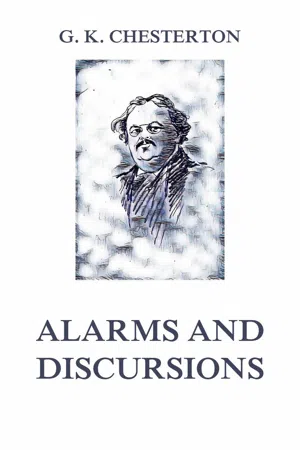
If Mr. Chesterton had been permitted to have his own way this handful of papers would have been sent out under the title of "Gargoyles." Perhaps the publisher foresaw horror upon the faces of really unimaginative readers when once brought face to face with a "monster" title; so it was changed to "Alarms and discursions, " as indefinite and capable of possibilities as one could wish. "Fragments of futile journalism or fleeting impressions, " Mr. Chesterton calls his essays. "This row of shapeless and ungainly monsters... does not consist of separate idols cut out capriciously in lonely valleys or various islands. These monsters are meant for the gargoyles of a definite cathedral. I have to carve the gargoyles, because I can carve nothing else; I leave to others the angels and the arches and the spires." Forty essays, in which excellent common sense and brilliantly phrased wisdom mingle with sheer nonsense.
- 196 pages
- English
- ePUB (mobile friendly)
- Available on iOS & Android
eBook - ePub
Alarms and Discursions
About this book
Trusted by 375,005 students
Access to over 1 million titles for a fair monthly price.
Study more efficiently using our study tools.
Information
The Red Town
When a man says that democracy is false because most people are stupid, there are several courses which the philosopher may pursue. The most obvious is to hit him smartly and with precision on the exact tip of the nose. But if you have scruples (moral or physical) about this course, you may proceed to employ Reason, which in this case has all the savage solidity of a blow with the fist. It is stupid to say that “most people” are stupid. It is like saying “most people are tall,” when it is obvious that “tall” can only mean taller than most people. It is absurd to denounce the majority of mankind as below the average of mankind.
Should the man have been hammered on the nose and brained with logic, and should he still remain cold, a third course opens: lead him by the hand (himself half-willing) towards some sunlit and yet secret meadow and ask him who made the names of the common wild flowers. They were ordinary people, so far as any one knows, who gave to one flower the name of the Star of Bethlehem and to another and much commoner flower the tremendous title of the Eye of Day. If you cling to the snobbish notion that common people are prosaic, ask any common person for the local names of the flowers, names which vary not only from county to county, but even from dale to dale.
But, curiously enough, the case is much stronger than this. It will be said that this poetry is peculiar to the country populace, and that the dim democracies of our modern towns at least have lost it. For some extraordinary reason they have not lost it. Ordinary London slang is full of witty things said by nobody in particular. True, the creed of our cruel cities is not so sane and just as the creed of the old countryside; but the people are just as clever in giving names to their sins in the city as in giving names to their joys in the wilderness. One could not better sum up Christianity than by calling a small white insignificant flower “The Star of Bethlehem.” But then, again, one could not better sum up the philosophy deduced from Darwinism than in the one verbal picture of “having your monkey up.”
Who first invented these violent felicities of language? Who first spoke of a man “being off his head”? The obvious comment on a lunatic is that his head is off him; yet the other phrase is far more fantastically exact. There is about every madman a singular sensation that his body has walked off and left the important part of him behind.
But the cases of this popular perfection in phrase are even stronger when they are more vulgar. What concentrated irony and imagination there is for instance, in the metaphor which describes a man doing a midnight flitting as “shooting the moon”? It expresses everything about the run away: his eccentric occupation, his improbable explanations, his furtive air as of a hunter, his constant glances at the blank clock in the sky.
No; the English democracy is weak enough about a number of things; for instance, it is weak in politics. But there is no doubt that democracy is wonderfully strong in literature. Very few books that the cultured class has produced of late have been such good literature as the expression “painting the town red.”
Oddly enough, this last Cockney epigram clings to my memory. For as I was walking a little while ago round a corner near Victoria I realized for the first time that a familiar lamp-post was painted all over with a bright vermilion just as if it were trying (in spite of the obvious bodily disqualification) to pretend that it was a pillar-box. I have since heard official explanations of these startling and scarlet objects. But my first fancy was that some dissipated gentleman on his way home at four o’clock in the morning had attempted to paint the town red and got only as far as one lamp-post.
I began to make a fairy tale about the man; and, indeed, this phrase contains both a fairy tale and a philosophy; it really states almost the whole truth about those pure outbreaks of pagan enjoyment to which all healthy men have often been tempted. It expresses the desire to have levity on a large scale which is the essence of such a mood. The rowdy young man is not content to paint his tutor’s door green: he would like to paint the whole city scarlet. The word which to us best recalls such gigantesque idiocy is the word “mafficking.” The slaves of that saturnalia were not only painting the town red; they thought that they were painting the map red—that they were painting the world red. But, indeed, this Imperial debauch has in it something worse than the mere larkiness which is my present topic; it has an element of real self-flattery and of sin. The Jingo who wants to admire himself is worse than the blackguard who only wants to enjoy himself. In a very old ninth-century illumination which I have seen, depicting the war of the rebel angels in heaven, Satan is represented as distributing to his followers peacock feathers—the symbols of an evil pride. Satan also distributed peacock feathers to his followers on Mafeking Night...
But taking the case of ordinary pagan recklessness and pleasure seeking, it is, as we have said, well expressed in this image. First, because it conveys this notion of filling the world with one private folly; and secondly, because of the profound idea involved in the choice of colour. Red is the most joyful and dreadful thing in the physical universe; it is the fiercest note, it is the highest light, it is the place where the walls of this world of ours wear thinnest and something beyond burns through. It glows in the blood which sustains and in the fire which destroys us, in the roses of our romance and in the awful cup of our religion. It stands for all passionate happiness, as in faith or in first love.
Now, the profligate is he who wishes to spread this crimson of conscious joy over everything; to have excitement at every moment; to paint everything red. He bursts a thousand barrels of wine to incarnadine the streets; and sometimes (in his last madness) he will butcher beasts and men to dip his gigantic brushes in their blood. For it marks the sacredness of red in nature, that it is secret even when it is ubiquitous, like blood in the human body, which is omnipresent, yet invisible. As long as blood lives it is hidden; it is only dead blood that we see. But the earlier parts of the rake’s progress are very natural and amusing. Painting the town red is a delightful thing until it is done. It would be splendid to see the cross of St. Paul’s as red as the cross of St. George, and the gallons of red paint running down the dome or dripping from the Nelson Column. But when it is done, when you have painted the town red, an extraordinary thing happens. You cannot see any red at all.
I can see, as in a sort of vision, the successful artist standing in the midst of that frightful city, hung on all sides with the scarlet of his shame. And then, when everything is red, he will long for a red rose in a green hedge and long in vain; he will dream of a red leaf and be unable even to imagine it. He has desecrated the divine colour, and he can no longer see it, though it is all around. I see him, a single black figure against the red-hot hell that he has kindled, where spires and turrets stand up like immobile flames: he is stiffened in a sort of agony of prayer. Then the mercy of Heaven is loosened, and I see one or two flakes of snow very slowly begin to fall.
The Furrows
As I see the corn grow green all about my neighbourhood, there rushes on me for no reason in particular a memory of the winter. I say “rushes,” for that is the very word for the old sweeping lines of the ploughed fields. From some accidental turn of a train-journey or a walking tour, I saw suddenly the fierce rush of the furrows. The furrows are like arrows; they fly along an arc of sky. They are like leaping animals; they vault an inviolable hill and roll down the other side. They are like battering battalions; they rush over a hill with flying squadrons and carry it with a cavalry charge. They have all the air of Arabs sweeping a desert, of rockets sweeping the sky, of torrents sweeping a watercourse. Nothing ever seemed so living as those brown lines as they shot sheer from the height of a ridge down to their still whirl of the valley. They were swifter than arrows, fiercer than Arabs, more riotous and rejoicing than rockets. And yet they were only thin straight lines drawn with difficulty, like a diagram, by painful and patient men. The men that ploughed tried to plough straight; they had no notion of giving great sweeps and swirls to the eye. Those cataracts of cloven earth; they were done by the grace of God. I had always rejoiced in them; but I had never found any reason for my joy. There are some very clever people who cannot enjoy the joy unless they understand it. There are other and even cleverer people who say that they lose the joy the moment they do understand it. Thank God I was never clever, and I could always enjoy things when I understood them and when I didn’t. I can enjoy the orthodox Tory, though I could never understand him. I can also enjoy the orthodox Liberal, though I understand him only too well.
But the splendour of furrowed fields is this: that like all brave things they are made straight, and therefore they bend. In everything that bows gracefully there must be an effort at stiffness. Bows arc beautiful when they bend only because they try to remain rigid; and sword-blades can curl like silver ribbons only because they are certain to spring straight again. But the same is true of every tough curve of the tree-trunk, of every strong-backed bend of the bough; there is hardly any such thing in Nature as a mere droop of weakness. Rigidity yielding a little, like justice swayed by mercy, is the whole beauty of the earth. The cosmos is a diagram just bent beautifully out of shape. Everything tries to be straight; and everything just fortunately fails.
The foil may curve in the lunge, but there is nothing beautiful about beginning the battle with a crooked foil. So the strict aim, the strong doctrine, may give a little in the actual fight with facts: but that is no reason for beginning with a weak doctrine or a twisted aim. Do not be an opportunist; try to be theoretic at all the opportunities; fate can be trusted to do all the opportunist part of it. Do not try to bend, any more than the trees try to bend. Try to grow straight, and life will bend you.
Alas! I am giving the moral before the fable; and yet I hardly think that otherwise you could see all that I mean in that enormous vision of the ploughed hills. These great furrowed slopes are the oldest architecture of man: the oldest astronomy was his guide, the oldest botany his object. And for geometry, the mere word proves my case.
But when I looked at those torrents of ploughed parallels, that great rush of rigid lines, I seemed to see the whole huge achievement of democracy, Here was mere equality: but equality seen in bulk is more superb than any supremacy. Equality free and flying, equality rushing over hill and dale, equality charging the world—that was the meaning of those military furrows, military in their identity, military in their energy. They sculptured hill and dale with strong curves merely because they did not mean to curve at all. They made the strong lines of landscape with their stiffly driven swords of the soil. It is not only nonsense, but blasphemy, to say that man has spoilt the country. Man has created the country; it was his business, as the image of God. No hill, covered with common scrub or patches of purple heath, could have been so sublimely hilly as that ridge up to which the ranked furrows rose like aspiring angels. No valley, confused with needless cottages and towns, can have been so utterly valleyish as that abyss into which the down-rushing furrows raged like demons into the swirling pit.
It is the hard lines of discipline and equality that mark out a landscape and give it all its mould and meaning. It is just because the lines of the furrow arc ugly and even that the landscape is living and superb. As I think I have remarked elsewhere, the Republic is founded on the plough.
The Philosophy of Sight-seeing
It would be really interesting to know exactly why an intelligent person—by which I mean a person with any sort of intelligence—can and does dislike sight-seeing. Why does the idea of a char-a-banc full of tourists going to see the birth-place of Nelson or the death-scene of Simon de Montfort strike a strange chill to the soul? I can tell quite easily what this dim aversion to tourists and their antiquities does not arise from—at least, in my case. Whatever my other vices (and they are, of course, of a lurid cast), I can lay my hand on my heart and say that it does not arise from a paltry contempt for the antiquities, nor yet from the still more paltry contempt for the tourists. If there is one thing more dwarfish and pitiful than irreverence for the past, it is irreverence for the present, for the passionate and many-coloured procession of life, which includes the char-a-banc among its many chariots and triumphal cars. I know nothing so vulgar as that contempt for vulgarity which sneers at the clerks on a Bank Holiday or the Cockneys on Margate sands. The man who notices nothing about the clerk except his Cockney accent would have noticed nothing about Simon de Montfort except his French accent. The man who jeers at Jones for having dropped an “h” might have jeered at Nelson for having dropped an arm. Scorn springs easily to the essentially vulgar-minded, and it is as easy to gibe at Montfort as a foreigner or at Nelson as a cripple, as to gibe at the struggling speech and the maimed bodies of the mass of our comic and tragic race. If I shrink faintly from this affair of tourists and tombs, it is certainly not because I am so profane as to think lightly either of the tombs or the tourists. I reverence those great men who had the courage to die; I reverence also these little men who have the courage to live.
Even if this be conceded, another suggestion may be made. It may be said that antiquities and commonplace crowds are indeed good things, like violets and geraniums; but they do not go together. A billycock is a beautiful object (it may be eagerly urged), but it is not in the same style of architecture as Ely Cathedral; it is a dome, a small rococo dome in the Renaissance manner, and does not go with the pointed arches that assault heaven like spears. A char-a-banc is lovely (it may be said) if placed upon a pedestal and worshipped for its own sweet sake; but it does not harmonize with the curve and outline of the old three-decker on which Nelson died; its beauty is quite of another sort. Therefore (we will suppose our sage to argue) antiquity and democracy should be kept separate, as inconsistent things. Things may be inconsistent in time and space which are by no means inconsistent in essential value and idea. Thus the Catholic Church has water for the new-born and oil for the dying: but she never mixes oil and water.
This explanation is plausible; but I do not find it adequate. The first objection is that the same smell of bathos haunts the soul in the case of all deliberate and elaborate visits to “beauty spots,” even by persons of the most elegant position or the most protected privacy. Specially visiting the Coliseum by moonlight always struck me as being as vulgar as visiting it by limelight. One millionaire standing on the top of Mont Blanc, one millionaire standing in the desert by the Sphinx, one millionaire standing in the middle of Stonehenge, is just as comic as one millionaire is anywhere else; and that is saying a good deal. On the other hand, if the billycock had come privately and naturally into Ely Cathedral, no enthusiast for Gothic harmony would think of objecting to the billycock—so long, of course, as it was not worn on the head. But there is indeed a much deeper objection to this theory of the two incompatible excellences of antiquity and popularity. For the truth is that it has been almost entirely the antiquities that have normally interested the populace; and it has been almost entirely the populace who have systematically preserved the antiquities. The Oldest Inhabitant has always been a clodhopper; I have never heard of his being a gentleman. It is the peasants who preserve all traditions of the sites of battles or the building of churches. It is they who remember, so far as any one remembers, the glimpses of fairies or the graver wonders of saints. In the classes above them the supernatural has been slain by the supercilious. That is a true and tremendous text in Scripture which says that “where there is no vision the people perish.” But it is equally true in practice that where...
Table of contents
- Introductory: On Gargoyles
- Cheese
- The Red Town
- Ethandune
Frequently asked questions
Yes, you can cancel anytime from the Subscription tab in your account settings on the Perlego website. Your subscription will stay active until the end of your current billing period. Learn how to cancel your subscription
No, books cannot be downloaded as external files, such as PDFs, for use outside of Perlego. However, you can download books within the Perlego app for offline reading on mobile or tablet. Learn how to download books offline
Perlego offers two plans: Essential and Complete
- Essential is ideal for learners and professionals who enjoy exploring a wide range of subjects. Access the Essential Library with 800,000+ trusted titles and best-sellers across business, personal growth, and the humanities. Includes unlimited reading time and Standard Read Aloud voice.
- Complete: Perfect for advanced learners and researchers needing full, unrestricted access. Unlock 1.4M+ books across hundreds of subjects, including academic and specialized titles. The Complete Plan also includes advanced features like Premium Read Aloud and Research Assistant.
We are an online textbook subscription service, where you can get access to an entire online library for less than the price of a single book per month. With over 1 million books across 990+ topics, we’ve got you covered! Learn about our mission
Look out for the read-aloud symbol on your next book to see if you can listen to it. The read-aloud tool reads text aloud for you, highlighting the text as it is being read. You can pause it, speed it up and slow it down. Learn more about Read Aloud
Yes! You can use the Perlego app on both iOS and Android devices to read anytime, anywhere — even offline. Perfect for commutes or when you’re on the go.
Please note we cannot support devices running on iOS 13 and Android 7 or earlier. Learn more about using the app
Please note we cannot support devices running on iOS 13 and Android 7 or earlier. Learn more about using the app
Yes, you can access Alarms and Discursions by Gilbert Keith Chesterton in PDF and/or ePUB format, as well as other popular books in Literature & Literary Essays. We have over one million books available in our catalogue for you to explore.