THE Book of Job is among the other Old Testament Books both a philosophical riddle and a historical riddle. Controversy has long raged about which parts of this epic belong to its original scheme and which are interpolations of considerably later date. The doctors disagree, as it is the business of doctors to do; but upon the whole the trend of investigation has always been in the direction of maintaining that the parts interpolated, if any, were the prose prologue and epilogue and possibly the speech of the young man who comes in with an apology at the end. This work contains Chesterton's assumptions and thoughts on this mysterious scripture.
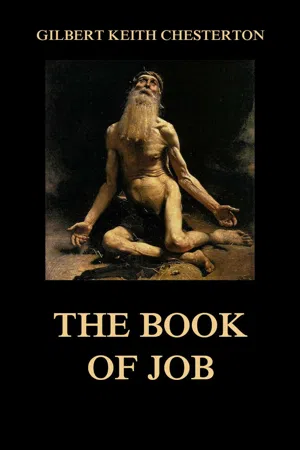
- 136 pages
- English
- ePUB (mobile friendly)
- Available on iOS & Android
eBook - ePub
The Book of Job
About this book
Information
Topic
Theology & ReligionSubtopic
Biblical CommentaryINTRODUCTION
THE Book of Job is among the other Old Testament Books both a philosophical riddle and a historical riddle. It is the philosophical riddle that concerns us in such an introduction as this; so we may dismiss first the few words of general explanation or warning which should be said about the historical aspect. Controversy has long raged about which parts of this epic belong to its original scheme and which are interpolations of considerably later date. The doctors disagree, as it is the business of doctors to do; but upon the whole the trend of investigation has always been in the direction of maintaining that the parts interpolated, if any, were the prose prologue and epilogue and possibly the speech of the young man who comes in with an apology at the end. I do not profess to be competent to decide such questions. But whatever decision the reader may come to concerning them, there is a general truth to be remembered in this connection. When you deal with any ancient artistic creation do not suppose that it is anything against it that it grew gradually. The Book of Job may have grown gradually just as Westminster Abbey grew gradually. But the people who made the old folk poetry, like the people who made Westminster Abbey, did not attach that importance to the actual date and the actual author, that importance which is entirely the creation of the almost insane individualism of modern times. We may put aside the case of Job, as one complicated with religious difficulties, and take any other, say the case of the Iliad. Many people have maintained the characteristic formula of modern skepticism, that Homer was not written by Homer, but by another person of the same name. Just in the same way many have maintained that Moses was not Moses but another person called Moses. But the thing really to be remembered in the matter of the Iliad is that if other people did interpolate the passages, the thing did not create the same sense of shock as would be created by such proceedings in these individualistic times. The creation of the tribal epic was to some extent regarded as a tribal work, like the building of the tribal temple. Believe then, if you will, that the prologue of Job and the epilogue and the speech of Elihu are things inserted after the original work was composed. But do not suppose that such insertions have that obvious and spurious character which would belong to any insertions in a modern individualistic book. Do not regard the insertions as you would regard a chapter in George Meredith which you afterwards found had not been written by George Meredith, or half a scene in Ibsen which you found had been cunningly sneaked in by Mr. William Archer. Remember that this old world which made these old poems like the Iliad and Job, always kept the tradition of what it was making. A man could almost leave a poem to his son to be finished as he would have finished it, just as a man could leave a field to his son, to be reaped as he would have reaped it. What is called Homeric unity may be a fact or not. The Iliad may have been written by one man. It may have been written by a hundred men. But let us remember that there was more unity in those times in a hundred men than there is unity now in one man. Then a city was like one man. Now one man is like a city in civil war.
Without going, therefore, into questions of unity as understood by the scholars, we may say of the scholarly riddle that the book has unity in the sense that all great traditional creations have unity; in the sense that Canterbury Cathedral has unity. And the same is broadly true of what I have called the philosophical riddle. There is a real sense in which the Book of Job stands apart from most of the books included in the canon of the Old Testament. But here again those are wrong who insist on the entire absence of unity. Those are wrong who maintain that the Old Testament is a mere loose library; that it has no consistency or aim. Whether the result was achieved by some supernal spiritual truth, or by a steady national tradition, or merely by an ingenious selection in after times, the books of the Old Testament have a quite perceptible unity. To attempt to understand the Old Testament without realizing this main idea is as absurd as it would be to study one of Shakespeare's plays without realizing that the author of them had any philosophical object at all. It is as if a man were to read the history of Hamlet, Prince of Denmark, thinking all the time that he was reading what really purported to be the history of an old Danish pirate prince. Such a reader would not realize at all that Hamlet's procrastination was on the part of the poet intentional. He would merely say, " How long Shakespeare's hero does take to kill his enemy." So speak the Biblesmashers, who are unfortunately always at bottom Bible worshippers. They do not understand the special tone and intention of the Old Testament; they do not understand its main idea, which is the idea of all men being merely the instruments of a higher power.
Those, for instance, who complain of the atrocities and treacheries of the judges and prophets of Israel have really got a notion in their head that has nothing to do with the subject. They are too Christian. They are reading back into the pre-Christian scriptures a purely Christian idea — the idea of saints, the idea that the chief instruments of God are very particularly good men. This is a deeper, a more daring, and a more interesting idea than the old Jewish one. It is the idea that innocence has about it something terrible which in the long run makes and re-makes empires and the world. But the Old Testament idea was much more what may be called the common-sense idea, that strength is strength, that cunning is cunning, that worldly success is worldly success, and that Jehovah uses these things for His own ultimate purpose, just as He uses natural forces or physical elements. He uses the strength of a hero as He uses that of a Mammoth — without any particular respect for the Mammoth. I cannot comprehend how it is that so many simpleminded sceptics have read such stories as the fraud of Jacob and supposed that the man who wrote it (whoever he was) did not know that Jacob was a sneak just as well as we do. The primeval human sense of honor does not change so much as that. But these simpleminded sceptics are, like the majority of modern sceptics. Christians. They fancy that the patriarchs must be meant for patterns; they fancy that Jacob was being set up as some kind of saint; and in that case I do not wonder that they are a little startled. That is not the atmosphere of the Old Testament at all. The heroes of the Old Testament are not the sons of God, but the slaves of God, gigantic and terrible slaves, like the genii, who were the slaves of Aladdin.
The central idea of the great part of the Old Testament may be called the idea of the loneliness of God. God is not the only chief character of the Old Testament; God is properly the only character in the Old Testament. Compared with His clearness of purpose all the other wills are heavy and automatic, like those of animals; compared with His actuality all the sons of flesh are shadows. Again and again the note is struck, "With whom hath he taken counsel? " "I have trodden the wine press alone, and of the peoples there was no man with me." All the patriarchs and prophets are merely His tools or weapons; for the Lord is a man of war. He uses Joshua like an axe or Moses like a measuring rod. For Him Samson is only a sword and Isaiah a trumpet. The saints of Christianity are supposed to be like God, to be, as it were, little statuettes of Him. The Old Testament hero is no more supposed to be of the same nature as God than a saw or a hammer is supposed to be of the same shape as the carpenter.
This is the main key and characteristic of the Hebrew scriptures as a whole. There are, indeed, in those scriptures innumerable instances of the sort of rugged humor, keen emotion, and powerful individuality which is never wanting in great primitive prose and poetry. Nevertheless, the main characteristic remains; the sense not merely that God is stronger than man, not merely that God is more secret than man, but that He means more, that He knows better what He is doing, that compared with Him we have something of the vagueness, the unreason, and the vagrancy of the beasts that perish. " It is he that sitteth above the earth, and the inhabitants thereof areas grasshoppers." We might almost put it thus. The book is so intent upon asserting the personality of God that it almost asserts the impersonality of man. Unless this gigantic cosmic brain has conceived a thing, that thing is insecure and void; man has not enough tenacity to ensure its continuance. " Except the Lord build the house their labor is but lost that build it. Except the Lord keep the city the watchman watcheth but in vain."
Everywhere else, then, the Old Testament positively rejoices in the obliteration of man in comparison with the divine purpose. The Book of Job stands definitely alone because the Book of Job definitely asks.
"But what is the purpose of God? Is it worth the sacrifice even of our miserable humanity? Of course it is easy enough to wipe out our own paltry wills for the sake of a will that is grander and kinder? But is it grander and kinder? Let God use His tools; let God break His tools. But what is He doing and what are they being broken for?" It is because of this question that we have to attack as a philosophical riddle the riddle of the Book of Job.
The present importance of the Book of Job cannot be expressed adequately even by saying that it is the most interesting of ancient books. We may almost say of the Book of Job that it is the most interesting of modern books. In truth, of course, neither of the two phrases covers the matter, because fundamental human religion and fundamental human irreligion are both at once old and new; philosophy is either eternal or it is not philosophy. The modern habit of saying, "This is my opinion, but I may be wrong," is entirely irrational. If I say that it may be wrong I say that is not my opinion. The modern habit of saying " Every man has a different philosophy; this is my philosophy and its suits me"; the habit of saying this is mere weak-mindedness. A cosmic philosophy is not constructed to lit a man; a cosmic philosophy is constructed to fit a cosmos. A man can no more possess a private religion than he can possess a private sun and moon. The first of the intellectual beauties of the Book of Job is that it is all concerned with this desire to know the actuality; the desire to know what is, and not merely what seems. If moderns were writing the book we should probably find that Job and his comforters got on quite well together by the simple operation of referring their differences to what is called the temperament, saying that the comforters were by nature "optimists" and Job by nature a "pessimist." And they would be quite comfortable, as people can often be, for some time at least, by agreeing to say what is obviously untrue. For if the word "pes...
Table of contents
- INTRODUCTION
- CHAPTER 5
- CHAPTER 15
- CHAPTER 30
Trusted by 375,005 students
Access to over 1.5 million titles for a fair monthly price.
Study more efficiently using our study tools.
Frequently asked questions
Yes, you can cancel anytime from the Subscription tab in your account settings on the Perlego website. Your subscription will stay active until the end of your current billing period. Learn how to cancel your subscription
No, books cannot be downloaded as external files, such as PDFs, for use outside of Perlego. However, you can download books within the Perlego app for offline reading on mobile or tablet. Learn how to download books offline
Perlego offers two plans: Essential and Complete
- Essential is ideal for learners and professionals who enjoy exploring a wide range of subjects. Access the Essential Library with 800,000+ trusted titles and best-sellers across business, personal growth, and the humanities. Includes unlimited reading time and Standard Read Aloud voice.
- Complete: Perfect for advanced learners and researchers needing full, unrestricted access. Unlock 1.5M+ books across hundreds of subjects, including academic and specialized titles. The Complete Plan also includes advanced features like Premium Read Aloud and Research Assistant.
We are an online textbook subscription service, where you can get access to an entire online library for less than the price of a single book per month. With over 1.5 million books across 990+ topics, we’ve got you covered! Learn about our mission
Look out for the read-aloud symbol on your next book to see if you can listen to it. The read-aloud tool reads text aloud for you, highlighting the text as it is being read. You can pause it, speed it up and slow it down. Learn more about Read Aloud
Yes! You can use the Perlego app on both iOS and Android devices to read anytime, anywhere — even offline. Perfect for commutes or when you’re on the go.
Please note we cannot support devices running on iOS 13 and Android 7 or earlier. Learn more about using the app
Please note we cannot support devices running on iOS 13 and Android 7 or earlier. Learn more about using the app
Yes, you can access The Book of Job by Gilbert Keith Chesterton in PDF and/or ePUB format, as well as other popular books in Theology & Religion & Biblical Commentary. We have over 1.5 million books available in our catalogue for you to explore.