The Homilies on the Epistles to the Corinthians have ever been considered by learned and devout men as among the most perfect specimens of his mind and teaching. They are of that mixed form, between exposition and exhortation, which serves perhaps better than any other, first, to secure attention, and then to convey to an attentive hearer the full purport of the holy words as they stand in the Bible, and to communicate to him the very impression which the preacher himself had received from the text. The date of these Homilies is not exactly known: but it is certain that they were delivered at Antioch, were it only from Hom. xxi. 9. ad fin. Antioch was at that time, in a temporal sense, a flourishing Church, maintaining 3, 000 widows and virgins, maimed persons, prisoners, and ministers of the altar; although, St. Chrysostom adds, its income was but that of one of the lowest class of wealthy individuals.
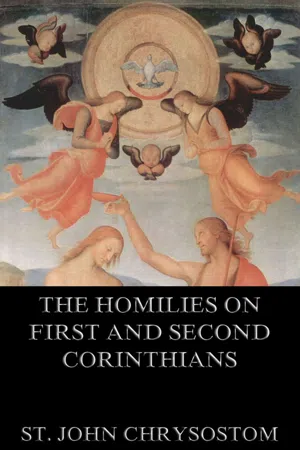
eBook - ePub
The Homilies On First And Second Corinthians
- 903 pages
- English
- ePUB (mobile friendly)
- Available on iOS & Android
eBook - ePub
The Homilies On First And Second Corinthians
About this book
Information
The Homilies On First And Second Corinthians
St. Chrysostom
Contents:
John Chrysostom – A Biography
Preface
Homilies on First Corinthians
Homily I.
Homily II.
Homily III.
Homily IV.
Homily V.
Homily VI.
Homily VII.
Homily VIII.
Homily IX.
Homily X.
Homily XI.
Homily XII.
Homily XIII.
Homily XIV
Homily XV.
Homily XVI.
Homily XVII.
Homily XVIII.
Homily XIX.
Homily XX.
Homily XXI
Homily XXII
Homily XXIII.
Homily XXIV
Homily XXV
Homily XXVI.
Homily XXVII.
Homily XXVIII.
Homily XXIX.
Homily XXX.
Homily XXXI.
Homily XXXII.
Homily XXXIII.
Homily XXXIV.
Homily XXXV.
Homily XXXVI.
Homily XXXVII.
Homily XXXVIII.
Homily XXXIX
Homily XL.
Homily XLI.
Homily XLII.
Homily XLIII.
Homily XLIV.
Homilies on Second Corinthians
Homily I
Homily II.
Homily III.
Homily IV
Homily V.
Homily VI.
Homily VII.
Homily VIII.
Homily IX.
Homily X.
Homily XI
Homily XII.
Homily XIII.
Homily XIV.
Homily XV.
Homily XVI.
Homily XVII.
Homily XVIII.
Homily XIX.
Homily XX.
Homily XXI.
Homily XXII.
Homily XXIII.
Homily XXIV.
Homily XXV.
Homily XXVI.
Homily XXVII.
Homily XXVIII.
Homily XXIX.
Homily XXX.
The Homilies On First And Second Corinthians, St. Chrysostom
Jazzybee Verlag Jürgen Beck
86450 Altenmünster, Germany
ISBN: 9783849620981
www.jazzybee-verlag.de
John Chrysostom – A Biography
John Chrysostom, a bishop, doctor, and saint of the eastern church, born in Antioch, according to the best authorities, Jan. 14, 347, died Sept. 14, 407. His name was only John, the appellation Chrysostom (Greek for "the golden-mouthed"), by which he is usually known, not having been given to him until the 7th century. His father, Secundus, who was magister militum Orientis, died while John was still in his infancy. Arethusa, his mother, left a widow in her 20th year, resolved to remain single in order to devote her whole life to her boy. Intending him to follow the legal profession, she sought for him the best school of eloquence, and placed him with the renowned Libanins, then teaching at Antioch. Libanius, who had formerly had among: his pupils the great Basil of Csesarea, his brother Gregory of Nyssa, and his bosom friend Gregory Nazianzen, had also been the master of the emperor Julian, and his most ardent auxiliary in his endeavor to put down Christianity and restore the worship of the old gods. He welcomed John, soon discovered his genius, labored to develop it, and predicted the preeminence which his favorite pupil afterward attained. At the age of 18 he was practising at the bar, where even then more than one great success laid the foundation of his fame.
This, as well as his social position and the virtues of his mother, drew on him the eyes of Meletius, bishop of Antioch, who wished to secure as a member of his clergy one so full of promise. He instructed and baptized him, gave him his first lessons in ecclesiastical science, ordained him lector or reader, and assigned him a residence beneath his own roof. This was not what his mother had designed for him; she had set her heart on seeing him foremost in the race for worldly honors, and resisted with all her might his entrance on a career so different. She represented to him that for love of him she had in youth renounced all earthly joys, and that he must not think of forsaking her now when old age and its infirmities were fast approaching. It was all in vain. The same wave of ascetic fervor which was carrying away into solitude and the austerities of monastic life the very elite of Christian youth, bore John into the mountains which surrounded his native city. For six years, two of which were spent in a hermitage, he gave himself up to a life divided between the study of the Scriptures and prayer, mortifying his body meanwhile with such rigor that his limbs were nearly paralyzed.
The urgent solicitations of his friends at length drew him back to Antioch, where the pallor of his countenance and his extreme emaciation touched all beholders with pity or veneration. Several years passed before he was ordained deacon. In 381 Meletius died. A rival Christian faction, with Paulinus as its bishop, had divided the church at Antioch. John, while yet a deacon, strove in vain to heal the schism. Flavian, successor to Meletius, appreciated his learning, eloquence, and disinterestedness. So great, indeed, was the esteem in which he was held throughout Asia Minor, that even before his elevation to the priesthood the neighboring bishops sought to raise him to the episcopal office. He shrank from the honor and responsibility, but induced his friend Basil to accept the proffered rank. In 386 John became a priest, and commenced his course as a preacher. He was justly considered even then as the shining light of the eastern church. In 397 the see of Constantinople became vacant by the death of Nectarius. For three months rival candidates and contending factions sought to no purpose to fill the coveted see.
The eunuch Eutropius, then all-powerful at court, and who had heard John's preaching, submitted his name to the emperor Arcadius. The latter approved of the choice; and forthwith a messenger was sent to Asterius, prefect of the East, who resided at Antioch, bidding him to secure by some stratagem the person of the presbyter John, and send him to Constantinople. John was invited by Asterius to accompany him on a visit to a new church just erected outside of Antioch, and his chariot was driven amid an armed escort toward the Bosporus. After the first emotion of surprise and anger, John thought he saw in all this the hand of an overruling Providence, and submitted passively. The episcopal chair of Constantinople, in which John now found himself, had a few years before been adorned by Gregory Nazianzen. Nectarius, whom Theodosius chose as his successor, had not even been baptized when, to his dismay, he, in the midst of the second general council, saw himself raised to such an exalted rank. But he discharged his episcopal functions with a careful piety, charming Theodosius and his court by his majestic presence and graceful manners, and dispensing in the patriarchal residence a princely hospitality to the many churchmen whom business drew to the capital.
Chrysostom brought a new spirit to these halls. He resolved to make his household a model for every household of churchman and layman within his jurisdiction, and his own life a mirror in which every bishop and priest should see what they must be themselves in order to be true shepherds in Christ's flock. He made a monastic frugality preside over his table and all his domestic expenses. The rich furniture of his predecessors and their abundant wardrobe of silks and cloth of gold were sold at auction, and the proceeds given to the poor. Nectarius had purposed erecting a magnificent basilica, and collected a large quantity of precious marbles and other rare building material. John did not hesitate to sell them for the benefit of the needy classes. The very sacred vessels which he judged too costly for the altar were similarly disposed of. This displeased the clergy, while the people were taught to attribute these reforms to parsimony or avarice. But when the poorly clad archbishop appeared in the pulpit of St. Sophia, his hearers forgot everything but that they possessed a man of God in their midst. It is impossible to study his works without being impressed with his deep devotion to the people.
Hence, in Constantinople as at Antioch, whenever he preached the largest edifices could not contain the crowds who flocked to hear him. They surrounded him in the streets, pouring blessings on his head as he passed along; and when his liberty or his life was threatened at a later period, they watched night and day around his dwelling. "I love you," he one day exclaimed to the worshipping throng "I love you as you love me. What should I be without you? You are to me father, mother, brothers, and children; you are all the world to me. I know no joy, no sorrow, which is not yours." This popularity constituted one great source of his power, and he used it in his vain attempt at reform both in court and church. Eutropius, who had been mainly instrumental in his elevation, did not find favor with the archbishop, who denounced his tyranny and the corruption which he encouraged in every branch of the administration, He retaliated by having a law passed which repealed or abridged ecclesiastical immunities, and in particular limited the right of asylum granted to churches. John inveighed against the extravagance and licentiousness of the court.
Arcadius dreaded the remonstrances which tended to rouse him from his unmanly love of ease, and the empress Eudoxia hated the man who dared to reprove openly her illicit amours. The courtiers and ministers of state shared their master's enmity, and only waited for an opportunity to make the archbishop feel the weight of their resentment. Eutropius fell into disgrace and fled for his life to the church of St. Sophia, where Chrysostom gave him a shelter, and protected him against the united rage of the courtiers, the military, and the populace. But it was only for a time. Eutropius was induced to leave his asylum, and perished by the hands of Eudoxia's satellites. She now ruled with absolute sway both the emperor and the empire. Her avarice was equal to her ambition, and she went so far as to take open possession of a vineyard which the owner would neither sell nor give up to her. Chrysostom denounced her from the pulpit as a second Jezebel. This brought matters to a crisis. Theophilus, bishop of Alexandria, who had himself aspired to the succession of Nectarius, found new matter of complaint as well as of hatred against Chrysostom in the toleration which the latter extended to some monks expelled from Egypt and excommunicated on account of their attachment to Origen and his doctrines.
This caused the accusation of heresy to be made against the archbishop, although at that time no council had condemned the opinions attributed to Origen. Chrysostom summoned before himself every member of his clergy in order to examine into the scandalous reports about their relations with deaconesses and other women. He reformed or rebuked wherever he found just cause; and thus there was wide-spread discontent among the clergy. It had been reported to him that the episcopal office was bought and sold in the provinces dependent on his patriarchate. In the midst of winter he set out, visiting every diocese, and before; he returned to Constantinople deposed 13 bishops convicted of simony and immorality. He even extended his visitation into provinces which owed him no obedience, and there exercised the same rigor against the guilty. This raised a great outcry against him, and gave the advantage to his enemies. Eudoxia and Theophilus joined hands; and in 403 a council of 36 bishops assembled at Chalcedon, a suburb of Constantinople. There Chrysostom was accused, among other crimes, of pride, oppression of the clergy, inhospitality, avarice, gluttony, undue familiarity with women, and high treason.
He refused to appear before his self-constituted judges until their president, Theophilus, and three other bishops, his declared enemies, had been excluded. Meanwhile he continued to give his usual homilies in the cathedral, and the people watched unceasingly his coming and going lest any evil should befall him. He was found guilty and deposed from his see, and a new bishop was appointed by the council and approved by the emperor. At length his house was surrounded in the night by soldiers, and himself borne off into exile at Nicaea. The people on hearing this rose a...
Table of contents
- John Chrysostom – A Biography
- Homilies on Second Corinthians
Trusted by 375,005 students
Access to over 1.5 million titles for a fair monthly price.
Study more efficiently using our study tools.
Frequently asked questions
Yes, you can cancel anytime from the Subscription tab in your account settings on the Perlego website. Your subscription will stay active until the end of your current billing period. Learn how to cancel your subscription
No, books cannot be downloaded as external files, such as PDFs, for use outside of Perlego. However, you can download books within the Perlego app for offline reading on mobile or tablet. Learn how to download books offline
Perlego offers two plans: Essential and Complete
- Essential is ideal for learners and professionals who enjoy exploring a wide range of subjects. Access the Essential Library with 800,000+ trusted titles and best-sellers across business, personal growth, and the humanities. Includes unlimited reading time and Standard Read Aloud voice.
- Complete: Perfect for advanced learners and researchers needing full, unrestricted access. Unlock 1.5M+ books across hundreds of subjects, including academic and specialized titles. The Complete Plan also includes advanced features like Premium Read Aloud and Research Assistant.
We are an online textbook subscription service, where you can get access to an entire online library for less than the price of a single book per month. With over 1.5 million books across 990+ topics, we’ve got you covered! Learn about our mission
Look out for the read-aloud symbol on your next book to see if you can listen to it. The read-aloud tool reads text aloud for you, highlighting the text as it is being read. You can pause it, speed it up and slow it down. Learn more about Read Aloud
Yes! You can use the Perlego app on both iOS and Android devices to read anytime, anywhere — even offline. Perfect for commutes or when you’re on the go.
Please note we cannot support devices running on iOS 13 and Android 7 or earlier. Learn more about using the app
Please note we cannot support devices running on iOS 13 and Android 7 or earlier. Learn more about using the app
Yes, you can access The Homilies On First And Second Corinthians by St. John Chrysostom, John Medley, Hubert Kestell Cornish in PDF and/or ePUB format, as well as other popular books in Theology & Religion & Biblical Criticism & Interpretation. We have over 1.5 million books available in our catalogue for you to explore.