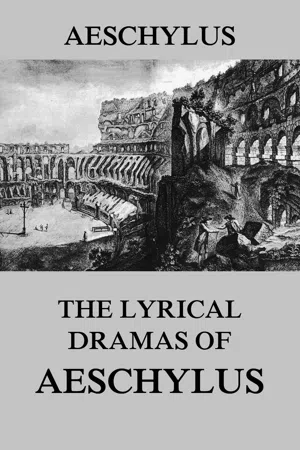
Aeschylus was one of the most famous ancient Greek tragedians He is often called "the father of tragedy", since this genre really begins with his works. This edition includes the following dramas: Agamemnon Choephoræ Or, The Libation-Bearers The Eumenides Prometheus Bound The Suppliants The Seven Against Thebes The Persians
- 894 pages
- English
- ePUB (mobile friendly)
- Available on iOS & Android
eBook - ePub
The Lyrical Dramas of Aeschylus
About this book
Information
Subtopic
Ancient & Classical DramaIndex
LiteratureTHE PERSIANS
A HISTORICAL CANTATA
“Why should calamity be full of words?
Windy attorneys to their client woes,
Airy succeeders of intestate joys,
Poor breathing orators of miseries!
Let them have scope; though what they do in part
Help nothing else, yet they do ease the heart.”
Shakespere.
Ὥ θείη Σαλαμὶς . ἀπολεɩ̂ς δὲ σὺ τέκνα γυναικωˆν.
Delphic Oracle
PERSONS
Chorus of Persian Elders.
Atossa, Mother of Xerxes.
Messenger.
Shade of Darius, Father of Xerxes.
Xerxes, King of Persia.
Scene—Before the Palace at Susa. Tomb of Darius in the background.
INTRODUCTORY REMARKS
The piece, on the perusal of which the reader is now about to enter, stands unique among the extant remains of the ancient drama, as drawing its materials from the historical, not the mythological, age of the Greek people. We are not, from this fact, to conclude that the Greeks, or the ancients generally, drew a more strict boundary line between the provinces of history and poetry, than the moderns. Such an inference were the very reverse of the fact, as the whole style of ancient history on the one hand, and the examples of Ennius and Lucan in poetry, sufficiently show. Not even within the special domain of the Greek stage is our one extant example the only historical drama of which the records of Hellenic literature have preserved the memory; on the contrary, one of the old arguments of the present play expressly testifies that Phrynichus, a contemporary of Æschylus, had written a play on the same subject; and we know, from other sources, that the same dramatist had exhibited on the stage, with the most powerful effect, the capture of the city of Miletus, which took place only a few years before the battle of Marathon. Endnote 188 There was a plain reason, however, why, with all this, historical subjects should, in the general case, have been excluded from the range of the Greek dramatic poetry; and that reason was, the religious character which, as we have previously shown, belonged so essentially to the tragic exhibitions of the Hellenes. That religious character necessarily directed the eye of the tragic poet to those ages in the history of his country, when the gods held more familiar and open converse with men, and to those exploits which were performed by Jove-descended heroes in olden time, under the express sanction, and with the special inspiration, of Heaven. Had a characteristically Christian drama arisen, at an early period, out of the festal celebrations of the Church, the sacred poets of such a drama would, in the same way, have confined themselves to strictly scriptural themes, or to themes belonging to the earlier and more venerable traditions of the Church.
With regard to the subject of the present drama, there can be no doubt that, like the fall of Napoleon at Moscow, Leipzig, and Waterloo, in these latter days, so in ancient history there is no event more suited for the purposes of poetry than the expedition of Xerxes into Greece There is “a beginning, a middle, and an end,” in this story, which might satisfy the critical demands of the sternest Aristotle; a moral also, than which no sermon ever preached from Greek stage or Christian pulpit is better calculated to tame the foolish pride, and to purify the turbid passions of humanity. In ancient and modern times, accordingly, from Chœrilus to Glover, the whole, or part of this subject has been treated, as its importance seemed to demand, epically; Endnote 189 but of all the poetical glorifications of this high theme, that of Æschylus has alone succeeded in asserting for its...
Table of contents
- PREFACE
- ON THE GENIUS AND CHARACTER OF THE GREEK TRAGEDY
- THE LIFE OF ÆSCHYLUS
- AGAMEMNON A LYRICO-DRAMATIC SPECTACLE
- CHOEPHORÆ OR, THE LIBATION-BEARERS A LYRICO-DRAMATIC SPECTACLE
- THE EUMENIDES A LYRICO-DRAMATIC SPECTACLE
- PROMETHEUS BOUND A LYRICO-DRAMATIC SPECTACLE
- THE SUPPLIANTS A LYRICO-DRAMATIC SPECTACLE
- THE SEVEN AGAINST THEBES A LYRICO-DRAMATIC SPECTACLE
- THE PERSIANS A HISTORICAL CANTATA
Trusted by 375,005 students
Access to over 1.5 million titles for a fair monthly price.
Study more efficiently using our study tools.
Frequently asked questions
Yes, you can cancel anytime from the Subscription tab in your account settings on the Perlego website. Your subscription will stay active until the end of your current billing period. Learn how to cancel your subscription
No, books cannot be downloaded as external files, such as PDFs, for use outside of Perlego. However, you can download books within the Perlego app for offline reading on mobile or tablet. Learn how to download books offline
Perlego offers two plans: Essential and Complete
- Essential is ideal for learners and professionals who enjoy exploring a wide range of subjects. Access the Essential Library with 800,000+ trusted titles and best-sellers across business, personal growth, and the humanities. Includes unlimited reading time and Standard Read Aloud voice.
- Complete: Perfect for advanced learners and researchers needing full, unrestricted access. Unlock 1.5M+ books across hundreds of subjects, including academic and specialized titles. The Complete Plan also includes advanced features like Premium Read Aloud and Research Assistant.
We are an online textbook subscription service, where you can get access to an entire online library for less than the price of a single book per month. With over 1.5 million books across 990+ topics, we’ve got you covered! Learn about our mission
Look out for the read-aloud symbol on your next book to see if you can listen to it. The read-aloud tool reads text aloud for you, highlighting the text as it is being read. You can pause it, speed it up and slow it down. Learn more about Read Aloud
Yes! You can use the Perlego app on both iOS and Android devices to read anytime, anywhere — even offline. Perfect for commutes or when you’re on the go.
Please note we cannot support devices running on iOS 13 and Android 7 or earlier. Learn more about using the app
Please note we cannot support devices running on iOS 13 and Android 7 or earlier. Learn more about using the app
Yes, you can access The Lyrical Dramas of Aeschylus by Aeschylus, John Stuart Blackie in PDF and/or ePUB format, as well as other popular books in Literature & Ancient & Classical Drama. We have over 1.5 million books available in our catalogue for you to explore.