This is the annotated edition including* an extensive biographical annotation about the author and his lifeCalvin produced commentaries on most of the books of the Bible. His commentaries cover the larger part of the Old Testament, and all of the new excepting Second and Third John and the Apocalypse. His commentaries and lectures stand in the front rank of Biblical interpretation.The Commentaries On Jeremiah, like those on The Minor Prophets, were delivered as Lectures In The Theological School At Geneva, taken down by some of the Pupils, and afterwards read to Calvin, and corrected. We find in them the production of the same vigorous and expansive mind: The Divine Oracles are faithfully explained, the meaning is clearly stated, and such brief deductions are made as the subjects legitimately warrant. Though the Lectures were extemporaneously delivered, there is yet so much order preserved, and such brevity, clearness, and suitableness of diction are found in them, that in these respects they nearly equal the most finished compositions of Calvin as proof that he possessed a mind of no common order.The Ministry Of Jeremiah extended over a large space of time from the thirteenth year of Josiah's reign till after the final overthrow of the nation; but for how long after that period, it is not known. Between the thirteenth year of Josiah and the destruction of the city and Temple, there were about forty years. This was a remarkable period, and Jeremiah nearly alone labored among the people. Their sins had been for the most part the same for a long time - for nearly two centuries, as it appears from the testimonies of his predecessors, Amos, Hosea, Isaiah, Joel, Micah, Nahum, and Zephaniah; for these seven had in this order preceded him. Zephaniah And Habakkuk were probably for a time his contemporaries, the first at the commencement, and the other near the end of his ministry.
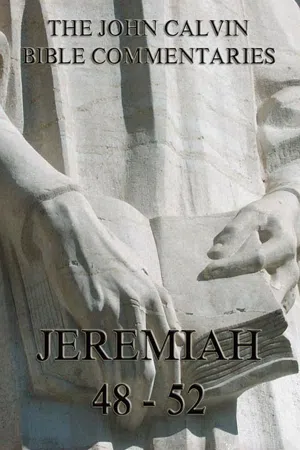
eBook - ePub
John Calvin's Commentaries On Jeremiah 48- 52 And The Lamentations
- 576 pages
- English
- ePUB (mobile friendly)
- Available on iOS & Android
eBook - ePub
John Calvin's Commentaries On Jeremiah 48- 52 And The Lamentations
About this book
Information
Topic
Teologia e religioneSubtopic
Commento della BibbiaCommentaries On Jeremiah 48- 52 And The Lamentations
John Calvin
Contents:
John Calvin – A Biography
Commentaries On Jeremiah 48- 52 And The Lamentations
Chapter 48
Chapter 49
Chapter 50
Chapter 51
Chapter 52
The Lamentations Of Jeremiah
Chapter 1
Chapter 2
Chapter 3
Chapter 4
Chapter 5
A Translation Of Calvin’s Version Of Jeremiah
Chapter 48
Chapter 49
Chapter 50
Chapter 51
Chapter 52
A Translation Of Calvin’s Version Of The Lamentations.
Chapter 1
Chapter 2
Chapter 3
Chapter 4
Chapter 5
Footnotes
Commentaries On Jeremiah 48- 52 And The Lamentations, John Calvin
Jazzybee Verlag Jürgen Beck
86450 Altenmünster, Germany
ISBN: 9783849620608
www.jazzybee-verlag.de
John Calvin – A Biography
By William Barry
This man, undoubtedly the greatest of Protestant divines, and perhaps, after St. Augustine, the most perseveringly followed by his disciples of any Western writer on theology, was born at Noyon in Picardy, France, 10 July, 1509, and died at Geneva, 27 May, 1564.
A generation divided him from Luther, whom he never met. By birth, education, and temper these two protagonists of the reforming movement were strongly contrasted. Luther was a Saxon peasant, his father a miner; Calvin sprang from the French middle-class, and his father, an attorney, had purchased the freedom of the City of Noyon, where he practised civil and canon law. Luther entered the Order of Augustinian Hermits, took a monk's vows, was made a priest and incurred much odium by marrying a nun. Calvin never was ordained in the Catholic Church; his training was chiefly in law and the humanities; he took no vows. Luther's eloquence made him popular by its force, humour, rudeness, and vulgar style. Calvin spoke to the learned at all times, even when preaching before multitudes. His manner is classical; he reasons on system; he has little humour; instead of striking with a cudgel he uses the weapons of a deadly logic and persuades by a teacher's authority, not by a demagogue's calling of names. He writes French as well as Luther writes German, and like him has been reckoned a pioneer in the modern development of his native tongue. Lastly, if we term the doctor of Wittenberg a mystic, we may sum up Calvin as a scholastic; he gives articulate expression to the principles which Luther had stormily thrown out upon the world in his vehement pamphleteering; and the "Institutes" as they were left by their author have remained ever since the standard of orthodox Protestant belief in all the Churches known as "Reformed." His French disciples called their sect "the religion"; such it has proved to be outside the Roman world.
The family name, spelt in many ways, was Cauvin latinized according to the custom of the age as Calvinus. For some unknown reason the Reformer is commonly called Maître Jean C. His mother, Jeanne Le Franc, born in the Diocese of Cambrai, is mentioned as "beautiful and devout"; she took her little son to various shrines and brought him up a good Catholic. On the father's side, his ancestors were seafaring men. His grandfather settled at Pont l'Evêque near Paris, and had two sons who became locksmiths; the third was Gerard, who turned procurator at Noyon, and there his four sons and two daughters saw the light. He lived in the Place au Blé (Cornmarket). Noyon, a bishop's see, had long been a fief of the powerful old family of Hangest, who treated it as their personal property. But an everlasting quarrel, in which the city took part, went on between the bishop and the chapter. Charles de Hangest, nephew of the too well-known Georges d'Amboise, Archbishop of Rouen, surrendered the bishopric in 1525 to his own nephew John, becoming his vicar-general. John kept up the battle with his canons until the Parliament of Paris intervened, upon which he went to Rome, and at last died in Paris in 1577. This prelate had Protestant kinsfolk; he is charged with having fostered heresy which in those years was beginning to raise its head among the French. Clerical dissensions, at all events, allowed the new doctrines a promising field; and the Calvins were more or less infected by them before 1530.
Gerard's four sons were made clerics and held benefices at a tender age. The Reformer was given one when a boy of twelve, he became Curé of Saint-Martin de Marteville in the Vermandois in 1527, and of Pont l'Eveque in 1529. Three of the boys attended the local Collège des Capettes, and there John proved himself an apt scholar. But his people were intimate with greater folk, the de Montmor, a branch of the line of Hangest, which led to his accompanying some of their children to Paris in 1523, when his mother was probably dead and his father had married again. The latter died in 1531, under excommunication from the chapter for not sending in his accounts. The old man's illness, not his lack of honesty, was, we are told, the cause. Yet his son Charles, nettled by the censure, drew towards the Protestant doctrines. He was accused in 1534 of denying the Catholic dogma of the Eucharist, and died out of the Church in 1536; his body was publicly gibbeted as that of a recusant.
Meanwhile, young John was going through his own trials at the University of Paris, the dean or syndic of which, Noel Bédier, had stood up against Erasmus and bore hard upon Le Fèvre d'Etaples (Stapulensis), celebrated for his translation of the Bible into French. Calvin, a "martinet", or oppidan, in the Collèege de la Marche, made this man's acquaintance (he was from Picardy) and may have glanced into his Latin commentary on St. Paul, dated 1512, which Doumergue considers the first Protestant book emanating from a French pen. Another influence tending the same way was that of Corderius, Calvin's tutor, to whom he dedicated afterwards his annotation of I Thessalonians, remarking, "if there be any good thing in what I have published, I owe it to you". Corderius...
Table of contents
- John Calvin – A Biography
Trusted by 375,005 students
Access to over 1.5 million titles for a fair monthly price.
Study more efficiently using our study tools.
Frequently asked questions
Yes, you can cancel anytime from the Subscription tab in your account settings on the Perlego website. Your subscription will stay active until the end of your current billing period. Learn how to cancel your subscription
No, books cannot be downloaded as external files, such as PDFs, for use outside of Perlego. However, you can download books within the Perlego app for offline reading on mobile or tablet. Learn how to download books offline
Perlego offers two plans: Essential and Complete
- Essential is ideal for learners and professionals who enjoy exploring a wide range of subjects. Access the Essential Library with 800,000+ trusted titles and best-sellers across business, personal growth, and the humanities. Includes unlimited reading time and Standard Read Aloud voice.
- Complete: Perfect for advanced learners and researchers needing full, unrestricted access. Unlock 1.5M+ books across hundreds of subjects, including academic and specialized titles. The Complete Plan also includes advanced features like Premium Read Aloud and Research Assistant.
We are an online textbook subscription service, where you can get access to an entire online library for less than the price of a single book per month. With over 1.5 million books across 990+ topics, we’ve got you covered! Learn about our mission
Look out for the read-aloud symbol on your next book to see if you can listen to it. The read-aloud tool reads text aloud for you, highlighting the text as it is being read. You can pause it, speed it up and slow it down. Learn more about Read Aloud
Yes! You can use the Perlego app on both iOS and Android devices to read anytime, anywhere — even offline. Perfect for commutes or when you’re on the go.
Please note we cannot support devices running on iOS 13 and Android 7 or earlier. Learn more about using the app
Please note we cannot support devices running on iOS 13 and Android 7 or earlier. Learn more about using the app
Yes, you can access John Calvin's Commentaries On Jeremiah 48- 52 And The Lamentations by John Calvin, John King in PDF and/or ePUB format, as well as other popular books in Teologia e religione & Commento della Bibbia. We have over 1.5 million books available in our catalogue for you to explore.