Focusing on the small island of Paama, Vanuatu, and the capital, Port Vila, this book presents a rare and recent study of the ongoing significance of urbanisation and internal migration in the Global South. Based on longitudinal research undertaken in rural 'home' places, urban suburbs and informal settlements over thirty years, this book reveals the deep ambivalence of the outcome of migration, and argues that continuity in the fundamental organising principles of cultural life – in this case centred on kinship and an 'island home' – is significantly more important for urban and rural lives than the transformative impacts of migration and urbanisation.
Trusted by 375,005 students
Access to over 1.5 million titles for a fair monthly price.
Mobility has long been important to Pacific Island societies and has been integral, both socially and economically, to key phases and directions of change in many cultures throughout the region. By contrast, urbanisation in the Pacific is characterised by recency and rapidity, but its impact and consequence have been at least as significant. Experiences of urbanisation and migration in Vanuatu, and the Pacific Islands more generally, are by no means unique to the region. As in many former colonies, but especially in Vanuatu, migration within and beyond national borders has been both enabled and constrained by colonial powers and their political legacies. Similarly, towns and cities, once a foreign concept, have become integral to social and economic life. Paamese rural-urban migration and urbanisation is thus situated in a wider regional and global context, and highlights both the commonalities and cultural distinctions that exist in how these phenomena are experienced.
Despite an enduring discourse of rural idylls, the Pacific is today unquestionably urban. As is true of other Melanesian capital cities, Port Vila is growing faster than any other part of Vanuatu. Nonetheless, as Hal Levine and Marlene Levine (1979) observed a generation ago, Pacific towns are not ‘closed systems’, and changes to urban areas are closely linked to similar processes occurring in rural ‘home’ places. It is therefore vital to compare and contrast urban and rural trends. To counter the common depiction of ‘modern’ urban towns versus ‘true’ and ‘traditional’ rural homes, this book highlights how rural and urban areas function as intricately connected nodes in a social field linked by established and emerging kin networks. Through the use of Gerald Haberkorn’s data and analysis of Paamese life from a generation ago, this book charts the way rural and urban life, and the kin linkages that sustain it, have adapted to change and, just as importantly, examines those aspects of Paamese life that have endured.
Vanuatu
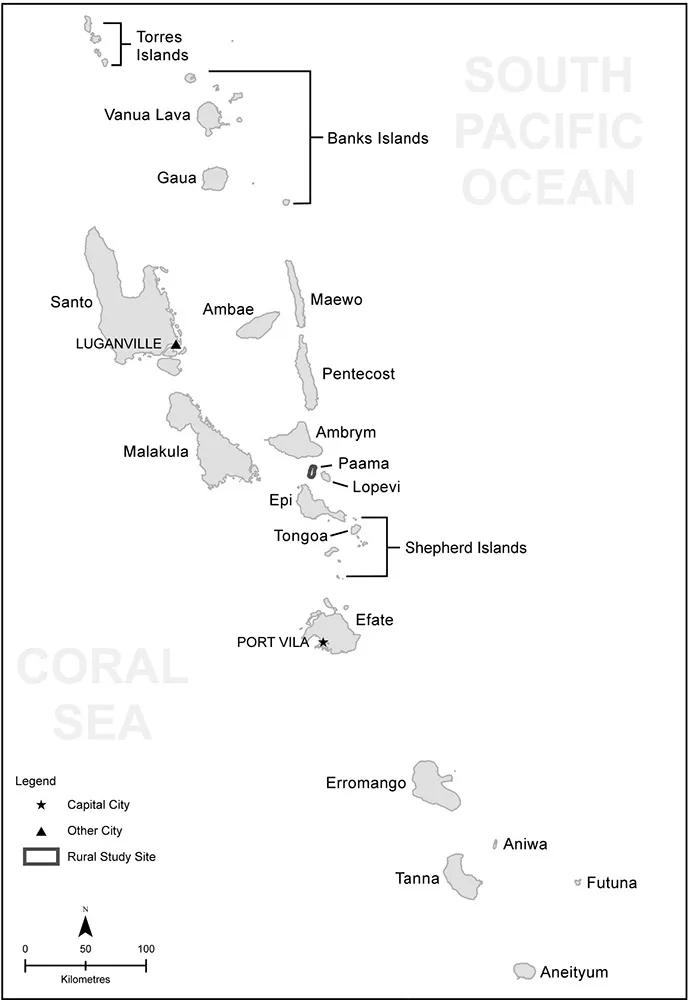
Vanuatu is invariably described as a y-shaped archipelago in the South West Pacific, which measures approximately 850 kilometres from north to south (Figure 1.1). The nation’s population of almost three hundred thousand is spread across some sixty-five of the archipelago’s eighty or so islands. Population distribution is predominantly rural, with just a quarter of the population living in urban areas, mainly the capital city of Port Vila and the smaller northern town of Luganville. This balance is steadily shifting, and a combination of natural increase and rural-urban migration has resulted in an urban population growth rate (2.6 per cent per annum in 2016) that has long been higher than, and often far outstripped, that of rural areas (2.3 per cent per annum in 2016) (VNSO 2011, 2017). The small but highly dispersed population brings with it serious challenges for transport and service provision, and while the recent introduction of mobile phones has improved communications (Sijapati-Basnett 2009), rural areas exemplify a poverty of opportunity with limited access to services such as healthcare and education and to employment and income-earning opportunities. There is little devolution of limited economic opportunities from urban centres, where services are concentrated, to the rural majority, and no opportunity for any economies of scale on such small islands. The larger islands of Tanna and Ambrym have recently experienced modest increases in tourist numbers, but even so, tourism remains firmly concentrated in Port Vila. Nonetheless, and even as opportunities are skewed towards town, it is urban areas where income disparity is greatest, and poverty most visible (ADB 2009).
Known at the time as the New Hebrides, Vanuatu was ruled by a French-British condominium government from 1906 to 1980. Under the condominium system, the two colonial powers had full sovereignty over their own subjects, while the indigenous population was jointly administered. Renowned for its inefficiency and doubling – and in some cases tripling – of essential services, the condominium governed by ‘benign neglect’ (Tonkinson 1979), a situation exacerbated by French-British disagreements over the principles of colonial administration. Vanuatu’s first prime minister, Father Walter Lini (1980), aptly described the condominium as a ‘pandemonium’. At least until the Second World War, there were no real urban centres, and only a handful of ni-Vanuatu took any part in colonial administration. The legacy of the condominium government persists today, and while the health system and police forces have been unified, a dual Anglophone/Francophone education system remains.
Figure 1.1 Vanuatu. Drawing by David Tran, used with permission.
Never content with the condominium government, ni-Vanuatu began to discuss independence with increasing frequency in the 1960s. Colonial land alienation was an important catalyst for the independence movement, coming to symbolise the indigenous lack of power in influencing the country’s future. In 1979, ni-Vanuatu opposition to condominium rule led to general elections, supported by the colonial administration, and after several delays, independence was eventually granted in July 1980. The transition from the New Hebrides to a united Vanuatu was unusual amongst Pacific Island nations in that it involved an element of violence. On Tanna, members of the John Frum cargo cult, who worship the mythical figure ‘John Frum’, objected to a centralised government. They believed unification and a modern system of government would invite meddling from the outside world and a move away from tradition, which posed a threat to the John Frum prophecy that rejecting modernity would bring wealth. However, opposition and unrest were strongest on Santo, where the Nagriamel movement, under the charismatic leadership of Jimmy Stephens, agitated for the recognition of the island as an independent state. Over a period of several weeks now referred to as the Coconut War, lively demonstrations ended in riots and kidnapping. This violence was only quelled when Prime Minister Lini called in the PNG Task Force for assistance (MacClancy 1981). After a bumpy start, Lini, and those who followed him, fostered a sense of national unity by drawing upon discourses of a Christian nation, and the uniqueness and importance of Vanuatu’s kastom.1
Like most small island states, Vanuatu’s contemporary formal economy is limited and relies heavily on urban oriented tourism and related service sectors. Subsistence agriculture is the main economic activity in rural areas, while the export industry is small and largely restricted to primary products including copra, kava, cocoa and, to a lesser extent, beef. Attempts to expand the agricultural export industry have been hampered by problems including unreliable transport and poor infrastructure. Consequently, the largely urban-based service sector, accounting for 74 per cent of gross domestic product, drives the economy. Urban employment is heavily concentrated in tourism, hospitality, government-related administration, the construction industry and financial services, the latter relating to Vanuatu’s tax haven status. Despite ongoing concerns over land alienation, real estate ‘sales’ (in reality, long-term leases) are also an important source of national revenue (ADB 2009). Employment opportunities may be concentrated in town, but urban unemployment is high and rising, and accessing jobs is heavily reliant on kin connections. The manufacturing industry is weak and largely restricted to servicing domestic needs as location, high wages relative to the Asian market and a lack of skills and raw materials pose significant barriers to expansion (Connell 2011). With a heavy reliance on tourism, aid and imports, Vanuatu’s economy is small and volatile, yet expansion is difficult.
A Brief History of Rapid Urbanisation
Urbanisation across the Pacific Islands, not least in Vanuatu, is intricately entwined with histories of colonialism. Before European ‘discovery’, most Pacific societies were organised around small hamlets with no central places. Established by colonial powers for the purposes of administration and trade, the initially tiny urban centres of the Pacific were designed as white male spaces, as colonial women – whose sexuality was considered at risk from ‘uncivilised’ natives – and indigenous Pacific Islanders – who were deemed not suited to ‘modern’ urban lifestyles – were largely excluded: a crude but basic form of apartheid that characterised the Melanesian states. Indigenous urban presence was tolerated for employment, but even when gainfully employed, Pacific Islanders were subject to various restrictions in town, including the need to carry a permit, strict curfews, low wages and, in the case of Vanuatu, urban accommodation only suitable for single men (Connell and Lea 2002; Haberkorn 1987). Segregated housing ensured that even where indigenous residence was possible, the local indigenous populations remained physically separate from the European population (Bennett 1957; Connell and Lea 1994). Colonial policies thus sought to ensure that indigenous Pacific Islanders did not settle permanently in urban areas and simultaneously discouraged and delayed the development of urban centres (Connell and Lea 2002; Fahey 1980; Koczberski et al. 2001).
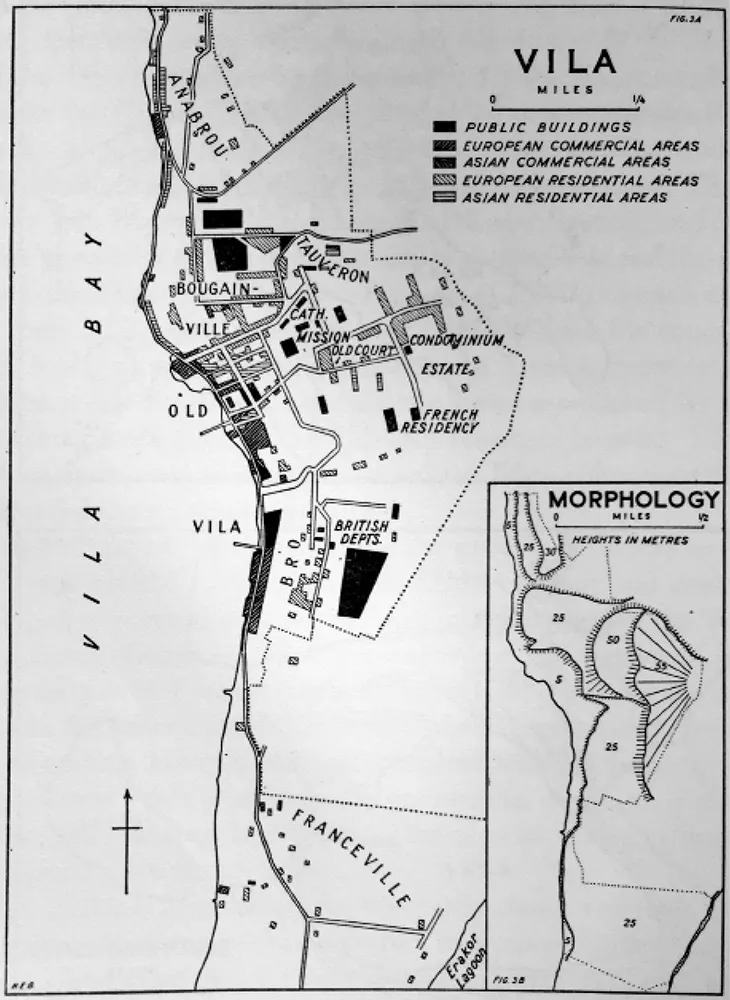
For the first half of the twentieth century, because of their small size and their distance from most of the national population, urban areas had little impact on the quotidian lives of Pacific Islanders. The largely administrative role of these towns, especially in Melanesia, meant their economies remained undeveloped and involved little more than some processing of raw materials until the late twentieth century and independence. The Second World War brought a first phase of change. The stationing of United States military troops throughout Vanuatu resulted in a construction boom; a large part of Port Vila’s present infrastructure dates from this period, while on Santo, and with the assistance of ni-Vanuatu labourers, the town of Luganville was constructed virtually ‘overnight’ (Connell and Lea 1994; Haberkorn 1987). In the aftermath of the war, colonial powers belatedly began to invest in their remote Pacific colonies, and urbanisation gradually became more significant, although geographical and institutional racial segregation persisted. In Port Vila, there was a clear separation of Asian and European residential areas, while the Melanesian population and their accommodation needs were excluded and discounted (Figure 1.2) (Connell and Lea 2002).
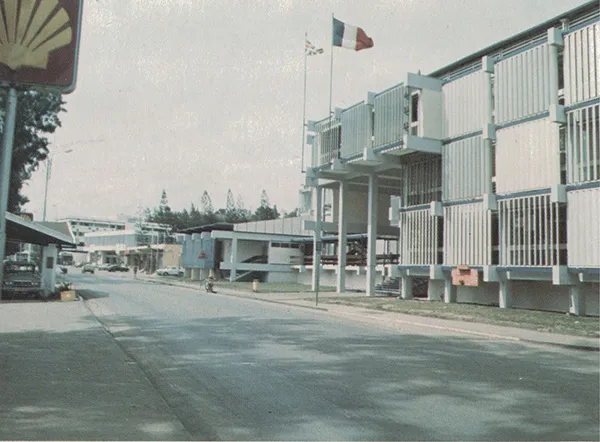
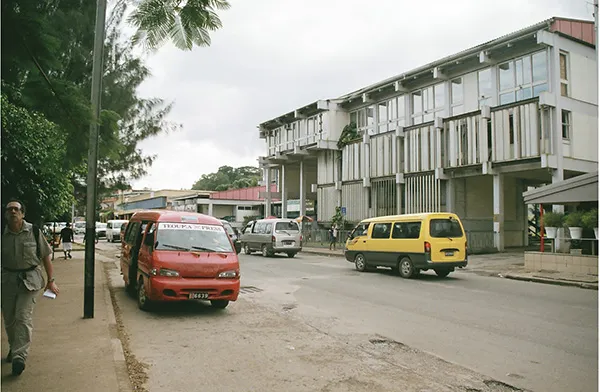
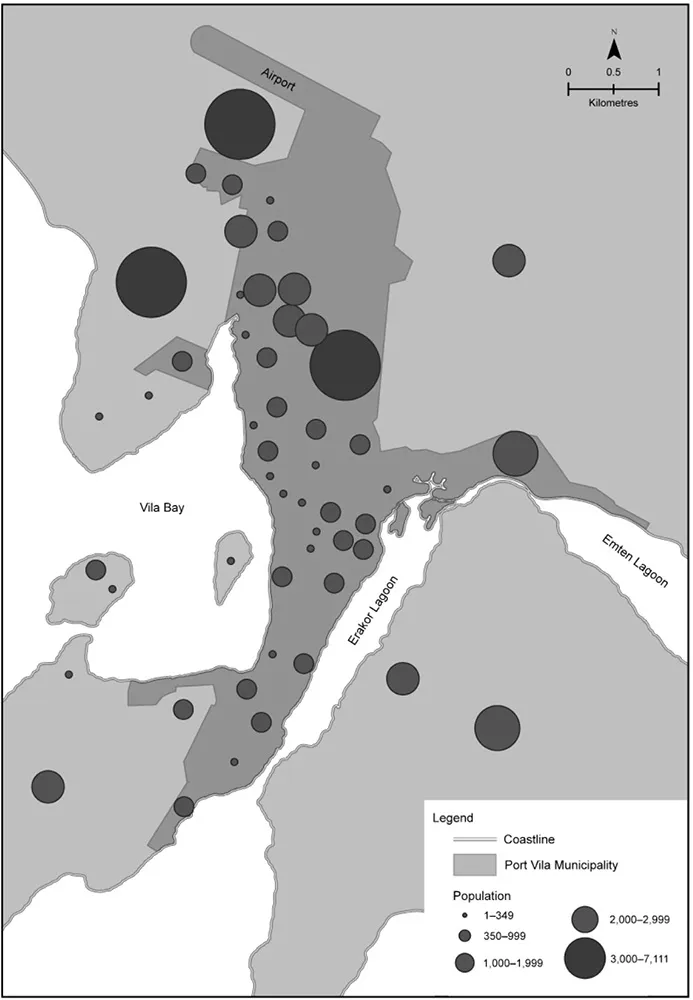
Urbanisation increased rapidly throughout the 1960s and early 1970s as employment opportunities expanded, especially in the colonial bureaucracy, and businesses requiring a permanent workforce gradually emerged. The 1970s signalled the beginning of a long decade of decolonisation in many Pacific Island nations, marked by associated political, social and economic change. Restrictions on an indigenous urban presence were removed, and urban areas were, for the first time, accessible to all Pacific peoples. Quite quickly, urban populations expanded faster than housing and other infrastructure, and informal settlements were established throughout Melanesia, as migrants embarked on their own forms of urbanisation, sometimes described as ‘urban villages’: a sense in which migrants were recreating rural social worlds in town. This trend continues today, and it is now estimated that as many as half of Melanesian urban populations live in informal settlements, many located on marginal land with limited access to infrastructure and basic services (Jones 2016). These settlements have been broadly stereotyped as places of crime, but there is little evidence to support these claims (Goddard 2001, 2005; Mitchell 2000, 2002). Importantly, informal settlement populations are not necessarily transient, and residents are usually little different from the wider urban population in terms of demographic structure and patterns of employment. As urban populations continue to grow while infrastructure stagnates (Figures 1.3 and 1.4), land pressure, overcrowding and associated health problems have become common, and environmental degradation resulting from lack of planning is more widespread (Bryant-Tokalau 1995). This has become a critical issue; in Vanuatu, much of Port Vila’s population, including several large, informal settlements, are located in peri-urban areas, outside the municipal boundary (Figure 1.5). The Port Vila Municipal Council remains ill equipped to regulate and manage these distant places. Consequently, long-term solutions remain largely absent, with evictions and similar approaches favoured as short-term expedients (Connell 2003; Goddard 2005; Koczberski et al. 2001). In this sense too, the absence of any planning philosophy supports the notion that migrants are merely temporary and their real homes are elsewhere.
Figure 1.2 Port Vila, 1955. Source: Bennett (1957: 120), used with permission.
Figure 1.3 Port Vila, late 1970s. Photograph by Fung Kuei, used with permission.
Figure 1.4 Port Vila, 2011. Photograph by Kirstie Petrou.
Rather than seek means of including and involving their residents in urban and national development by providing basic services, urban ‘policies’ have tended to oppose informal settlements throughout Melanesia, and even informal economic activities such as markets. This has raised questions over who benefits from urbanisation, and the extent to which residents of informal settlements are effectively citizens, with rights to the city. Access to urban housing, and associated infrastructure, remains problematic for many, whereas, simultaneously, a new, increasingly visible middle class is emerging (Gewertz and Errington 1999). However, as is evident for Paamese in Port Vila, there are multiple ways of being in the city, and this book seeks to capture the variety of urban experience.
Until very recently, because of the strong subsistence sector and kin support networks, poverty was rarely acknowledged as an issue facing Pacific Island nations; in some contexts, it was tolerated as ‘acceptable’ (Allen et al. 2005), and in Vanuatu it was deemed merely ‘hardship’ (ADB 2003). While poverty remains difficult to measure, in urban areas it has become increasingly visible and impossible to ignore. Improved health and rising education levels have occurred alongside a sharp decline in living standards for many urban residents who inhabit overcrowded, poorly serviced areas. Unemployment is high, and has been for decades; in Vanuatu, Sarah Mecartney (2001) has suggested the urban population had probably already outstripped employment opportunities by the 1970s, that is, even before independence and more significant flows of rural-urban migration. Small markets, restrictive legislation and a lack of skills mean the informal sector remains limited, and profits from informal economic activities are low almost everywhere in Melanesia (e.g. Barber 2010; Umezaki 2010). More intangible aspects of poverty, such as social breakdown, remain difficult to quantify and are complicated, as some forms of kin support have decreased as participation in urban exchange networks has become reliant on cash (Barber 2010; Monsell-Davis 1993). While kin networks and the subsistence sector continue to play an important role in Pacific Island cultures, in an environment where cash incomes have become a necessity, they are generally unable to counteract rising poverty. Beyond broad generalisations however, little is known about how kin-based support systems, including rural-urban remittance flows, have adapted over time to cope with these changing circumstances.
Figure 1.5 Urban Population distribution, Port Vila 2009. Drawing by David Tran, used with permission.
Regional identities remain strong, and this has sometimes resulted in ethnic tensions in urban areas (Rio 2011). These ethnic divisions, coupled with a lack of amenities, unemployment and housing issues, have together contributed to the emergence of social problems. In PNG, for example, the social structure and order that functioned in rural villages was ineffective in urban areas, and traditional leadership and authority could be avoided and ignored (Ward 2000). Limited incomes and opportunities have seen an increase in crime, domestic violence and less morally sanctioned earning opportunities like prostitution (Burry 2017; Connell 2003). Traditional controls on the use of drugs, including kava, have eroded, and as these substances have become readily available to a wider population, their use – and sometimes abuse – has increased (McDonald and Jowitt 2000). Whereas town was once a place to escape social conflicts such as black magic, contemporary urban areas with their heterogeneous populations are places where, in a climate of uncertainty, sorcery is now said to flourish (Mitchell 2000; Rio 2011). At the same time, however, new inter-ethnic networks are emerging as individuals forge relationships outside their kin groups (Kobayashi et al. 2011; Kraemer 2013; Mecartney 2001). Through participation with second- and third-generation migrants, this book considers how their sociality and ethnic relations may or may not differ from those of the first generation.
The negative view of an urban Pacific that began in colonial times persists today, with administrative reluctance to recognise urban settlers as permanent. Rural areas are still usually considered the rightful home of urban residents, even as those with limited ties to their ‘home’ area and second- and third-generation migrants may not be easily able to ‘return ...
Table of contents
Cover
Title Page
Copyright Page
Dedication
Contents
List of Figures and Tables
Acknowledgements
Introduction
1 Urbanisation and Migration: Rapid Change but Enduring Patterns
2 Subsistence Realities, Material Dreams: Rural Lives and Livelihoods
3 It’s Like We Live in Town Already: Island Social Organisation
4 The Everyday Ordinariness of Mobility: Persistent Patterns of Rural Outmigration
5 I Just Came to Visit My Kin: The Evolution of Urban Permanence
6 Friends, Lovers and Stranger Danger: Urban Social Worlds
7 Living on Money: Urban Economic Life
Conclusion. Fluidity and Flexibility: A Generation of Paamese Migration and Urban Experiences
Glossary of Frequently Used Bislama Terms
References
Index
Frequently asked questions
Yes, you can cancel anytime from the Subscription tab in your account settings on the Perlego website. Your subscription will stay active until the end of your current billing period. Learn how to cancel your subscription
No, books cannot be downloaded as external files, such as PDFs, for use outside of Perlego. However, you can download books within the Perlego app for offline reading on mobile or tablet. Learn how to download books offline
Perlego offers two plans: Essential and Complete
Essential is ideal for learners and professionals who enjoy exploring a wide range of subjects. Access the Essential Library with 800,000+ trusted titles and best-sellers across business, personal growth, and the humanities. Includes unlimited reading time and Standard Read Aloud voice.
Complete: Perfect for advanced learners and researchers needing full, unrestricted access. Unlock 1.5M+ books across hundreds of subjects, including academic and specialized titles. The Complete Plan also includes advanced features like Premium Read Aloud and Research Assistant.
Both plans are available with monthly, semester, or annual billing cycles.
We are an online textbook subscription service, where you can get access to an entire online library for less than the price of a single book per month. With over 1.5 million books across 990+ topics, we’ve got you covered! Learn about our mission
Look out for the read-aloud symbol on your next book to see if you can listen to it. The read-aloud tool reads text aloud for you, highlighting the text as it is being read. You can pause it, speed it up and slow it down. Learn more about Read Aloud
Yes! You can use the Perlego app on both iOS and Android devices to read anytime, anywhere — even offline. Perfect for commutes or when you’re on the go. Please note we cannot support devices running on iOS 13 and Android 7 or earlier. Learn more about using the app
Yes, you can access If Everyone Returned, The Island Would Sink by Kirstie Petrou in PDF and/or ePUB format, as well as other popular books in Social Sciences & Emigration & Immigration. We have over 1.5 million books available in our catalogue for you to explore.