It will be argued that Zechariah 9-14 consists of four collections of traditional eschatological hope (9: 1-17; 10: 3b-12; 12: 1-4a, 5, 8-9; and 14: 1-13, 14b-21). Of the collections, the first three included hopes vital during the first half of the Persian period. The fourth collection (chapter 14) seems to have arisen later than the other three (though still before the time of Nehemiah) and expressed much more pessimism. These variations were then supplemented by a collection (12: 6-7; 12: 10-13: 6) that is pro-Judean vis-à-vis Jerusalem and by the shepherd materials, which contradict the hopes of the first two collections. This final stage probably arose after the time of Nehemiah, i. e. after the city grew strong enough to raise the ire of Judeans outside the power structure. It is plausible to conclude, therefore, that the redactor of Zechariah 9-14 assembled the four collections and revised them by means of the supplements in 12: 6-7, 12: 10-13: 6 and the shepherd materials.
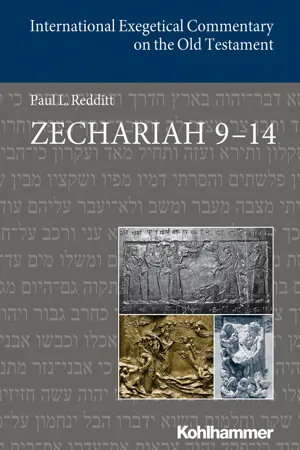
- 168 pages
- English
- ePUB (mobile friendly)
- Available on iOS & Android
eBook - ePub
Zechariah 9-14
About this book
Information
Topic
Theology & ReligionSubtopic
Biblical StudiesZechariah 12–13.
The Future of Jerusalem and Judah, 1
12:1–13:9
Zechariah 12:1–13:9 is the longest section of Zechariah 9–14, and it is connected to Zechariah 11 by its return in 13:7–9 to the topic of the shepherd of Zech 11:17.1 The passage is quite choppy since it is comprised of various genres: a title, a superscription, and a hymn fragment in 12:1; a prophecy of salvation in 12:2–9; a statement of divine favor in v. 10 followed by a description of lamenting in vv. 11–14; a short prophecy of salvation in 13:1; an enigmatic treatment of prophets in 13:2–6; and a conclusion in vv. 7–9, combining an apostrophe to God’s sword (v. 7) with a prophecy of destruction (vv. 8–9a) and a prediction of the repentance of God’s people (v. 9b).2 Despite its choppiness, most of the passage is written in the first person singular, i.e. as a speech of Yhwh.3 Also, many of the individual passages are introduced by the phrase “on that day,” used a total of nine times.4
The opening incipit in 12:1 marks a major new section (chapters 12–14) of Zechariah. The move from the battle against Jerusalem (12:2–9) to a section on mourning in Jerusalem (12:10–13:6) is made with no transition word or phrase, as is the transition to poetry in 13:7–9, which obviously has in view the shepherd materials in Zech 11:4–16(17). It makes sense, therefore, to treat the two chapters together, while noting that they constitute a composite, not a unified discourse. Petersen calls them a montage, a description Curtis adopts, calling 12:2–13:6 an eschatological narrative and 13:7–9 the final shepherd oracle.5
Zechariah 12–13 shares the negative turn the plot of Zechariah 9–14 took in Zechariah 11. As there, Zechariah 12–13 does not mention the northern kingdom of Israel. Expectations for its restitution disappeared after Zechariah 10 and do not resurface in Zechariah 12–14. Chapters 12–13 concentrate on Jerusalem (mentioned in 12:2, 3, 5, 6, 7, 8, 9, 10, 11; 13:1; 14:2, 4, 8, 10, 11, 12, 14, 16, 17, 18–19, 21) and Judah (mentioned in 12:2, 4, 5, 6, 7; 14:5, 14, 21). There is, moreover, a new attention on the feeblest people of Jerusalem becoming “like David” and the house of David “like a god” or “god-like” (12:8). In that sense the argument of Sweeney seems justified that Zechariah 9–11 and 12–14, though written later than and independently from Zechariah 1–8, function to explain how Yhwh’s statements concerning the restoration of Zion envisioned in Zech 1:7–8:21 would be realized.6 That restoration, however, would be accompanied by violence and war, and any role for the house of David would be conditioned on its repentance and cleansing (Zech 12:10, 12; 13:1, 7–9). The Levities also would have to repent (Zech 12:12–13), and the false prophets would cease prophesying (Zech 13:2–6).
Such a program of thorough rethinking of the future has the markings of what Leon Festinger calls “cognitive dissonance.”7 In discussing that concept, R. P. Carroll says that if the future turns out differently than a group of visionaries predicted it becomes necessary for the visionaries or their followers to “… construct a system of explanation showing how failed predictions can be rescued by a reinterpretation and reapplication.”8 Zechariah 12–14 seems to assume that task. In general, Zechariah 12–13 explains what went wrong with expectations like those in Zechariah 9 and 10:1, 3b-12, while Zechariah 14 envisions the new future.
Zechariah 12–13 itself covers four subjects: a future war against Jerusalem and Judah (12:1–9), the failures of the Davidides and Levites (12:10–13:1) and of false prophets (13:2–6), and a concluding denunciation of a shepherd (13:7–9). Together, these passages criticize the most important groups in post-exilic Judah. The depiction of the future war will be discussed first.
12:2–9. The Future War
1 An Oracle
The word of Yhwh concerning Israel, saying of Yhwh,
who stretched out heaven and founded earth,
who formed the breath of humanitya within him.
2 Behold, I myself am about to make Jerusalem a cup of reelinga for all the surrounding peoples, band also they will be against Judah in the siege against Jerusalem.b 3 And on that day I shall make Jerusalem a heavy stone to all the peoples; all those carrying it will cut themselves badly. Then all the nations of the earth will be gathered against her.
4 On that day, saying of Yhwh, I shall smite every horse with panic and its rider with madness, but upon the house of Judah I shall open my eyes, when I smite with blindness every horse of the peoples. 5 Then the clans of Judah will say to themselves: “The inhabitants of Jerusalem have strength in Yhwh of hosts, their God.”
6 On that day I shall make the clans of Judah like a fiery pot in trees and like a fiery torch in a sheaf; they will devour on the right and on the left all the surrounding peoples, and Jerusalem still will be inhabited in her place in Jerusalem. 7 Then Yhwh will deliver the tents of Judah first in order that the glory of the house of David and the glory of the inhabitants of Jerusalem will not be great againsta Judah.
8 On that day Yhwh will shield each inhabitant of Jerusalem, so that the feeblest among them on that day will be like David, and the house of David will be like a god, like the angel of Yhwh before them. 9 On that day I shall set outa to destroy all the nations going up against Jerusalem.
Notes on Text and Translation
1a The word אדם used here is typically understood to refer to humanity, not to Adam the man in Gen 2–5.
2a The word רעל occurs only here in the Old Testament, but a related noun תרעלה, used in Isa 51:17, 22 and Ps 60:5 (v. 3 in English Bibles), means “reeling.” For a discussion, see Meyers and Meyers, Zechariah 9–14, 313.
2b-b The MT is awkward. BHS sees the text as mixed, and derives the clause “and the siege will also be against Judah” from the Septuagint and Peshita, and the clause “and also Judah will be in the siege” from the Targum and the Vulgate. Meyers and Meyers (Zechariah 9–14, 315) think the MT is awkward, but comprehensible. Despite the 3ms verb, they argue that the sentence means “they” (the surrounding nations) will be in the siege against Judah, and against Jerusalem.”
7a See NJB “at Judah’s expense.”
9a See NIV. Ackroyd (“Zechariah,” 654) translates “I purpose.” NRSV translates “I seek.”
Synchronic Analysis
12:1a. משׂא, Superscription, and Hymn Fragment
The title משׂא (oracle) introduces Zechariah 12–14, just as it did Zechariah 9–11. As mentioned in connection with Zech 9:1, Weis has argued that it designates a “prophetic exposition of a divine revelation.”9 He says that a משׂא responds to a question concerning a lack of clarity about divine intention or else some aspect of the human events through which the intention will be fulfilled. In many texts the message needing further explication lies within a passage headed by the word משׂא, but in the case of Zech 9:1, the texts needing further explication are Haggai 1–2 and Zechariah 1–8. In the case of Zech 12:1, the text is Zech 11:4–17.
If the superscription in Zech 9:1 merely reads משׂא (oracle), Zech 12:1 adds that the oracle was a word of Yhwh to Israel. Mal 1:1 also opens with משׂא and adds that the word of Yhwh came to Israel “by means of Malachi.”10 In Zech 12:1, no human speaker or medium of revelation is specified. The verse simply says that the text concerns Israel.11 Unlike Zechariah 9 and 10, Zechariah 12–14 never mentions Ephraim or any northern site. In fact, the last mention of northern Israel in Zechariah 9–14 occurs in 11:14, where the breaking of the shepherd’s second staff annulled the family ties between Judah and Israel (Zech 11:14). It seems best to conclude, therefore, that 12:1 uses the genetic name Israel for the post-exilic political entity Yehud, and does not include political Israel, the northern kingdom. It is also likely that the phrase “the word of the Lord concerning Israel” and the rest of v. 1 originally introduced 12:2–9, all or in part, and that the title משׂא was copied from Zech 9:1 and added when chapters 9–11 and 12–14 were connected to Malachi.
The rest of v. 1 constitutes a hymn-like celebration of God as creator of heaven and earth in general and of humankind in particular.12 On the topic of the creation of heaven and earth, Meyers and Meyers cite the following similar texts: Isa 42:5; 44:24, 45:12; Amos 4:13; 5:8; 9:6; Jer 51:15; Ps 18:10; 104:2; and Job 9:8.13 Clearly the verse employed a widely-known, bipartite worldview (with heaven above and earth below), which also appears in Gen 1:1–2:4a. Whether Zech 12:1 actually borrowed from Genesis may be left open. Even if it did, however, its worldview is older than that account.14 The appeal to God’s creation of the world is foundational for what follows; the same God that created the world was about to recreate it.
The verse also calls to mind the older Genesis account in 2:4b-25, generally attributed to the Yahwistic source. There the picture is quite anthropomorphic. God scoops up dirt, ...
Table of contents
- Cover
- Contents
- Editors’ Forward
- Author’s Preface
- Introduction
- Zechariah 9. God’s Future Kingdom and Earthly King
- Zechariah 10. Judah, Ephraim, and the Exiles
- Zechariah 11. The Shepherd Narrative
- Zechariah 12–13. The Future of Jerusalem and Judah, 1
- Zechariah 14. The Future of Jerusalem and Judah, 2
- Conclusion
- Bibliography
- Indexes
- Abbreviations
Trusted by 375,005 students
Access to over 1.5 million titles for a fair monthly price.
Study more efficiently using our study tools.
Frequently asked questions
Yes, you can cancel anytime from the Subscription tab in your account settings on the Perlego website. Your subscription will stay active until the end of your current billing period. Learn how to cancel your subscription
No, books cannot be downloaded as external files, such as PDFs, for use outside of Perlego. However, you can download books within the Perlego app for offline reading on mobile or tablet. Learn how to download books offline
Perlego offers two plans: Essential and Complete
- Essential is ideal for learners and professionals who enjoy exploring a wide range of subjects. Access the Essential Library with 800,000+ trusted titles and best-sellers across business, personal growth, and the humanities. Includes unlimited reading time and Standard Read Aloud voice.
- Complete: Perfect for advanced learners and researchers needing full, unrestricted access. Unlock 1.5M+ books across hundreds of subjects, including academic and specialized titles. The Complete Plan also includes advanced features like Premium Read Aloud and Research Assistant.
We are an online textbook subscription service, where you can get access to an entire online library for less than the price of a single book per month. With over 1.5 million books across 990+ topics, we’ve got you covered! Learn about our mission
Look out for the read-aloud symbol on your next book to see if you can listen to it. The read-aloud tool reads text aloud for you, highlighting the text as it is being read. You can pause it, speed it up and slow it down. Learn more about Read Aloud
Yes! You can use the Perlego app on both iOS and Android devices to read anytime, anywhere — even offline. Perfect for commutes or when you’re on the go.
Please note we cannot support devices running on iOS 13 and Android 7 or earlier. Learn more about using the app
Please note we cannot support devices running on iOS 13 and Android 7 or earlier. Learn more about using the app
Yes, you can access Zechariah 9-14 by Paul L. Redditt, Helmut Utzschneider in PDF and/or ePUB format, as well as other popular books in Theology & Religion & Biblical Studies. We have over 1.5 million books available in our catalogue for you to explore.