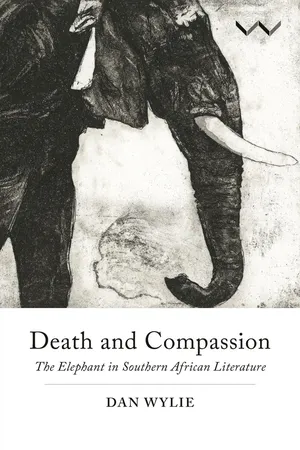
Traces the literary history of the elephant, and its role in South Africa's cultural imaginary
Elephants are in dire straits – again. They were virtually extirpated from much of Africa by European hunters in the eighteenth and nineteenth centuries, but their numbers resurged for a while in the heyday of late-colonial conservation efforts in the twentieth. Now, according to one estimate, an elephant is being killed every 15 minutes. This is at the same time that the reasons for being especially compassionate and protective towards elephants are now so well-known that they have become almost a cliché: their high intelligence, rich emotional lives including a capacity for mourning, caring matriarchal societal structures, that strangely charismatic grace. Saving elephants is one of the iconic conservation struggles of our time.
As a society we must aspire to understand how and why people develop compassion – or fail to do so – and what stories we tell ourselves about animals that reveal the relationship between ourselves and animals. This book is the first study to probe the primary features, and possible effects, of some major literary genres as they pertain to elephants south of the Zambezi over three centuries: indigenous forms, early European travelogues, hunting accounts, novels, game ranger memoirs, scientists' accounts, and poems. It examines what these literatures imply about the various and diverse attitudes towards elephants, about who shows compassion towards them, in what ways and why. It is the story of a developing contestation between death and compassion, between those who kill and those who love and protect.
- English
- ePUB (mobile friendly)
- Available on iOS & Android
eBook - ePub
About this book
Information
Subtopic
African HistoryIndex
Biological SciencesChapter 1
No Simple Sort of Mirror: Compassion and the precolonial
About five million years ago, when the West Coast region of South Africa was a lot more lush than it is today, a flash flood abruptly drowned an extraordinary number of animals. Entombed in mud until phosphate miners uncovered them in the 1950s, the bones of sabre-toothed cats, African bears and short-necked giraffes constitute one of the richest Pliocene-era fossil deposits on the planet.
Among the specimens are the remains of an early four-tusked elephantine species, a gomphothere whose descendants would evolve into the three main genera of modern-day elephants. Four million years ago Mammuthus planifrons roamed the region, twice migrating into Europe and Asia, founding the woolly-mammoth genealogies as well as the Asian elephant. Left behind was the line of Loxodonta, the African elephant. One of them shed a tusk, which fossilised around 130 000 years ago, eventually to be unearthed north of Durban.1 These recent types thus virtually co-evolved with humans and some anthropologists have speculated that humans would not have been able to migrate out of Africa had the elephants not preceded them. Human and elephant histories are deeply entangled from the beginnings of memory itself.
The fossils of the West Coast deposit at Langebaanweg, solidified remnants of once living, eating, fighting, breeding and bleeding creatures, are today carefully preserved beneath a coating of yellowish resin. Rather like these fossils, precolonial stories tend to be extracted from their original contexts, eviscerated of the vivacity of living performance and overlaid with a patina of modern attitudes. Once-oral meanings are simultaneously preserved and occluded, repackaged in literate forms, archived, retold, republished in lavishly illustrated books mostly aimed at children and in simplified tourist brochures and Internet sites. There are various problems, then: the infantilisation of stories that would once have been rich with adult meaning; their reduction to mere moralising; their increasing decontextualisation; and inevitable slippages in translation. Even as we moderns reach back into the past, in the very reaching we alter the nature of what we grasp.
Pre-modern depictions of human-elephant relations are so modified or fragmentary that it is hard to discern attitudes with any certainty. Did the earliest humans evince anything like compassion for the massive mammalians? Can we find traces of compassion for elephants in precolonial stories, folk tales, fables, legends, myths? Was there room for animal compassion in hunter-gatherer societies? What relationships pertain between compassion and reverence, between compassion and taboo? Precolonial societies are often praised for their ecological knowledge and attunement, but does that intimacy eventuate in compassion or just in more effective exploitation, defence or coexistence? Or is compassion effectively a modern invention? Is there, in modern times, a hidden link between compassion and taming, compassion dependent on control, on the reduction if not elimination of threat or necessary usage? How does this modern stance emerge in recent refashionings of the precolonial tales?
The oldest traces of elephant-human relations in southern Africa are those captured in rock art, either painted or chipped out of suitable surfaces. Elephants are depicted less often than many other species. It is hard to decipher these images, distributed across the subcontinent, from the Cederberg in the west to the Drakensberg in the east, from the petroglyphs of Twyfelfontein in Namibia to the life-sized paintings near Mtoko, Zimbabwe. Beliefs about elephants may vary, subtly or widely, from one region or era to another. The elephant, through its sheer size and its inherent danger to humans, probably provoked fearful awe or reverence among all peoples, but it seems unsatisfactory to collapse all images into a single generalised realm of meaning, as Tim Forssman and Ken Gutteridge tend to do in their book Bushman Rock Art:
The elephant is one of the Great Meat Animals and thus is one of the most powerful animals in the bush. Essentially, it contains more n/om [magico-spiritual force] than most other creatures. Bushmen view the elephants as powerful for a number of reasons. Firstly, it is an enormous animal and can be very dangerous. Secondly, Bushmen believe it maintained human qualities from the First Order of Existence, when all animals were human. For example, elephants are very affectionate. During typical herd or parent-offspring interaction they frequently appear to embrace, intertwining trunks, often touching, smelling or rubbing one another. Further, Bushmen perceive that elephant meat is similar to that of humans; they also believe elephants dance, something very important to Bushman society.2
The authors supply no specificity of sources, age or locations, and only a generalised explanation of what they take to be the informing dynamics. The notion that elephants continue to display quasi-human qualities once dominant in a mythical Early Age, when humans and animals were one, seems to be expressed in taboo rather than compassion. In support, Forssman and Gutteridge mention the story of the Elephant Girl, a tale that exists in more than one version, but seems derived in their version from Megan Biesele’s research among the Ju/’hoansi of the Kalahari in Women Like Meat (more on this below). Forssman and Gutteridge credibly suggest that depictions of elephants being pierced by arrows are not hunts as much as they are metaphors for shamanistic acquisition of the elephants’ intrinsic potency; their inclusion of an elephant petroglyph in which the animal is surrounded by obvious therianthropic figures – human-animal hybrids – supports this suggestion. (They do not say so, but this oft-reproduced image is from the Cederberg.)
But the trance-dance interpretation need not exclude the occasional hunt, such as a rare elephant depiction in the Drakensberg.3 Bert Woodhouse’s overview of elephant rock art in When Animals Were People argues for a number of elephant hunt depictions, including of hamstringing as a technique.4 The elephant was obviously a formidable adversary, but not entirely beyond the capacity of arrow- and spear-wielding hunters to subdue, even if it took days of harassing the animal to exhaustion, as in an account from the 1860s.5 Both Khoisan and Xhosa hunters used staked pits for elephants, probably for centuries, and certainly as early as the eighteenth century; somewhat comically, François le Vaillant fell into one in the Outeniqua area in 1782.6 Such colonial-era accounts of indigenous hunting methods may be cautiously extrapolated back in time and across the continent. Killing an elephant would be a rare and therefore powerful event, worthy of rock art depiction.
Woodhouse has also argued that a number of elephant depictions – including examples as far-flung as Harrismith, Piketberg, Uitenhage and Zimbabwe – are associated with rainmaking; he points to trance-associated showers of lines in the vicinity, overarching ‘rainbows’ and preternaturally elongated trunks in some cases.7 The latter features fascinatingly in a painting from the so-called Ebusingata panel, now in the KwaZulu-Natal Museum, Pietermaritzburg. A shamanic therianthropic figure bears ritual objects, including fly whisks, is apparently surrounded by a swarm of bees and sports an elephant’s tusks, trunk and perhaps forefeet. One can only wonder if the living shaman felt that oft-encountered testimony of Bushmen hunters: they can detect or even attract animals through tremors and vibrations in their own bodies – a highly attuned form of somatic empathy, perhaps. Some are sceptical:
‘In my imagination, I become the animal I am stalking’, is linked to the supposed San cosmology that animals derived from humans. The zoologist Charles Handley who hunted with the Ju/’hoansi in 1952 while a member of the Marshall Family Expedition said that hunters ‘could actually think like the animal enough so that they soon knew what its strategy was, where it was going. [It was] not some kind of mystical ability unknown to outsiders[:] the ability to track is learnt, not genetically encoded.8
The empathetic connection with rain and trance is persuasive in some cases, admittedly tentative in others, and certainly not always applicable. Some commentators eschew speculation altogether and settle for mere description, as in Peter Garlake’s treatment of some Zimbabwean rock art:
Through the sheer size of the images, elephants dominate the paintings in many caves. Many are shown in outline only and some are huge – up to 4 m across. The tusks and ears of elephants caused particular problems of representation in profile, the eartips because they lie against the body, the tusks because only one is visible from the side. The ears were therefore represented either by showing the tip breaking and extending beyond the outline of back and head or by adding two quite unrealistic curved mop-like shapes to the top of the head. Mop-eared elephants were almost never drawn in outline only. There is probably some genuinely stylistic and chronological significance to these two sorts of representation. Elephants with ‘mop’ ears in solid paint seem to be altogether cruder, more lifeless and less realistic . . . To judge by superpositions, the solid images are later paintings than the others.9
Garlake believes that each painting ‘was conceived as representing a generalised archetype, not a particular individual’, but some paintings evince a creditable closeness of observation, as in the raised tail of alarm in one Zimbabwean example, the searching, scenting raised trunk in a depiction from the Dordrecht area of the Eastern Cape, or one elephant holding another’s tail in a Cederberg image. Such close observation presumably embodies some form of familiar coexistence; hunting scenes might evince the associated frissons of fear, challenge, excitement or triumph; shamanic scenes might well express bodily felt empathetic resonances or reverential taboo. But these are generalisations and the degree to which any of these ideas entail compassionate action designed to benefit the animals must remain somewhat open.
Edward Eastwood and Cathelijne Eastwood’s Capturing the Spoor, quoted in the introduction to this volume, and Forssman and Gutteridge above, are examples of a commonly used attempt to explicate rock art by reference to recorded oral tales and similar testimonies. These writers make an assumption that ‘sensing through the myths’ and through bodily sensations, an empathy with the animals is established analogous to that interpreted in the rock art.10 But do the myths and tales ‘say’ the same thing as the rock art? As the researcher Janette Deacon writes, ‘neither one is derived from the other’.11 Matthias Guenther similarly argues that the naturalistic rock art cannot be said to be ‘illustrations’ of particular myths and legends, like illustrations accompanying text in modern coffee-table books.12 Biesele convincingly shows, moreover, that the folk tales and legends themselves are ‘no simple sort of mirror’ of their society.13 Hunter-gatherer social organisation is highly variable. Far from being static or unified in their ‘traditions’, those societies were characterised, Guenther writes, by ‘flexibility, fluidity, adaptability, individual autonomy, organisational ability and ambiguity and lack of standardisation of belief’.14 Similarly, Bushman stories or kukummi are impelled by a wide variety of motives; the very term kukummi encompasses all kinds of myth, tale and anecdotal account, rendering Western generic terms such as legend, poem or folk tale of shaky analytical value. Guenther calls the myths ‘hauntingly asocial and pre-cultural’. This may be overstated: products of the imagination, however ‘liminal and surreal’ they may appear, must still somehow be connected to and illuminative of the way a people thinks of itself (its culture). In any event, notably missing from the analyses of Guenther and others is any thorough consideration of the emotional import of stories and representations. It is impossible to divine what the artists felt towards the animals, including elephants, that they were depicting.
Southern African literature is replete with collections of so-called folk tales, stories undying in their appeal, retold and recycled in various formats, sometimes over many decades, tapping the deepest layers of the psyche. Animal tales have always been particularly powerful and vivacious. Ruth Finnegan, the doyenne of oral literature studies, neatly calls this modern-era recycling of tales a ‘snaring into writing’ – new in form, but also ‘the kind of human processing and negotiating that has always been going on everywhere . . . founded in the interaction of many participants, using and negotiating and adapting them in multifarious transformations to a whole variety of purposes’.15 One may be inclined to take the tales for what they are: innovative and vivid collaborations across eras and cultures but, still, some cautionary notes are necessary.
Firstly, the ethnicities these collections purport to illustrate or identify are seldom as stable as they seem, nor are their folk tales as timeless as they are said to be. The ‘Zulu’, for example, came into being as a self-identifying unit only in the eighteenth century, and the name has proved a highly mobile signifier, flexing and narrowing through successive stages of colonial boundary-making and civil wars. This applies even more to larger ostensible groupings such as ‘Bantu’, whose provenance and coherence are matters of intense debate, but whose commonality has often been taken for granted. An example is the volume Bantu Folk Tales from Southern Africa, rewritings by a tireless compiler, Phyllis Savory. Her introductory outline of Bantu migration, her implication that all ‘Bantu’ people somehow think alike and her view that these stories are ‘age-old’ unalloyed transmissions from ‘the deep, dark ages of man’ are all at best doubtful, demonstrably false in some cases and in most others impossible to verify.16
A second caution, though, is that many of these tales have indeed migrated over time and space from one community and group to another, so that similar but variant versions of the same tale can be found across vast swathes of Africa. This means that we need to pay attention to who exactly is involved in the collection or transcription of any particular version.
Thirdly, then, suggestions that there was ever an original story, which might somehow be reproduced, or even referred back to, are usually delusory. Layers and networks of long-transmitted memorised elements are shot through and transmogrified by modern poetics, narrative techniques and print-publication technologies. With both positive and negative effects, this ‘snaring into writing’ has resulted in widespread infantilisation of the tales. What is now often advertised as learning about ‘other’ cultures, began as a cultur...
Table of contents
- Cover
- Title
- Copyright
- Contents
- Acknowledgements
- Introduction: Compassion for elephants?
- 1. No Simple Sort of Mirror: Compassion and the precolonial
- 2. Experiments and Devastation: Early travelogues and the advent of zoology
- 3. A Most Delightful Mania: Hunters’ tales and evasions
- 4. Not Very Good at Remorse: Elephants in fiction
- 5. A Tear Rolled down Her Face: Teen fiction and elephant mind
- 6. Bosses of the Bushveld: Game-ranger memoirs
- 7. Repeatedly Folded Frontier: The ‘field-research memoir’
- 8. The Cult of the Remnant: The elephants of Knysna and Addo
- 9. The Elephant Is Unhappy: Poetry as compassion
- Afterword
- Notes
- Select Bibliography
- Index
Trusted by 375,005 students
Access to over 1.5 million titles for a fair monthly price.
Study more efficiently using our study tools.
Frequently asked questions
Yes, you can cancel anytime from the Subscription tab in your account settings on the Perlego website. Your subscription will stay active until the end of your current billing period. Learn how to cancel your subscription
No, books cannot be downloaded as external files, such as PDFs, for use outside of Perlego. However, you can download books within the Perlego app for offline reading on mobile or tablet. Learn how to download books offline
Perlego offers two plans: Essential and Complete
- Essential is ideal for learners and professionals who enjoy exploring a wide range of subjects. Access the Essential Library with 800,000+ trusted titles and best-sellers across business, personal growth, and the humanities. Includes unlimited reading time and Standard Read Aloud voice.
- Complete: Perfect for advanced learners and researchers needing full, unrestricted access. Unlock 1.5M+ books across hundreds of subjects, including academic and specialized titles. The Complete Plan also includes advanced features like Premium Read Aloud and Research Assistant.
We are an online textbook subscription service, where you can get access to an entire online library for less than the price of a single book per month. With over 1.5 million books across 990+ topics, we’ve got you covered! Learn about our mission
Look out for the read-aloud symbol on your next book to see if you can listen to it. The read-aloud tool reads text aloud for you, highlighting the text as it is being read. You can pause it, speed it up and slow it down. Learn more about Read Aloud
Yes! You can use the Perlego app on both iOS and Android devices to read anytime, anywhere — even offline. Perfect for commutes or when you’re on the go.
Please note we cannot support devices running on iOS 13 and Android 7 or earlier. Learn more about using the app
Please note we cannot support devices running on iOS 13 and Android 7 or earlier. Learn more about using the app
Yes, you can access Death and Compassion by Dan Wylie in PDF and/or ePUB format, as well as other popular books in Biological Sciences & African History. We have over 1.5 million books available in our catalogue for you to explore.