Genocide has been called the crime of crimes and an odious scourge. With millions of victims in the last century alone, it is one of the great moral and political challenges of our age. Despite the challenges, such human cruelty has not stopped. The 21st century is recording its first genocide in Cameroon with only a scanty few raising a finger. The significance of the odious scourge has compelled Tatah Mentan to research on the trajectory of the scourge in Africa over the past centuries. The targeted ongoing mass killings in Cameroon, like those of Rwanda before, have driven the scholar to expand his focus beyond the Holocaust, which had long been the primary case study. In this book, Tatah Mentan explains that these cases were not merely a human catastrophe, nor an atavistic reversion to the barbarism of a past epoch, but rather an event produced by the unfolding of the logic of capitalism itself. This book therefore critically explores the essence of capitalism as genocide in Africa and its consequences on Africans during their colonisation and incorporation into the European-dominated racialised capitalist world system in the late 18th century. It uses multidimensional, comparative methods, and critical approaches to explain the dynamic interplay among social structures, human agency, and terror to explain the connection between structural capitalist terrorism and the emergence of the capitalist world system. Tatah Mentan proposes a genuine participatory democratic alternative to the unending genocide nightmares. Nurturing participatory attitudes, would facilitate and reinforce self-management, and educate and empower individuals and dispossessed and under-represented communities to seek self-determination and democratic participation in the political arena. Tatah Mentan concludes that the same fundamental commitments that urge humanity to promote participatory political democracy should compel them to promote truly inclusive economic democracy as well. Political economists, historians, students, corporate managers and policy makers at national and international levels are invited to share the insights of this book.
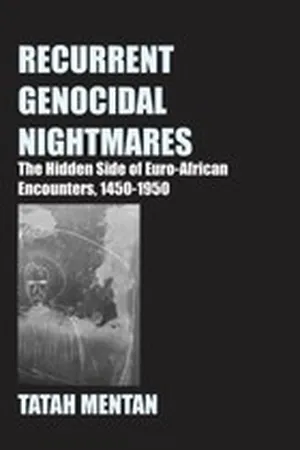
eBook - PDF
Recurrent Genocidal Nightmares
The Hidden Side of Euro-African Encounters, 1450-1950
- 302 pages
- English
- PDF
- Available on iOS & Android
eBook - PDF
About this book
Information
Table of contents
- Cover
- Title page
- Copyright page
- Dedication
- Contents
- Acknowledgement
- Chapter One - Introduction: Understanding the Unthinkable
- Chapter Two - Conceptualizing Capitalism as Structural Genocide
- Chapter Three - Genocide: Slave Raids, Arabic and Trans-Atlantic Slave Trade, and Slavery
- Chapter Four - The Dynamics of European Colonial Genocidal Terror in Africa
- Chapter Five - Exemplifying German Colonial Genocide in South West Africa (Namibia)
- Chapter Six - Theoretical Reprise, Summary, Conclusion and Way Forward
- Bibliography
- Annexture I: The 795th meeting of the AU Peace and Security Council on the African Standby Force (ASF)
- Annexture II: Case study of the life of Gustavus Vassa
- Annexture III: Slavery’s Roots-War and Economic Domination
- Back cover
Trusted by 375,005 students
Access to over 1.5 million titles for a fair monthly price.
Study more efficiently using our study tools.
Frequently asked questions
Yes, you can cancel anytime from the Subscription tab in your account settings on the Perlego website. Your subscription will stay active until the end of your current billing period. Learn how to cancel your subscription
No, books cannot be downloaded as external files, such as PDFs, for use outside of Perlego. However, you can download books within the Perlego app for offline reading on mobile or tablet. Learn how to download books offline
Perlego offers two plans: Essential and Complete
- Essential is ideal for learners and professionals who enjoy exploring a wide range of subjects. Access the Essential Library with 800,000+ trusted titles and best-sellers across business, personal growth, and the humanities. Includes unlimited reading time and Standard Read Aloud voice.
- Complete: Perfect for advanced learners and researchers needing full, unrestricted access. Unlock 1.5M+ books across hundreds of subjects, including academic and specialized titles. The Complete Plan also includes advanced features like Premium Read Aloud and Research Assistant.
We are an online textbook subscription service, where you can get access to an entire online library for less than the price of a single book per month. With over 1.5 million books across 990+ topics, we’ve got you covered! Learn about our mission
Look out for the read-aloud symbol on your next book to see if you can listen to it. The read-aloud tool reads text aloud for you, highlighting the text as it is being read. You can pause it, speed it up and slow it down. Learn more about Read Aloud
Yes! You can use the Perlego app on both iOS and Android devices to read anytime, anywhere — even offline. Perfect for commutes or when you’re on the go.
Please note we cannot support devices running on iOS 13 and Android 7 or earlier. Learn more about using the app
Please note we cannot support devices running on iOS 13 and Android 7 or earlier. Learn more about using the app
Yes, you can access Recurrent Genocidal Nightmares by Tatah Mentan in PDF and/or ePUB format, as well as other popular books in Política y relaciones internacionales & Colonialismo y poscolonialismo. We have over 1.5 million books available in our catalogue for you to explore.