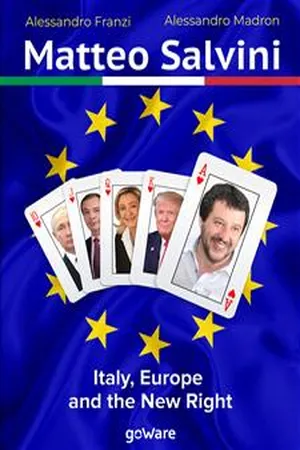
Matteo Salvini is one of the most controversial up-and-coming figures on the European political scene. Since 2013 he has been the leader of Italian Lega - formerly a secessionist party which he himself transformed into the champion of the new nationalist right, a pendulum between Putin and Trump. In 2018 he became both the Vice-Prime Minister and the Minister of the Interior in a coalition government with the populist Five Star Movement. Accused of racism, Salvini has built his success on the social disorientation created by globalization and on the fear of immigration, using an aggressive and irreverent media campaign. But it's also thanks to his political ability, developed during his long militancy in the party, which began when he was 17 years old, that he was able to recognize before others the new spirit of the times. According to most people, after the election in 2018, Salvini had in reality become the leader of Italian politics, with the goal of heading the nationalist front in Brussels after the European elections in May of 2019, and then, the next Italian government. This book is a map that seeks to answer one simple question: who is Matteo Salvini, really?
- English
- ePUB (mobile friendly)
- Available on iOS & Android
eBook - ePub
Matteo Salvini. Italy, Europe and the New Right
About this book
Trusted by 375,005 students
Access to over 1.5 million titles for a fair monthly price.
Study more efficiently using our study tools.
Information
Chapter 1
The Politician
It was two days before Christmas. Matteo Salvini had been the federal Secretary of the Lega Nord for just one week. The assembly held in Torino on December 15, 2013 had handed him the keys to an ailing party. But that day, the new secretary had one priority: he wanted to invite the citizens of Milan to donate blood.
avis, the volunteer donor’s association, was concerned because during the holiday season there were always fewer people willing to give blood and the supply in the metropolitan area was already dwindling.
It was imperative to launch an appeal.
The morning of December 23 was the Monday of Christmas week. Salvini, a long-time member of avis, summoned his fellow party members and journalists to the health center in Largo Volontari del Sangue, in the northeastern suburbs of Milan.
Salvini donated blood. The local party leaders did the same. Including the President of the Lombardy Region, Roberto Maroni, the face representing the Lega in government, who Salvini, the militant leader, had replaced as Party Secretary.
“Come donate blood. Help others with deeds, not just with words.” Salvini’s call to action resonated on social media. It was the way of engaging in politics he had always preferred: taking an everyday problem, getting in the middle of it and making it a reason to mobilize.
For Salvini, donating blood to help his fellow citizens was much more useful than being a bleeding heart full of kind words about the immigrants coming from afar.
But this episode from 2013 didn’t just signal a positioning in policy. It also revealed the new leader’s deep ties with Milan, the city where he was born and raised, and where he had always dreamed of becoming the sheriff-mayor.
In Milan
His Lega Lombarda membership card was issued in 1990. He was 17 years old.
“I remember Salvini from the beginning, he was still in high school at the Liceo Manzoni, and he was part of a small youth group that came to the old headquarters in Via Vespri Siciliani,”[1] recalled Luigi Negri, the province secretary of Milan at the time, who later left the movement in 1995 after having led the Lega Lombarda. “Once a week there was a night dedicated to the youth members. We’d study the issues and organize the public meetings.”
They needed to coordinate putting up posters, distributing brochures on the streets and setting up stands. Two topics were key: the autonomies and the moral question.
“I was a student at Manzoni high school,” remembered Salvini, “surrounded by classmates who were leftists or members of the Communion and Liberation Movement. I was struck by a Lega manifesto that said, ’I am a Lombard and I vote Lombard’; it still hangs in my office. I was fascinated by this theme of being linked to one’s territory: at school they were always talking about left and right, about communists and fascists, but instead I was interested in the idea of identity, autonomy, federalism and community.”[2]
The Lega Nord would only officially be born the following year at the congress in Pieve Emanuele, when Umberto Bossi, who in 1984 had founded the Lega Lombarda, was successful in uniting under his leadership all the different independent factions of the Nord (north) movement.
But even before then, those who belonged to the various sections had one common objective in their dna: to take power and money away from Rome, the central State accused of milking the wealth and fiscal revenues produced by Lombardy, Veneto and Piedmont to maintain the South of Italy, historically more underdeveloped.
It was this economical and cultural gap, which has divided the country since its unification, that Bossi’s Lega was able to capitalize on politically for the first time, as the post-wwii party system entered a crisis. For a long time Bossi had even considered a break in national unity, with a slogan that has never gone out of style: “Masters in our own house.”
However in 1990, as noted by Daniele Vimercati, “biographer” of the first Lega, the movement was already “getting stirred up over what was to become its mantra: no to unregulated immigration.”[3]
At the regional elections that year the Lega had its first boom, one of the signs that the first republic was crumbling. On the national level they got 5.39% of the vote, while becoming the second party in Lombardy with 18.9%, one tenth of a point ahead of the pci (Communist Party) and well ahead of the 14.3% tallied by the psi (Socialist Party). They were only behind the Democrazia Cristiana, the party that had governed Italy from 1948 to 1994, which had received 28.6%.
The year an unknown sympathizer named Salvini decided to join the movement was the same year that marked the turning point for the Lega Nord.
“My life,” Salvini himself would later recount at the peak of his popularity, “changed radically during my fourth year of high school, when I decided to register as a member of the Lega”.[4]
The Barbarians
The chance to put himself to the test came in 1993. He became a candidate for the City Council of Milan, with that typical bit of luck which would always be a part of the future Secretary of the Lega’s destiny.
“Salvini was put on the list because I wanted to focus on young candidates,” sustained Negri, “and I asked, practically demanded, that we add many. They needed to gain experience. But they were all very even-tempered young people, unlike the picture that had been painted of them on the outside.”
Milan was never the center of consensus for the Lega, despite being geographically and symbolically the physical and moral capital of the North. It was said that the civilized Milan was dif...
Table of contents
- Cover
- Title page
- Colophon
- Description
- Introduction
- Chapter 1 The Politician
- Chapter 2 The Leader
- Chapter 3 To the Right
- Chapter 4 The Government
- Chapter 5 The Words
- Chapter 6 The Image
- In Conclusion
- List of names and places
Frequently asked questions
Yes, you can cancel anytime from the Subscription tab in your account settings on the Perlego website. Your subscription will stay active until the end of your current billing period. Learn how to cancel your subscription
No, books cannot be downloaded as external files, such as PDFs, for use outside of Perlego. However, you can download books within the Perlego app for offline reading on mobile or tablet. Learn how to download books offline
Perlego offers two plans: Essential and Complete
- Essential is ideal for learners and professionals who enjoy exploring a wide range of subjects. Access the Essential Library with 800,000+ trusted titles and best-sellers across business, personal growth, and the humanities. Includes unlimited reading time and Standard Read Aloud voice.
- Complete: Perfect for advanced learners and researchers needing full, unrestricted access. Unlock 1.5M+ books across hundreds of subjects, including academic and specialized titles. The Complete Plan also includes advanced features like Premium Read Aloud and Research Assistant.
We are an online textbook subscription service, where you can get access to an entire online library for less than the price of a single book per month. With over 1.5 million books across 990+ topics, we’ve got you covered! Learn about our mission
Look out for the read-aloud symbol on your next book to see if you can listen to it. The read-aloud tool reads text aloud for you, highlighting the text as it is being read. You can pause it, speed it up and slow it down. Learn more about Read Aloud
Yes! You can use the Perlego app on both iOS and Android devices to read anytime, anywhere — even offline. Perfect for commutes or when you’re on the go.
Please note we cannot support devices running on iOS 13 and Android 7 or earlier. Learn more about using the app
Please note we cannot support devices running on iOS 13 and Android 7 or earlier. Learn more about using the app
Yes, you can access Matteo Salvini. Italy, Europe and the New Right by Alessandro Franzi, Alessandro Madron in PDF and/or ePUB format, as well as other popular books in Politics & International Relations & Political Biographies. We have over 1.5 million books available in our catalogue for you to explore.