Dr. Marco Conci, psychiatrist and psychoanalyst, active in the international psychoanalytic community and inhabiting three linguistic and cultural environments (Italian, German, and American), has given us a definitive book on the life and work of Harry Stack Sullivan, the founder of interpersonal psychiatry and psychoanalysis in the United States and other countries. Sullivan continues to animate the interpersonal therapies of psychiatrists and analysts of various schools. In this richly detailed, fascinating and highly readable narrative Dr. Conci combines the passion of a historian with the compassion of a humanistic practitioner of psychiatry and psychotherapy. He also brings us a much needed moral message: to restore the tradition of psychological help to the suffering soul of mankind, an antidote the current medicalization of psychiatry world-wide (Zvi Lothane, M.D., Clinical Professor of Psychiatry, Mount Sinai School of Medicine – New York, USA).
This is a remarkably comprehensive study of Sullivan's milieu, teaching and influence, in the course of which we are treated to nothing less than an ambitious, new perspective on the early history and recent developments of American psychoanalysis. It is, moreover, the unique and valuable perspective of someone who has lived both in America and abroad, and has both the insider's easy familiarity and the outsider's objective eye. It is at once an illuminating study in American intellectual tradition, a detailed study of Sullivan's teaching as understood by an experienced and open-minded clinician, an informative survey of his relationships with other analysts, and a vision of his heritage in the contemporary relational school. It is hard to imagine an analytic reader of any stripe who will not find illumination in areas of special interest, and unexpected profit in areas previously neglected (Lawrence Friedman, M.D., Clinical Professor of Psychiatry, Weill Medical College of Cornell University – New York, USA).
eBook - ePub
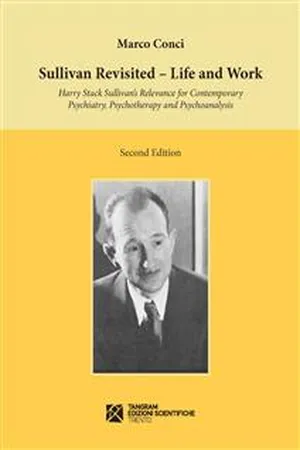
Sullivan Revisited. Life and Work. Harry Stack Sullivan's Relevance for Contemporary Psychiatry, Psychotherapy and Psychoanalysis
- English
- ePUB (mobile friendly)
- Available on iOS & Android
eBook - ePub
Sullivan Revisited. Life and Work. Harry Stack Sullivan's Relevance for Contemporary Psychiatry, Psychotherapy and Psychoanalysis
About this book
Information
Topic
MedicineSubtopic
Social Science BiographiesPart One:
The Historical and Scientific Context of Sullivan’s Life and Work
The Historical and Scientific Context of Sullivan’s Life and Work
Biography usually fails to integrate its subject person with the significant others who facilitated and handicapped his durable achievements as a contributor to cultural history, and rarely indicates whence came his skills and limitations in the interpersonal relations which made his contribution effective… The phenomenon of Freud without its setting in the contemporary society of Vienna has been followed by the phenomena of Freud’s evangelists and Freud’s detractors, also without sensitivity to the nuances of cultural differences within the major context of the Western world… Any person is to a great degree a function of his past interpersonal history, the immediate present, and the well- or ill-foreseen neighboring future. Any people is an interlocking dynamic network of a great many contemporary persons, each with past, present, and neighboring future with considerable identities and similarities – roughly equaling the culture – and some significant differences (Sullivan, BR/1947, p. 216)39.
As Henri Ellenberger (1905-1993) has taught us in The Discovery of the Unconscious. The History and Evolution of Dynamic Psychiatry, a unique book both for the wealth of research it contains and for its methodology, the social, cultural, and historical contexts, including the so-called Zeitgeist40, are naturally of fundamental significance, as are the personalities and the interpersonal relationships of the pioneers of dynamic psychiatry. For this reason, I begin this first chapter not by unfolding Sullivan’s life and the events that will condition his personality and work, but rather by describing the social atmosphere of the Progressive Era, paying particular attention to the emergence of modern American psychotherapy at the turn of the twentieth century41. Specifically, I trace this aspect through the work and influence exerted by William James (1842-1910), James J. Putnam (1848-1918) and Adolf Meyer (1866-1950). Their influence is indeed essential for understanding – as we will do in the second chapter – both the context in which Freud held his famous Five Lectures on Psychoanalysis at Clark University (in Worcester, Massachusetts) in September 1909 and the reception and further development of his work in the “New World”, especially in terms of the specifically American phenomenon of the good reception of psychoanalysis within psychiatry. The third chapter traces Sullivan’s life, and together these first three chapters facilitate focusing more easily on Sullivan’s fellow travelers, the so-called neo-Freudians, whom I will address in the fourth chapter. At this point I will end chapter four by turning to the role Sullivan played in the 1930s and 1940s in the American psychiatric and psychoanalytic scene, as well as the legacy of his writings in their entirety, for the most part published posthumously.
The first step, then, is to attempt to understand how at the turn of the last century certain preconditions would develop in various fields of knowledge, and how the need for modern psychotherapy in American society as a whole came to be felt42.
(39) This is the quote that Helen Perry selected from Sullivan’s review of Chrysatemum and the Sword, written by his friend Ruth Benedict (1889-1948). Perry used it for the Preface to her Sullivan biography (1982, p. XII), and I do the same, in homage to them both.
(40) Henri Ellenberger writes: “It is impossible to understand the personality and work of Carl Gustav Jung without considering his Swiss background and his family” (1970, p. 658). According to the obituary written on Ellenberger by the Editorial Committee of the journal History of Psychiatry, Ellenberger’s work was “arguably the single most important text written to date in psychiatric history” (1993, p. 448).
(41) It is within the Zeitgeist of the Progressive Era that not only this last phenomenon but also Sullivan’s own intellectual background and development – for instance, its clear expression in the progressive orientation of his journal Psychiatry – should be located. For more on key characteristics of this particular phase of American history, see, among others: Maldwyn A. Jones: The Limits of Liberty: American History, 1607-1980. It is worthwhile in this context to point out that Adolf Meyer’s as well as John Dewey’s (1859-1952) social engagement were greatly stimulated by their meeting with one of the protagonists of the “Progressive Era”, Jane Addams, who in 1899 founded Hull House, a social welfare center, in Chicago on South Halsted Street, in the middle of a neighborhood slum (see Jones, 1983, p. 328). Finally, what became set in this socio-political climate is not only this very American pragmatism, but also the initial positive reception of psychoanalysis in the United States.
(42) The definition of the term “psychotherapy” that Umberto Galimberti proposes in his recent book Dizionario di psicologia [Dictionary of psychology] is to be recommended for its conciseness and efficacy. However, Galimberti fails to consider the historical dimension of the development, which, like Ellenberger (1970) I consider fundamentally important and which guides my own work. As Ellenberger writes in his Introduction: “In this way it will appear to the reader that the growth of psychoanalysis and of the newer dynamic systems was not so much a revolution as a gradual evolution from the first dynamic psychiatry to the newer ones” (1970, p. X).
Chapter One: Psychotherapy Takes Hold in North America
Nathan Hale, author of the classic Freud and the Americans: The Beginnings of Psychoanalysis in the United States, 1876-1917, was the first to have put the question “Where should a study of Freud in America begin?” (1971a, p. XIII). And thus, in contrast to other studies that preceded this one, Hale explored in quite an original way “the professional, social, and moral order that determined the American reception of psychoanalysis” (ibidem)43. Indeed, as Hale writes: “Without an analysis of the pre-Freudian order, the nature of Freud’s influence could not be determined” (ibidem, p. XII). In other words, rather than adopt the route inaugurated by Ernest Jones in his Freud biography, which was later adopted also by Shakow and Rapaport (1964) and Burnham (1967), Hale takes on a rigorously historical approach analogous to Ellenberger’s and provides us with two fundamental contributions. First, he clearly demonstrates the reasons for the continuity between psychoanalysis and the pre-existing American psychotherapy, admirably describing its genesis and development, which began within psychology, neurology, and psychiatry. Second, he elaborates the particular type of reception that Freud’s work encountered in North America, thereby decisively contributing to the field of studies that examines the reception of psychoanalysis in individual Western countries, culminating in 1989 with sociologist Edith Kurzweil’s The Freudians: A Comparative Perspective44.
Thus Hale, within this conceptual framework, devotes ample space to the so-called Boston School. In 1832, Boston had welcomed Johann Gaspar Spurzheim (1776-1832) and had become a fertile field of dissemination for the phrenology developed by Spurzheim’s teacher Franz Joseph Gall (1758-1828)45. Here, according to Hale, in the capital of New England and spanning the years from 1885 to 1909, modern American psychotherapy began and gradually took on a specific shape. This goes far in explaining why in 1906 the entry “psychotherapy” is included in the Index Medicus (Hall 1971a, p. 146) and why Morton Prince (1854-1929) founded the Journal of Abnormal Psychology. In May 1909, this same Prince, together with Putnam and Boris Sidis (1868-1923), in front of the participants at the American Medical Association (AMA) meeting in New Haven, summed up for the first time the actual state of psychotherapy (ibidem, p. 147), which Ernest Jones (1879-1958) then echoed in a pioneering contribution on psychoanalysis46.
In other words, as Hale writes, “between 1904 and 1909 psychotherapy became a national medical and popular interest, and psychoanalysis became better known as one of several competing new methods” (ibidem, p. 138).
What exactly was this psychotherapy? Apart from the fact that hypnosis, suggestion, and re-education represented its three principle methods, the issue at hand was the emergence of the new psychopathology that in May 1910 would lead to the foundation of the American Psychopathological Association in Washington, D. C. (ibidem, p. 280). This “new psychopathology” gradually developed as a response to the crisis of the “somatic” style, that is, the organicist approach in neuropsychiatry, which “resulted”, as Hale explains, “from three converging streams of professional activity – medical observations of nervous and mental disorders; new experiments in hypnosis conducted by neurologists, and the research and theory of academic psychologists” (ibidem, p. 98).
And the Boston School? Actually, all three of these currents were palpable in New England and reinforced one another, thanks as well to the fortunate, or at least very productive, personal rapport that developed among those promoting these ideas47. As Hale points out:
William James, Josiah Royce, and Hugo Münsterberg, professors of psychology and philosophy at Harvard, worked with Boston neurologists and psychiatrists. James Jackson Putnam, Harvard’s first professor of neurology, was one of five men whose ‘intellectual companionship’ stimulated William James’s Principles of Psychology, and the major achievements of the Boston school of psychopathologists came after the publication of James’s Principles. James took his students to the psychiatric demonstrations by Adolf Meyer at the Worcester Insane Hospital, and the two men discussed psychiatry and scientific method (ibidem, p. 100).
This, in other words, is how we should examine James’s, Putnam’s, and Meyer’s important roles in founding modern American psychotherapy, as well as their contribution to the reception of psychoanalysis and to Sullivan’s intellectual orientation.
1.1 William James and Functionalism
In speaking of psychotherapy, we are primarily reaching beyond the contrast between healthy and sick; on a psychological level we recognize only a quantitative deviation of processes in the suffering person familiar to us all. In other words, we develop the capacity to identify and empathize with the Other – the definition we are now accustomed to associating with psychoanalysis. For this reason, but based above all on his particular personal vicissitudes, James was a living example of this new mental attitude. Let me provide an overview of my argument. The concept of “conflict” itself, which became the core of the psychoanalytical doctrinal system (see, for instance, Brenner 1976), not only represented (as we will see shortly) a state of mind that James thoroughly experienced in his own lifetime, but also an outlook that emerged systematically from his work48. Indeed, to take this one step further, not only did James, as Hale writes, codify “for a wide public America’s pre-Freudian views of the unconscious” (1971a, p. 109) but, as Shakow and Rapaport write, “in many respects [James] appears to have anticipated Freud’s ideas” (1964, p. 38).
At the same time, writing as I do now from the standpoint of a Zeitgeist different from that of Shakow and Rapaport, and interested as I am in showing the relevance of Sullivan’s work in relation to the problems confronting us today, I can also say that dynamic psychology itself, which for decades tended to be assimilated sic et simpliciter to Freud’s works, had already found in James’s writings a source and foundation which soon enabled the first systematic autonomous formulation of it. Indeed, as Boring writes, “about 1910 Woodworth began to use the expression dynamic psychology” (1950, p. 722). Notably, this was within the scope of the functionalist perspective that Woodworth had learned from James and from Cattell (1860-1940), and which in 1917 led him to present his definition of this new disciplinary sphere in his volume Dy...
Table of contents
- Forewords
- Prefaces
- Introduction
- Part One: The Historical and Scientific Context of Sullivan’s Life and Work
- Part Two: Sullivan’s Relevance Today
- H. S. Sullivan’s Works
- References
- About the Author
Trusted by 375,005 students
Access to over 1.5 million titles for a fair monthly price.
Study more efficiently using our study tools.
Frequently asked questions
Yes, you can cancel anytime from the Subscription tab in your account settings on the Perlego website. Your subscription will stay active until the end of your current billing period. Learn how to cancel your subscription
No, books cannot be downloaded as external files, such as PDFs, for use outside of Perlego. However, you can download books within the Perlego app for offline reading on mobile or tablet. Learn how to download books offline
Perlego offers two plans: Essential and Complete
- Essential is ideal for learners and professionals who enjoy exploring a wide range of subjects. Access the Essential Library with 800,000+ trusted titles and best-sellers across business, personal growth, and the humanities. Includes unlimited reading time and Standard Read Aloud voice.
- Complete: Perfect for advanced learners and researchers needing full, unrestricted access. Unlock 1.5M+ books across hundreds of subjects, including academic and specialized titles. The Complete Plan also includes advanced features like Premium Read Aloud and Research Assistant.
We are an online textbook subscription service, where you can get access to an entire online library for less than the price of a single book per month. With over 1.5 million books across 990+ topics, we’ve got you covered! Learn about our mission
Look out for the read-aloud symbol on your next book to see if you can listen to it. The read-aloud tool reads text aloud for you, highlighting the text as it is being read. You can pause it, speed it up and slow it down. Learn more about Read Aloud
Yes! You can use the Perlego app on both iOS and Android devices to read anytime, anywhere — even offline. Perfect for commutes or when you’re on the go.
Please note we cannot support devices running on iOS 13 and Android 7 or earlier. Learn more about using the app
Please note we cannot support devices running on iOS 13 and Android 7 or earlier. Learn more about using the app
Yes, you can access Sullivan Revisited. Life and Work. Harry Stack Sullivan's Relevance for Contemporary Psychiatry, Psychotherapy and Psychoanalysis by Marco Conci in PDF and/or ePUB format, as well as other popular books in Medicine & Social Science Biographies. We have over 1.5 million books available in our catalogue for you to explore.