The current period of significant and relatively long-term social changes in the Slovak Republic brings the expected positives, but also negative consequences, especially in the social and socio-economic, or in the value area, of the life of an individual, but also for the whole of society.
The knowledge of social reality is one of the important prerequisites for its influence, therefore, we present a partial section of the results of research work by doctoral students from the Slovak Republic and Poland, who study at the Faculty of Education at the Catholic University, in Ružomberok.
We support thus their enthusiasm for scientific work, but also the eminent interest to take control of the tools of scientific research.
In the first part of the publication, the studies are devoted to the socio-educational care for a child in foster care, the caring of a child with severe disabilities and the connection between dysfunctional families and the relationship of the current young generation towards parenthood and towards the family.
The second part is devoted to poverty, its common cause, unemployment and some aspects of the social services in the Slovak environment and in a European context.
The third part consists of externally thematically unrelated studies, which are focused on the behaviour of secondary school students in terms of environmental ethics, on the social work with people engaged in prostitution, on corporate social responsibility, but also on the training of social workers, in Poland. However, they have a common denominator and thus scope for the application of the presented knowledge, in the theoretical and also the practical field of social work.
The variety in the quality of the individual articles, is directly proportional to the length of the individual research carried out by the doctoral students. For all that, we show our joy from their work, we express our gratitude to all the authors for the willingness and courage to have their "skin in the game" and we wish them a lot of successful research and work experience. Tratto dall'Introduzione
- English
- ePUB (mobile friendly)
- Available on iOS & Android
eBook - ePub
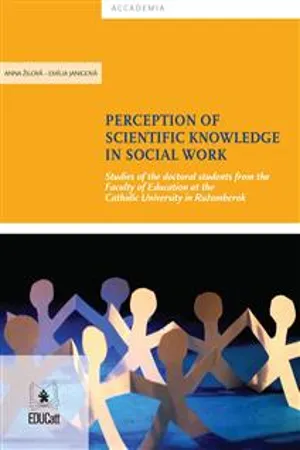
Perception of scientific knowledge in social work
About this book
Information
Topic
EducationSubtopic
Essays in EducationPOVERTY, UNEMPLOYMENT AND
SOCIAL SERVICES
Poverty in Subtatra Region from
Subjective Point of View
Tomáš Šoltýs
Abstract: The author wants to present in this article the results of the research, the aim of which was to examine subjective perception of poverty in Subtatra region among secondary school students. Firstly, theoretical underpinnings are presented in the article with the emphasis on subjective concept of poverty. With the help of statistical data in measuring EU SILC (The European Union Statistics on Income and Living Conditions, further referred to as EU SILC) the author creates an image of existing state of poverty in some of its indicators, especially in Slovakia. In practical part, research in subjective perception of poverty was carried out with the help of quantitative method (questionnaire). The said personal perception of poverty by the respondents was unexpected, because vast majority of them does not consider themselves poor.
Key words: Poverty. Subjective poverty. Poverty indicators.
Poverty and its subjective concept
Poverty is a worldwide phenomenon. People in every country are familiar with it. Certainly every one of us has had contact with poverty as a term or as a social phenomenon. Poverty affects all people, also the ones who are not considered poor.
It is known that in Slovakia the notion of poverty and its lines is not defined by law. The term material insufficiency is used as replacement and it is described in Sec. 2 Law no. 599/2003 Coll. on assistance in material insufficiency. According to European benchmark poverty indicates individuals, families or groups of people, whose material, cultural and social sources are limited to the extent which excludes them from minimally accepted lifestyle of countries in which they live1. According to Novotná and Žilová2 there is no complete and generally respected definition or line of poverty. Perception of poverty and its line may be different in various countries depending on their wealth and economic growth. Therefore, poverty is always defined in relation to standards of a given society. Authors include definition of poverty according to Towsend, which we will shorten, who understands it as “insufficiency of means for lifestyle, activities and living conditions which are common in society to which individuals belong.”
This definition seems to us very adequate in a context of previous statement. Individual who is poor in developed countries of the world does not have to be poor in countries which are poorer. This example presents certain relativity of the term poverty.
The abovementioned perception of poverty and its lines does not only depend on the wealth and economic growth of particular countries, but also on every individual who lives in a given country.
The concept of subjective poverty is based on feelings and evaluation of one’s own life experience regardless of other people’s opinions and specified signs of poverty. It means that an individual who is poor according to objective signs of poverty does not have to feel poor. On the contrary, an individual who is not poor according to objective signs of poverty may feel poor3. Tvrdoň and Kasanová claim similarly4. This concept includes great extent of individuality of perceiving poverty, which can be affected by various factors such as upbringing, moral orientation, environment in which one grows up, etc.
As we have concentrated on a specific region (Subtatra) in our research we must not forget that a matter of poverty is closely related to this factor. As it is generally known, Slovakia in spite of its relatively small size, differs according to region. Especially western Slovakia and vicinity of Bratislava is in great contrast with other regions of Slovakia.
Gerbery et al.5 is of the opinion that poverty is connected with area. It is expressed by increased concentration of excluded individuals and social groups in specific geographical areas, respectively their exclusion from specific area. Novotná and Žilová6 add that not only individuals may be poor, but also indirectly the area they occupy. On the contrary, poverty of a given region may affect individuals. Poverty is regionalised, it is unevenly distributed according to region and it becomes characteristic of a given area. Regions of poverty typically occur in areas with low economic growth, as a result there are no means for investment and accumulation of capital, they have dated economic structure, poor industry, long-term unemployment, poorly developed market, unfavourable demographic composition of society, etc.
New social risks
Keller7 describes typology of poverty according to French sociologist Serge Paugam. According to him, so called integrating poverty was characteristic of changes governing in pre-industrial societies. There were many poor individuals and life in poverty was spread on all generations. Due to the fact that they lived in a society which was poor as a whole, their situation was not exceptional and they were not in any way stigmatised. Along with the development of industrial society this original form of poverty recedes and with continuous economic growth poverty survives in the form of small islands of individuals and small groups of socially disadvantaged. With regard to social growth of all other groups they are disrespectfully perceived as individuals who are unable to adapt to new living conditions. These ind...
Table of contents
- Content
- Introduction
- SOCIAL AND EDUCATIONAL CHILD CARE
- POVERTY, UNEMPLOYMENT ANDSOCIAL SERVICES
- OTHER CONNECTIONSBETWEEN THE LIFEOF SOCIETY AND SOCIAL WORK
Trusted by 375,005 students
Access to over 1.5 million titles for a fair monthly price.
Study more efficiently using our study tools.
Frequently asked questions
Yes, you can cancel anytime from the Subscription tab in your account settings on the Perlego website. Your subscription will stay active until the end of your current billing period. Learn how to cancel your subscription
No, books cannot be downloaded as external files, such as PDFs, for use outside of Perlego. However, you can download books within the Perlego app for offline reading on mobile or tablet. Learn how to download books offline
Perlego offers two plans: Essential and Complete
- Essential is ideal for learners and professionals who enjoy exploring a wide range of subjects. Access the Essential Library with 800,000+ trusted titles and best-sellers across business, personal growth, and the humanities. Includes unlimited reading time and Standard Read Aloud voice.
- Complete: Perfect for advanced learners and researchers needing full, unrestricted access. Unlock 1.5M+ books across hundreds of subjects, including academic and specialized titles. The Complete Plan also includes advanced features like Premium Read Aloud and Research Assistant.
We are an online textbook subscription service, where you can get access to an entire online library for less than the price of a single book per month. With over 1.5 million books across 990+ topics, we’ve got you covered! Learn about our mission
Look out for the read-aloud symbol on your next book to see if you can listen to it. The read-aloud tool reads text aloud for you, highlighting the text as it is being read. You can pause it, speed it up and slow it down. Learn more about Read Aloud
Yes! You can use the Perlego app on both iOS and Android devices to read anytime, anywhere — even offline. Perfect for commutes or when you’re on the go.
Please note we cannot support devices running on iOS 13 and Android 7 or earlier. Learn more about using the app
Please note we cannot support devices running on iOS 13 and Android 7 or earlier. Learn more about using the app
Yes, you can access Perception of scientific knowledge in social work by Emília Janigová, Emília Janigová in PDF and/or ePUB format, as well as other popular books in Education & Essays in Education. We have over 1.5 million books available in our catalogue for you to explore.