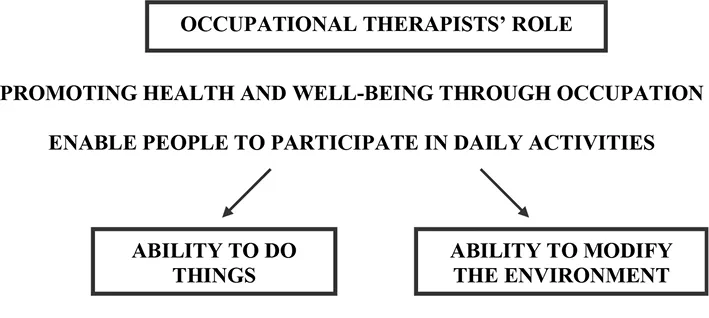
Occupational therapy, or OT, is a profession that promotes health and well-being through occupation.
According to Anne G. Fisher, occupation is:
•The act of mastering or taking possession of something, of occupying time, spaces and roles
•An action or a series of actions in which the subject engages
•A targeted and meaningful action.
Occupational therapy around the world
The primary goal of OT is to enable people to participate in everyday activities. In order to reach this goal, occupational therapists help disabled patients learn how to do activities that enhance their engagement and participation abilities by modifying the environment (see WFOT definition).
The term 'occupational' refers not only to the use of activities and occupations, but also to the idea that disabled people must become the real 'protagonists' of the therapy. Tratto dall'Introduzione dell'Autrice
- English
- ePUB (mobile friendly)
- Available on iOS & Android
eBook - ePub
Occupational therapy for children in the world
About this book
Information
Topic
EducationSubtopic
Essays in EducationChapter 1
Scope and specificity of occupational therapy (OT)
1.1 The concept of occupation
As the name suggests, occupation is the main focus of occupational therapy.
Occupation is a meaningful and scheduled activity, which can be useful or pleasant and whose objective is clear and supported by exact purposes.
This means that therapists must use it as a specific and typical instrument of their profession, from assessment to treatment and outcome evaluation.
The concept of occupation is strictly personal: it stems from and belongs to everyone’s life.
Literature offers a variety of definitions for the term ‘occupation’: “Occupation includes all targeted tasks having a meaning for whom accomplishes them. Occupation and the act of doing something are essential for good health” (Cunningham Piergrossi, 2006).
The occupational sphere includes every performance a person wants and needs to do or an action society expects him/her to complete. In other words, occupation calls people to ‘assume a role’.
The organisation of everyday occupations requires deep thinking and involves individuals at an emotional level: the path towards success can on the one hand generate anxiety and worry and on the other hand stimulate the search for resources and collaborations – especially if the content of the activity is pleasant and the expected result will ultimately give satisfaction.
The type, quality and outcome of occupation elicit a positive or negative judgement of subjects, according to their role and to the expectations that the environment has of them.
Occupation enablement is the very heart of occupational therapy: “Everyone can take part in everyday occupations, in proportion to their potential” (Ianes, Polatajko, 2010).
Occupations can be divided into three key moments of everyday life:
Ø Self-care activities
Ø Production (play-school-work)
Ø Free time
These are also the specific intervention areas of OT. Although each dimension has its own particular features, they all share some basic activities that can be applied to every performance. The cross-beneficial value of such activities is due to the fact that they target body structures, processes and cognitive functions at the same time.
Ø Self-care activities
The main purpose of these activities is to satisfy a primary need: feeding, protecting from hot/cold, washing the body, enjoying physical well-being and regular biological rhythms. These needs are common to all human beings.
Self-care also implies the ability to take care of other people.
This domain includes two kinds of tasks: basic ADLs – that is, Activities of Daily Living linked to personal care – and instrumental ADLs, which consist of:
– Using common spaces and services
– Using and/or driving vehicles
– Housework
– Taking care of other people, objects and environments (physical spaces and nature).
People who are able to manage their autonomy are aware of their needs and know how much time is required to perform an action and how they will be judged if such action is successfully completed. As far as the result of the performance is concerned, they can also tell the difference between the purely instinctive satisfaction of answering a need and the reward for their efforts and for having accomplished something useful and economically valuable.
In brief, achieving independence through self-care entails an age-appropriate cognitive development, a self-control level in line with circumstances and life contexts, an adequate education and a progressive adaptation to the environment in order to experience social integration and relationships.
The benefits of self-care can be split in two major categories:
• Qualitative benefits: sense of beauty, taste for different foods and drinks, need for privacy, gratification of doing something without external help, control on an environment that is regulated by specific cultural codes that make it different and unique
• Ethical benefits: a deliberate containment of drives supported by will, the idea of personal well-being and the replacement of egocentricity with altruism, which means giving equal importance to everyone’s needs.
Acknowledging that other people’s needs are as vital as mine is the very foundation of solidarity and the key to perform useful actions on both a private and community level.
Ø Production (play-school-work)
The main trait of this domain is the ability to fit in an environment subject to clear rules, which are imposed by times, culture and lifestyle.
For a play to be defined as such, it must give pleasure. And in order to experience pleasure, especially in social games, it is indispensable to comply with rules and to accept and manage the competitiveness that makes a play challenging and interesting.
Games evolve from an egocentric phase during childhood to a socialising and rallying function: as participants grow up, they still want to win but they also learn to respect their opponents.
The pleasure of a...
Table of contents
- Acknowledgements
- Index
- Preface
- Introduction
- Chapter 1 Scope and specificity of occupational therapy (OT)
- Chapter 2 Autonomy in everyday life
- Chapter 3 Occupational therapy and school
- Chapter 4 Play and free time
- Chapter 5 OT and family cooperation
- Chapter 6 Assessment and treatment
- Conclusion
- Glossary
- Bibliography
Trusted by 375,005 students
Access to over 1.5 million titles for a fair monthly price.
Study more efficiently using our study tools.
Frequently asked questions
Yes, you can cancel anytime from the Subscription tab in your account settings on the Perlego website. Your subscription will stay active until the end of your current billing period. Learn how to cancel your subscription
No, books cannot be downloaded as external files, such as PDFs, for use outside of Perlego. However, you can download books within the Perlego app for offline reading on mobile or tablet. Learn how to download books offline
Perlego offers two plans: Essential and Complete
- Essential is ideal for learners and professionals who enjoy exploring a wide range of subjects. Access the Essential Library with 800,000+ trusted titles and best-sellers across business, personal growth, and the humanities. Includes unlimited reading time and Standard Read Aloud voice.
- Complete: Perfect for advanced learners and researchers needing full, unrestricted access. Unlock 1.5M+ books across hundreds of subjects, including academic and specialized titles. The Complete Plan also includes advanced features like Premium Read Aloud and Research Assistant.
We are an online textbook subscription service, where you can get access to an entire online library for less than the price of a single book per month. With over 1.5 million books across 990+ topics, we’ve got you covered! Learn about our mission
Look out for the read-aloud symbol on your next book to see if you can listen to it. The read-aloud tool reads text aloud for you, highlighting the text as it is being read. You can pause it, speed it up and slow it down. Learn more about Read Aloud
Yes! You can use the Perlego app on both iOS and Android devices to read anytime, anywhere — even offline. Perfect for commutes or when you’re on the go.
Please note we cannot support devices running on iOS 13 and Android 7 or earlier. Learn more about using the app
Please note we cannot support devices running on iOS 13 and Android 7 or earlier. Learn more about using the app
Yes, you can access Occupational therapy for children in the world by Alda Pellegri in PDF and/or ePUB format, as well as other popular books in Education & Essays in Education. We have over 1.5 million books available in our catalogue for you to explore.