Of the sixty-seven sonnets composed by John Keats fifty are commented here. The number sixty-seven is inclusive of 'Nature withheld Cassandra in the skies', Keats's unfinished translation of Ronsard's sonnet 'Nature ornant Cassandre qui devoyt', and of The Poet, that is not universally acknowledged as composed by Keats. The sonnets proposed thus present an ample spectrum of Keats's sonnet writing and cover the span of his writing career, from 1814 to 1819. The sonnets are commented in chronological order: two belong to the year 1814, three to 1815, seventeen to 1816, six to 1817, thirteen to 1818 and nine to 1819. For each sonnet, the text is presented, followed by the date of composition and of the first publication. An indication of the typology to which the sonnet belongs and of its rhyme scheme is also furnished. The text is based on the editions of Miriam Allott, The Poems of John Keats, Longman, London, 1972 [1970], Jack Stillinger, John Keats: Complete Poems, Harvard University Press, Cambridge, Mass., and London, 1982 [1978], John Barnard, John Keats: The Complete Poems, Penguin Books, London, 1988 [1973], Nicholas Roe, John Keats: Selected Poems, Dent, London, 2000 [1995], and Paul Wright, The Poems of John Keats, Wordsworth Poetry Library, Ware, 2001. For the dating, that proposed by Miriam Allott has been followed. For each sonnet the circumstances of its composition, when known, are referred. The letters of Keats are cited to provide information on the date and on the events surrounding the writing of the poems, to furnish the poet's own comments concerning the sonnets, and to document parallels in wording, images and thoughts, useful for the analysis on hand, as well as other more general observations and reflections of the poet retained to be pertinent for a better understanding of the poems. The edition from which the citations of the letters are taken is that of Grant F. Scott, Selected Letters of John Keats, Harvard University Press, Cambridge, Mass. and London, 2002, integrated, when necessary, by that of Hyder Edward Rollins, The Letters of John Keats 1814-1821, 2 vols., Harvard University Press, Cambridge, Mass., 1958. Other important sources of information regarding the sonnets that have here been used are Richard Monckton Milnes's edition of the life of Keats, Life, Letters and Literary Remains of John Keats, 2 vols., London, 1848, the recollections of Charles Cowden Clarke, Recollections of Writers (1878), Centaur Press, Fontwell, 1969, and the literary remains of the Keats Circle, collected by Hyder Edward Rollins, The Keats Circle: Letters and Papers 1816-1879, 2 vols., Harvard University Press, Cambridge, Mass., 1965 [1948]. For the meanings and significations of specific words, reference has been made to the Oxford English Dictionary, 2nd ed. on CD-ROM (v. 4.0), Oxford University Press, Oxford, 2009. Some of the sonnets have been commented in previous articles and books of the author, in particular in her Il primo Keats: lettura della poesia 1814-1818, Milella, Lecce, 1978, The Letters and Poems of John Keats's Northern Tour, Europrint Publications, Milan, 1997 and John Keats and the Creative Process, Europrint Publications, Milan, 2001, but here the analyses are re-visited, integrated and modified. Tratto dall'Introduzione dell'Autrice
- English
- ePUB (mobile friendly)
- Available on iOS & Android
eBook - ePub
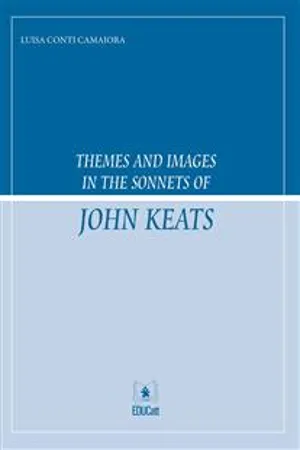
Themes and images in the sonnets of John Keats
About this book
Information
Topic
LetteraturaSubtopic
Critica letteraria ingleseSelected Bibliography
Poetical Works
Allott, Miriam, ed., The Poems of John Keats, Longman, London, 1972 [1970].
Barnard, John, ed., John Keats: The Complete Poems, Penguin Books, London, 1988 [1973].
de Selincourt, E., ed., The Poems of John Keats, Methuen, London, 1926 [1905].
Roe, Nicholas, ed., John Keats: Selected Poems, Dent, London, 2000 [1995].
Stillinger, Jack, ed., John Keats: Complete Poems, Harvard University Press, Cambridge, Mass. and London, 1982 [1978].
Wright, Paul, ed., The Poems of John Keats, Wordsworth Poetry Library, Ware, 2001.
Letters
Scott, F. Grant, ed., Selected Letters of John Keats, Harvard University Press, Cambridge, Mass. and London, 2002.
Rollins, H.E., ed., The Letters of John Keats 1814-21, 2 vols., Harvard University Press, Cambridge, Mass., 1958.
Rollins, H.E., ed., The Keats Circle: Letters and Papers 1816-1879, 2 vols., Harvard University Press, Cambridge, Mass., 1965 [1948].
Biographies
Bate, Walter Jackson, John Keats, Harvard University Press, Cambridge, Mass., 1963.
Colvin, Sir Sidney, John Keats: His Life and Poetry, His Friends, Critics and After-Fame, Macmillan, London, 1917.
Coote, Stephen, John Keats: A Life, Hodder & Stoughton, London, 1995.
Gittings, Robert, John Keats, Heinemann, London, 1968.
Hewlett, Dorothy, Adonais: A Life of John Keats, Hurst & Blackett, London, New York, 1970 [1937].
Motion, Andrew, John Keats, Faber & Faber, London, 1998.
Plumly, Stanley, Posthumous Keats: A Personal Biography, W.W. Norton, New York, 2008.
Ward, Aileen, John Keats: The Making of a Poet, Secker & Warburg, London, 1963.
Memoirs, Recollections, Literary Remains
Cowden Clarke, Charles and Mary, Recollections of Writers (1878), Centaur Press, Fontwell, 1969.
Milnes, Richard Monckton, ed., Life, Letters and Literary Remains of John Keats, 2 vols., London, 1848.
Sperry, Stuart M., Jr., “Richard Woodhouse’s Interleaved and Annotated Copy of Keats’s Poems (1817)”, in Eric Rothstein and Thomas K. Denseath, eds., Literary Monographs, vol. 1, The University of Wisconsin Press, Madison, 1967.
Critical Studies
Barnard, John, John Keats, Cambridge University Press, London and New York, 1993.
Bate, Walter Jackson, The Stylistic Development of Keats, Routledge & Kegan Paul, London, 1958 [1945].
Bennet, Andrew, Keats, Narrative and Audience, Cambridge University Press, London and New York, 1994.
Blackstone, Bernard, The Consecrated Urn: An Interpretation of Keats in Terms of Growth and Form, Longmans, Green and Co., London, New York, Toronto, 1959.
Bloom Harold, The Visionary Company: A Reading of English Romantic Poetry, Doubleday & Company, Garden City, N.Y., 1961.
Brotemarkle, Diane, Imagination and Myths in John Keats’s Poetry, Mellen Research University Press, San Francisco, 1993.
Bush, Douglas, John Keats: His Life and Writings, Weidenfeld and Nicolson, London, 1966.
Bush, Douglas, Mythology and the Romantic Tradition in English Poetry, W.W. Norton, New York, 1963 [1937].
Caldwell, James Ralston, John Keats’ Fancy: The Effect on Keats of the Psychology of His Day, Cornell University Press, Ithaca, New York, 1945.
Cama...
Table of contents
- Contents
- Introduction
- On Peace
- To Lord Byron
- To Chatterton
- Written on the Day that Mr. Leigh Hunt left Prison
- ‘O Solitude, if I must with thee dwell’
- To – [‘Had I a man’s fair form’]
- ‘Woman! when I behold thee flippant, vain’
- ‘Light feet, dark violet eyes, and parted hair’
- ‘Ah, who can e’er forget so fair a being’
- ‘To one who has been long in city pent’
- ‘Oh, how I love, on a fair summer’s eve’
- To my Brother George
- ‘How many bards gild the lapses of time’
- On First Looking into Chapman’s Homer
- ‘Keen, fitful gusts are whispering here and there’
- On Leaving Some Friends at an Early Hour
- To my Brothers
- Addressed to Haydon
- Addressed to the Same [‘Great Spirits’]
- On the Grasshopper and Cricket
- To Georgiana Augusta Wylie
- ‘Happy is England! I could be content’
- ‘After dark vapours have oppressed our plains’
- To Leigh Hunt, Esq.
- Written on a blank space at the end of Chaucer’s tale ‘The Floure and the Leafe’
- On Seeing the Elgin Marbles
- To B.R. Haydon, with a Sonnet Written on Seeing the Elgin Marbles
- On The Story of Rimini
- On the Sea
- On Sitting Down to Read King Lear Once Again
- ‘When I have fears that I may cease to be’
- To – [‘Time’s sea’]
- To the Nile
- ‘Spenser! A jealous honourer of thine’
- ‘O thou whose face hath felt the winter’s wind’
- ‘Four seasons fill the measure of the year’
- To Homer
- On Visiting the Tomb of Burns
- To Ailsa Rock
- ‘This mortal body of a thousand days’
- ‘Read me a lesson, Muse, and speak it loud’
- ‘Why did I laugh to-night?’
- ‘As Hermes once took to his feathers light’
- To Sleep
- ‘Fame like a wayward girl will still be coy’
- ‘How fever’d is the man who cannot look’
- ‘If by dull rhymes our English must be chain’d’
- ‘The day is gone and all its sweets are gone’
- ‘I cry your mercy, pity, love’
- ‘Bright star! Would I were steadfast as thou art’
- Conclusion
- Selected Bibliography
Trusted by 375,005 students
Access to over 1.5 million titles for a fair monthly price.
Study more efficiently using our study tools.
Frequently asked questions
Yes, you can cancel anytime from the Subscription tab in your account settings on the Perlego website. Your subscription will stay active until the end of your current billing period. Learn how to cancel your subscription
No, books cannot be downloaded as external files, such as PDFs, for use outside of Perlego. However, you can download books within the Perlego app for offline reading on mobile or tablet. Learn how to download books offline
Perlego offers two plans: Essential and Complete
- Essential is ideal for learners and professionals who enjoy exploring a wide range of subjects. Access the Essential Library with 800,000+ trusted titles and best-sellers across business, personal growth, and the humanities. Includes unlimited reading time and Standard Read Aloud voice.
- Complete: Perfect for advanced learners and researchers needing full, unrestricted access. Unlock 1.5M+ books across hundreds of subjects, including academic and specialized titles. The Complete Plan also includes advanced features like Premium Read Aloud and Research Assistant.
We are an online textbook subscription service, where you can get access to an entire online library for less than the price of a single book per month. With over 1.5 million books across 990+ topics, we’ve got you covered! Learn about our mission
Look out for the read-aloud symbol on your next book to see if you can listen to it. The read-aloud tool reads text aloud for you, highlighting the text as it is being read. You can pause it, speed it up and slow it down. Learn more about Read Aloud
Yes! You can use the Perlego app on both iOS and Android devices to read anytime, anywhere — even offline. Perfect for commutes or when you’re on the go.
Please note we cannot support devices running on iOS 13 and Android 7 or earlier. Learn more about using the app
Please note we cannot support devices running on iOS 13 and Android 7 or earlier. Learn more about using the app
Yes, you can access Themes and images in the sonnets of John Keats by Luisa Conti Camaiora in PDF and/or ePUB format, as well as other popular books in Letteratura & Critica letteraria inglese. We have over 1.5 million books available in our catalogue for you to explore.