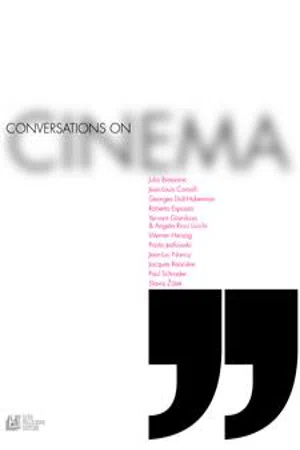
Eleven conversations taken from as many issues of Fata Morgana. Eleven conversations which synthesize the project behind the journal which was born in spring 2006. At the time it was decided against having an editorial comment because of the conviction that if the journal was going to succeed it would speak for itself. However, the time has come to say a few words. A journal is first and foremost a collective gesture whose outline creates a field. The gesture made by Fata Morgana, which at the beginning was only an intuition and then it slowly developed, is the same one that makes cinema a place and an opportunity to think about contemporaneity. It is not simply about what happens around us; it is what emerges from within the events which gather around a concept: from the concept of Bíos (issue No. 0) to the concept of the Sacred (issue No. 10). In this perspective, cinema needs to be interpreted and understood as having its own un-specific specificity. It needs to be interpreted and understood in its principal form where it is capable of categorizing its un-specificity, in other words, its autonomous form where it can categorize its heteronomy. This means thinking about a concept starting from cinema, and thinking about cinema starting from the concept. Thus, cinema becomes a special place and an opportunity to think about the universality of the concept (as a marker of contemporaneity) and the concept becomes the perspective from which to conceive cinema. By avoiding the double edged sword of a sterile specificity or of a self serving un-specificity cinema becomes the quintessential way of thinking about modernity where autonomy of aesthetical form is affirmed in its heteronomy, and its individuation imposes itself as a dis-individuation.
- English
- ePUB (mobile friendly)
- Available on iOS & Android
eBook - ePub
About this book
Information
Topic
ArteSubtopic
FotografíaCould it Be that Cinema Itself Is Contemporaneity?
A Conversation with Jean-Luc Nancy
edited by
Bruno Roberti
“Fata Morgana”, World, No. 1, 2007
You say that jouissance, enjoyment, is a quality of the world which frees it from holding out for another world. Enjoyment produces an excess which allows for something to be left behind so that there may be a residue. You also say that every work of art is a creation of the world. In your opinion, does cinema have this excess of the world? Does the way cinema dissolves the world in order to recreate it in images leave a residue which is, indeed, enjoyment and which exceeds the economy of power inherent to the visions of the world?
Cinema’s specificity lies in the showing, simulating and reproducing the world with its own forms, its colors, its movements. If we look at the history of cinema there are two strong tendencies. One is the tendency to reproduce reality exactly the way it is (L’arrivée d’un train à La Ciotat by the Lumière brothers) and the other is the creation of a completely unrealistic world (Méliès’ Voyage dans la lune). These are the two tensions which have been present in the history of cinema. There are entire periods of history of cinema characterized by one tension or the other. Hollywood, today more than ever, is the cinema of other worlds, fantasy worlds but it is also a cinema of the real world which is not represented through the eyes of realism, but rather through new ways of writing and re-writing the world. In a way, to answer your question, cinema has undoubtedly launched the notion of pleasure, enjoyment, jouissance. The two tensions I was talking about are also two different forms of pleasures; the pleasure of recognition (the excitement of the train that looks like it is coming in the theatre) and the pleasure of the illusion, of the imaginary (which is the origin of cinema as carnival entertainment, as a freak show). However, both tensions postulate real phantoms.
I am reminded of the phantasmagoria, the panorama, the forms of pre-cinema which lay between the pretension to reproduce reality, the invention of photography and the illusionism of imagination. Do you remember what Benjamin wrote about it? There were modern epiphanies, and together they encapsulated the illusionary forms of the representation of the Baroque world. Think of the fetish, the falsehood and the goods, the phantom of the goods, and the “specter” which roamed Europe. In The Creation of the World, with regard to fetish and Marx, you quote Derrida’s Specters of Marx “One would have to say that the phantasmagoria began before the said exchange-value, at the threshhold of the value of value in general.” Thus, if the phantasmagoria of the goods is a value of worth, meaning something that existed before the value of exchange, just as the phantasmagoria-form of entertainment is something that existed before cinema, then it is possible to think of cinema as a place where the goods are pre-existing. A place where the exchange is not an economy of equivalency and, therefore, something remains and resists, and that is the residual enjoyment.
Yes, but what is this pleasure, this enjoyment (jouissance)? Is it right to wonder what was there before cinema? It is not only the phantasmagoria; we have to go back to in time, between the 17th and 18th century, where we find the wonderful theatre, the illusionist scenes of the transforming Baroque ballet. We always find an element of wonder, of phantasmagoria, even if we go further back in time, for example Greek tragedy. The Greek tragedy, which we represent intellectually and aesthetically unilaterally as something bare, simple, essential, with Neoclassical costumes, with Greek ruins in the background and so on, I am convinced that it was a place of illusions, of apparitions, of machines. I am certain that there was pleasure; the pleasure of the surprise when Athena appeared and said, “I am here to administer justice!” This pleasure could not be anything but sacred enjoyment, the rite and the religious ceremony which existed before theatre. In what we call enjoyment (jouissance), fundamentally there is an idea of excess, of going beyond (dépassement), of adding something for nothing; something that when it is added does not complete and does not fulfill anything. It is an addition that does not enrich, that adds nothing; the enjoyment is that extra but it is not added; it does not add up to anything.
Without a reason…
Yes. The characteristic of this addition without reason is that we want it; we want it infinitely.
It is the good infinite.
It is the good infinite, but evidently the good and the bad infinite are glued together. This means that it is always possible to desist, to stop or to overcome; when the film is finished we need to leave. But the good infinite gives a sense that there is something there, an element, a dimension that recalls itself. In French I say redemander, even though this word does not exist in the language. I took it from Valéry when, talking about poetry, he said, “le sens redemande le son” (the sense recalls the sound). In other words, the text, the sense of the text needs to recall, to re-play the sound. The idea of recalling is the pleasure. Hearing the sound, the sounds of the language, of the words again is the poetic pleasure and that releases the sense. When we are in the realm of desire, redemander is a fundamental dimension but for nothing, a request, a recalling of nothing for nothing. Some of this is always present in every art form. Even when the art form proposes a very harsh, strict, painful, tragic thought it never expects the sadness of the spectator, the unhappiness or the pain of the public or of the onlookers. When sadness and displeasure is evoked, there is always a turning point, a trick to divert them. In the context of Contemporary art there are artists who inflict sacrificial gestures upon themselves; they mutilate themselves and so on, but no artist has ever asked the audience or the spectators to sacrifice themselves. In French the term jouissance also has legal meaning: the enjoyment of property (the jouissance de la propriété). Enjoyment as possession or ownership; it is not sexual possession, but, indirectly, we can talk about aesthetic possession. If I go to the cinema and I am enchanted by the film that is al...
Table of contents
- Opening Horizons Over what Is DeniedA Conversation with Roberto Esposito
- Could it Be that Cinema Itself Is Contemporaneity?A Conversation with Jean-Luc Nancy
- Archives that SaveA Conversation withYervant Gianikian and Angela Ricci Lucchi (starting with fragments of their work)
- Transparency that HidesA Conversation with Jean-Louis Comolli
- The Rhythm of ExperienceA Conversation with Paolo Jedlowski
- The Limit as IntervalA Conversation with Julio Bressane
- Being Exposed to NatureA Conversation with Werner Herzog
- The Curved Space of DesireA Conversation with Slavoj Žižek
- Temporality and Memory of the VisualA Conversation with Georges Didi-Huberman
- Reasons for DisagreementA Conversation with Jacques Rancière
- An Anti-Cinema Is Neededto Express the SacredA Conversation with Paul Schrader
Trusted by 375,005 students
Access to over 1.5 million titles for a fair monthly price.
Study more efficiently using our study tools.
Frequently asked questions
Yes, you can cancel anytime from the Subscription tab in your account settings on the Perlego website. Your subscription will stay active until the end of your current billing period. Learn how to cancel your subscription
No, books cannot be downloaded as external files, such as PDFs, for use outside of Perlego. However, you can download books within the Perlego app for offline reading on mobile or tablet. Learn how to download books offline
Perlego offers two plans: Essential and Complete
- Essential is ideal for learners and professionals who enjoy exploring a wide range of subjects. Access the Essential Library with 800,000+ trusted titles and best-sellers across business, personal growth, and the humanities. Includes unlimited reading time and Standard Read Aloud voice.
- Complete: Perfect for advanced learners and researchers needing full, unrestricted access. Unlock 1.5M+ books across hundreds of subjects, including academic and specialized titles. The Complete Plan also includes advanced features like Premium Read Aloud and Research Assistant.
We are an online textbook subscription service, where you can get access to an entire online library for less than the price of a single book per month. With over 1.5 million books across 990+ topics, we’ve got you covered! Learn about our mission
Look out for the read-aloud symbol on your next book to see if you can listen to it. The read-aloud tool reads text aloud for you, highlighting the text as it is being read. You can pause it, speed it up and slow it down. Learn more about Read Aloud
Yes! You can use the Perlego app on both iOS and Android devices to read anytime, anywhere — even offline. Perfect for commutes or when you’re on the go.
Please note we cannot support devices running on iOS 13 and Android 7 or earlier. Learn more about using the app
Please note we cannot support devices running on iOS 13 and Android 7 or earlier. Learn more about using the app
Yes, you can access Conversations on Cinema by De Gaetano Roberto, Slavoj Žižek, Paul Schrader, Jacques Rancière, Jean-Luc Nancy, Paolo Jedlowski, Werner Herzog, Angela Ricci Lucchi, Yervant Gianikian, Roberto Esposito, Georges Didi-Huberman, Jean-Louis Comolli, Julio Bressane in PDF and/or ePUB format, as well as other popular books in Arte & Fotografía. We have over 1.5 million books available in our catalogue for you to explore.