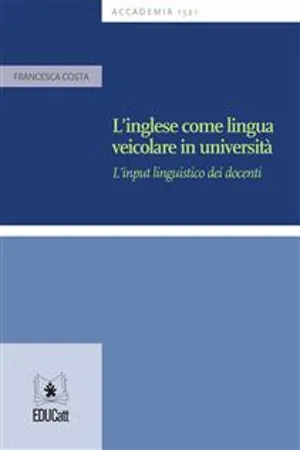
L'apprendimento integrato di lingua e contenuto, in inglese CLIL (Content and Language Integrated Learning), in altre parole l'utilizzo di una lingua straniera per veicolare contenuti, è diventato una tecnica ampiamente usata in tutti i settori educativi in Europa. La prima parte di questa monografia, il capitolo uno, si occupa di definizioni, giustificazioni teoretiche e fattori correlati ai casi in cui il CLIL si è rivelato una pratica efficace, ma si occupa anche dei risultati negativi. Un'intera sezione dedicata alla lingua veicolare nei contesti universitari precede una discussione sulle teorie dell'input, dell'interazione e dell'output, mettendo in evidenza il ruolo chiave dell'input linguistico, ossia la lingua target (inglese) alla quale sono esposti gli studenti. Sono infine descritte le poche ricerche che si sono occupate dell'input dei docenti universitari in ambito CLIL per poi contestualizzare lo scenario italiano come parte di un movimento pan-europeo.
Lo studio inedito che forma la seconda parte del libro, si propone di descrivere e di offrire esempi reali, presi da un corpus autentico di circa venti ore di trascrizioni, di strategie di presentazione dell'input linguistico usate da sei diversi docenti di materie scientifiche cui è stato chiesto di insegnare in inglese attraverso un approccio che può essere definito come CLIL. L'analisi fa riferimento agli studi che hanno diviso in categorie quelle strategie linguistiche che permettono agli insegnanti di facilitare la comprensione in contesti di lingua veicolare. Queste sono: l'uso di esempi, l'uso di sinossi, l'uso di definizioni, l'uso dei sinonimi, le domande e l'enfasi attraverso l'intonazione. Tali categorie sono state ampliate con altre derivanti da studi precedenti. Accanto a un'analisi qualitativa si è scelto di procedere con una quantitativa delle frequenze di occorrenze di queste strategie in modo da potere stabilire se vi fosse un certo grado di variabilità tra i docenti osservati. La triangolazione dei dati è stata completata attraverso delle interviste ai docenti osservati allo scopo di avere una maggiore comprensione dei punti di vista e delle convinzioni dei professori universitari in merito a queste strategie.
La scelta dell'Italia per questa ricerca è dovuta all'incremento di programmi di tipo CLIL negli ultimi dieci anni. Scuole primarie statali bilingui sono state create come progetto pilota in Lombardia (http://www.britishcouncil.org/it/italy-bilingual-education.htm) e recenti riforme e documenti relativi alla scuola secondaria (Legge Moratti, 53/2003; DL 17.10.2010 n. 226) hanno reso obbligatorio l'insegnamento di una materia in inglese durante l'ultimo anno del Liceo, Istituto Tecnico non professionale, e anche a partire dal terzo anno del Liceo Linguistico. Inoltre, una sezione specifica sull'internazionalizzazione è contenuta nella nuova legge italiana per le università (Legge Gelmini, 240/2010).
Per concludere, questa monografia potrà essere di interesse primariamente per tre diversi tipi di pubblico. In primo luogo, gli insegnanti universitari orientati verso la ricerca sulla lingua veicolare. In secondo luogo, la comunità crescente di sostenitori dell'uso della lingua veicolare sempre pronti a documentarsi su un argomento esplorato in maniera inadeguata. Infine, grazie alla sua natura descrittiva e pratica, questo libro fornirà un'utile guida agli insegnanti non anglofoni di discipline non linguistiche oltre che agli insegnanti di lingue, sia universitari sia di altri contesti educativi, che sono chiamati a usare l'approccio CLIL, nonché ai responsabili della loro formazione.
- English
- ePUB (mobile friendly)
- Available on iOS & Android
eBook - ePub
L'ingelse come lingua veicolare in università
About this book
Information
Subtopic
LinguisticsBibliografia
Admiraal, W., Westhoff, G. e de Bot, K. (2006) “Evaluation of Bilingual Secondary Education in the Netherlands: Students’ Language Proficiency in English”, Educational Research and Evaluation, 12, 1, pp. 75-93.
Airey, J. (2009) Science, Language and Literacy, Doctoral Thesis, Uppsala, Uppsala Universitet.
Albert Gomez, M.J. (2007) La investigación educativa: Claves teóricas, Madrid, Mc-Graw-Hill.
Alexander, J.R. (2008) “International Programmes in the German-speaking World and Englishization: a Critical Analysis”, in R. Wilkinson and V. Zegers, (eds) Realizing Content and Language Integration in Higher Education, Maastricht, Universitaire Pers Maastricht.
Alidou, H. (2004) “Medium of Instruction in Post-Colonial Africa”, in J.W. Tollefson e A.B.M. Tsui, (eds) Medium of Instruction Policies. Which Agenda? Whose Agenda?, Mahwah, Lawrence Erlbaum Associates.
Ammon, U. e McConnell, G. (2002) English as an Academic Language in Europe, Frankfurt, Peter Lang.
Annamalai, E. (2003) “Medium of Power: the Question of English in Education in India”, in J.W. Tollefson e A.B.M. Tsui, (eds) Medium of Instruction Policies. Which Agenda? Whose Agenda?, Mahwah, Lawrence Erlbaum Associates.
Anolli, L., Ciceri, R. e Infantino, M.G. (2002) “Behind Dark Ages: Irony as a Strategy for Indirect Communication”, Genetic, Social, and General Psychology Monographs, 128, 1, pp. 76-95.
Argondizzo, C., De Bartolo, A.M., e Ting, T. (2007) “ICLHE: Are Those Who Might, Willing and Prepared? A Quantitative Survey and an In-Depth Qualitative Analysis of Case Studies of ICL Attempts in the University Context”, in R. Wilkinson e V. Zegers, (eds) Researching Content and Language Integration in Higher Education, Maastricht, Universitaire Pers Maastricht.
Baetens Beardsmore, H. (1999) “La consolidation des expériences en éducation plurilingue”, in D. Marsh e B. Marsland, (eds) CLIL Initiatives for the Millenium, Jyväskylä, University of Jyväskylä Continuing Education Centre.
Baetens Beardsmore, H. (2003) “Who is Afraid of Bilingualism?”, in J.M. Dewaele, A. Housen e L. Wei, (eds) Bilingualism: Beyond Basic Principles, Clevedon, Multilingual Matters.
Baker, C. (2001) Foundations of Bilingual Education and Bilingualism, Clevedon, Multilingual Matters.
Barbe, K. (1995) Irony in Context, Amsterdam/Philadelphia, John Benjamins Publishing Group.
Bartik, K., Maerten, C., Tudor, I. e Valcke, J. (2010) A Discussion Brief of Content and Language Integrated Learning (CLIL) at the Faculty of Applied Sciences, Bruxelles, Université Libre de Bruxelles.
Benati, A., Van Patten, B. e Wong, W. (2005) Input Processing & Processing Instruction, Roma, Armando Editore.
Björkman, B. (2011) “Pragmatic Strategies in English as an Academic Lingua Franca: Ways of Achieving Communicative Effectiveness?”, Journal of Pragmatics, 43, pp. 950-964.
Björkman, B. (2008) “English as a Lingua Franca of Engineering: The Morphosyntax of Academic Speech Events”, Nordic Journal of English Studies, 7, pp. 103-122.
Björkman, B. (2011) “So you Think you Can ELF: English as a Lingua Franca as the Medium of Instruction”, Hermes – Journal of Language and Communication Studies, 45, pp. 77-96.
Bogdan, B. (1992) Qualitative Research for Education, Boston, Allyn and Bacon.
Brinton, D. e Snow, M.A. (1990) Content-based Language Instruction, New York, Newbury House.
Brinton, D., Snow, M.A. e Wesche M. (2003) Content-based Second Language Instruction, Michigan Classics Edition.
Burgess, H. Sieminski, S. e Arthur, L. (2006) Achieving Your Doctorate in Education, London, Sage.
Butzkamm, W. (1998) “ Codeswitching in a Bilingual History Lesson: the Mother Tongue as a Conversational Lubricant”, International Journal of Bilingual Education and Bilingualism, 1,2, pp. 81-99.
Carroll, S. (2001) Input and Evidence, Amsterdam/Philadelphia, John Benjamins Publishing Group.
Chaudron, C. (1988) Second Language Classrooms, Cambridge, Cambridge University Press.
Coleman, J.A. (2006) “English-Medium Teaching in European Higher Education”, Language Teaching, 39, 1, pp. 1-14.
Coonan, C.M. (2002) La lingua straniera veicolare, Torino, UTET.
Confederation of EU Rectors’ Conferences and Association of European Universities (1999) The Bologna Declaration on the European Space for Higher Education: an Explanation, (http://ec.europa.eu/education/policies/educ/bologna /bologna.pdf).
Costa, F. (2009) “ICLHE/CLIL at the Tertiary Level of Education. State-of-the-Art”, Studies about Languages, 15, pp. 85-88.
Costa, F. (2011) “Focus on Form in CLIL Lectures”, AILAReview, in stampa.
Costa, F. (2011) “Content Lecturers’ Views of Teaching Through English in a ICLHE Context”, in S. Breidbach e B. Viebrock, (eds) CLIL: Research, Policy and Practice, Frankfürt, Peter Lang, in stampa.
Costa, F. e Coleman, J. (2011) “A Survey of English-Medium Instruction in Italian Higher Education”, International Journal of Bilingual Education and Bilingualism, in revisione.
Costa, F. e Coleman, J. (2011) “What do Students Think Works? Questionnaire On Input Presentation Strategies, in D. Marsh, e O. Meyer, (eds) Quality Interfaces - Examining Evidence & Exploring Solutions in CLIL, Frankfürt, Peter Lang, in stampa.
Costa, F. e Coleman, J. (2010) “Integrating Content and Language in Higher Education in Italy. Ongoing Research”, International CLIL Research Journal, vol. 1, 3, pp. 19-29.
Council of Europe (1995) Council Resolution of 31 March 1995 on Improving and Diversifying Language Learning and Teaching within the Education Systems of the European Union, Brussels, (http://eur-lex.europa.eu/LexUriServ/LexUriServ.do?uri=CELEX:31995Y0812(01):EN:HTML).
Coyle, D. (2007a) “The CLIL Quality Challenge”, in D. Marsh e D. Wolff, (eds) Diverse Contexts-Converging Goals: CLIL in Europe, Frankfürt, Peter Lang.
Coyle, D. (2007b) “Content and Language Integrated Learning: Towards a Connected Research Agenda for CLIL Pedagogies”, International Journal of Bilingual Education and Bilingualism, 10, 5, pp. 543-562.
Coyle, D., Hood, P. e Marsh, D. (2010) CLIL Content and Language Integrated Learning, Cambridge, Cambridge University press.
Crandall, J. e Kaufman, D. (eds) (2002) Content -Based Instruction in Higher Education Settings, Alexandria, VA, TESOL Practice Series.
Crawford Camiciottoli, B. (2005) “Adjusting a Business Lec...
Table of contents
- INDICE
- FOREWORD
- INTRODUZIONE
- CAPITOLO PRIMO
- CAPITOLO SECONDO
- CAPITOLO TERZO
- CAPITOLO QUARTO
- CONCLUSIONI
- TRASCRIZIONI
- Bibliografia
- APPENDIX – Legenda delle trascrizioni
Trusted by 375,005 students
Access to over 1.5 million titles for a fair monthly price.
Study more efficiently using our study tools.
Frequently asked questions
Yes, you can cancel anytime from the Subscription tab in your account settings on the Perlego website. Your subscription will stay active until the end of your current billing period. Learn how to cancel your subscription
No, books cannot be downloaded as external files, such as PDFs, for use outside of Perlego. However, you can download books within the Perlego app for offline reading on mobile or tablet. Learn how to download books offline
Perlego offers two plans: Essential and Complete
- Essential is ideal for learners and professionals who enjoy exploring a wide range of subjects. Access the Essential Library with 800,000+ trusted titles and best-sellers across business, personal growth, and the humanities. Includes unlimited reading time and Standard Read Aloud voice.
- Complete: Perfect for advanced learners and researchers needing full, unrestricted access. Unlock 1.5M+ books across hundreds of subjects, including academic and specialized titles. The Complete Plan also includes advanced features like Premium Read Aloud and Research Assistant.
We are an online textbook subscription service, where you can get access to an entire online library for less than the price of a single book per month. With over 1.5 million books across 990+ topics, we’ve got you covered! Learn about our mission
Look out for the read-aloud symbol on your next book to see if you can listen to it. The read-aloud tool reads text aloud for you, highlighting the text as it is being read. You can pause it, speed it up and slow it down. Learn more about Read Aloud
Yes! You can use the Perlego app on both iOS and Android devices to read anytime, anywhere — even offline. Perfect for commutes or when you’re on the go.
Please note we cannot support devices running on iOS 13 and Android 7 or earlier. Learn more about using the app
Please note we cannot support devices running on iOS 13 and Android 7 or earlier. Learn more about using the app
Yes, you can access L'ingelse come lingua veicolare in università by Francesca Costa in PDF and/or ePUB format, as well as other popular books in Languages & Linguistics & Linguistics. We have over 1.5 million books available in our catalogue for you to explore.