eBook - ePub
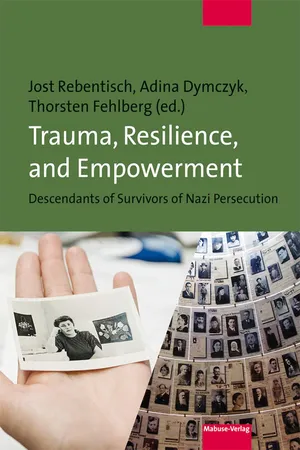
Trauma, Resilience, and Empowerment
Descendants of Survivors of Nazi Persecution
- 211 pages
- English
- ePUB (mobile friendly)
- Available on iOS & Android
eBook - ePub
Trauma, Resilience, and Empowerment
Descendants of Survivors of Nazi Persecution
About this book
Traumas can be passed from one generation to the next - this is well known – and hardly any group is so affected by this phenomenon as the descendants of people persecuted by the Nazis. But just how does this transfer take place? What role do family traditions and continued social practices play? Does genetics have an impact? Furthermore, can the cycle be broken?
The descendants of those persecuted by the Nazis can draw on unique resources and skills. They make significant contributions to political and social reckonings with the Nazi era and they work for the welfare of the survivors. Many are active in political education and advocate for an appropriate culture of remembrance. In a time of increasing right-wing populism, their views are indispensable.
This publication was made possible with support from the German Federal Ministry for Family Affairs, Senior Citizens, Women and Youth.
Information
Topic
PsicologíaSubtopic
Historia del Holocausto“It took me a few years until I understood that I am, as a matter of fact, Jewish”: The Third Generation writ small going large as a generaction
My aim in this essay is to address the diversity of the age cohort ‘third generation.’ How does the inner-Jewish diversity impact the experiences of individuals falling within the age cohort of the third generation? Does the ‘third generation writ small’ demand an extended concept of ‘generation’? Karl Mannheim (1952) and other scholars in his wake had posited that an age cohort needs to share shaping experiences in order to qualify as a generation. Within this logic, the First Generation – writ large – of post-Shoah1 Jews in Germany is defined by their experiences of persecution, terror, and their exposure to the Shoah, while the Second Generation – writ large – is defined by being the children of Shoah survivors, and by having been born and/or raised in Germany. A plethora of sources exists covering the First and the Second Generation, as well as intergenerational transmission from First to Second Generation. The Second Generation psychoanalyst Kurt Grünberg (2007) defined the relationships of First Generation parents, and their Second Generation children as ‘contaminated intergenerativity’, which was defined by the trauma suffered by the First Generation, resulting in dysfunctionalities. By this token, First and Second Generation Jews fit with Mannheim’s concept of generation, although in the worst possible way. They fit with the concept of a community of fate, which they oftentimes, and to date, used in fieldwork conversations to relate to each other, while also questioning if “Maybe as Third Generations you (a Third Generation) are less encumbered than we (First and Second Generation) are, and you (Third Generations) less of a community of fate?”
Nearly two decades before Grünberg’s concept of ‘contaminated intergenerativity’ was published, another Second Generation Jew, Cilly Kugelmann (1988)2, outlined that one needs to consider the specifics of living in Germany among first generation German non-Jews and their children, i.e. the second generation of German non-Jews. Simplified, and from a Jewish perspective, this means living amongst a majority consisting of perpetrators, followers, bystanders, and a few dissidents, which in their totality harboured and transmitted antisemitic attitudes (Schönbach 1961). Contrary to this population, Jews were defined – and trapped – by their victimhood, in which some individual Jewish resistance fighters, as well as the collective Warsaw Ghetto rising, stood out. This common – sense division opens up the issue of locality, and, in particular, that of the German locality: the vast majority of Jews who lived in Germany prior to the migration of Jews from the Former Soviet Union (FSU) consisted of post-Shoah First, Second, and Third Generations. The latter, Third Generations and their ‘co-age-cohortists’, are at the centre of this paper.
While the German locality remains defined by particular Jewish/non-Jewish relations, the relationship is dynamic. Russian-speaking Jews who fall within the age cohort of the Third Generation came to Germany, and, unlike their parents, and their grandparents, arrived at an age that allowed for a relatively easier integration process. These young FSU Jews learned the German language with ease, they attended German schools and continued to study at German universities. German structures, including local Jewish and local non-Jewish structures, became native to them.
Israeli Jews also entered Germany in significant numbers since the mid-2000s. While the majority of these Israelis fall within the ‘Third Generation’ age bracket, their passage and settling in Germany is different to those arriving from the FSU. Coming from a Jewish majority society, and speaking Hebrew natively, defining themselves primarily Israeli as opposed to Jew, the shared parameters that are key to their self – definition (Rebhun, Kranz & Sünker 2015) differ from those of other Jews in the country. 70% of the Israeli Jews define themselves as Ashkenazi (Kranz 2016), a third hold German citizenship, and 54% have significant others, who are German citizen (Rebhun, Kranz & Sünker 2015). This is to say that, while these Israelis are migrants to Germany, and while some define themselves as immigrants, others as emigrants, migrants, or returnees, their way to Germany and into Germany has specific qualities. These qualities may be shared between Israelis, but not with the Russian speaking immigrants of their same age group. An additional differentiation between the two (im)migrant groups comes by ways of their recognition – or non-recognition – as Jews within the Jewish ingroup. In their majority, Israelis tend to be recognised as Jews within the Jewish framework in Germany by way of the status, which the Israeli orthodox rabbinate had provided to them. A significant amount of the same age group arriving from the FSU entered Germany as Jews eligible under the Gesetz über Maßnahmen für im Rahmen humanitärer Hilfsaktionen aufgenommene Flüchtlinge (HumAG) [literally: Law for the measures of refugees accepted under the framework of humanitarian aid] and became Jewish Kontingentflüchtlinge (quota refugees) based on the line ‘Jew’ under section 5 in their Soviet passports. Upon arriving in Germany, these FSU Jews might turn into non-Jews in the process because of different definitions applied by the German state, and the German rabbinate. The rabbinate decides upon eligibility for membership in a Jewish community. Eligibility for membership bases on matrilineal descent, or a recognised (kosher) conversion. Israelis, on the other hand, entered as self-ascribed Israelis but became categorical Jews in the process, because they fit with local rabbinical definitions of who is a Jew. The opening quote by the Israeli (Jewish) artist Adi Liraz exemplifies this scenario.
All of this diversity, the conflicting definitions, and competing discourses, prompted me to approach the question as to whether a third generation exists, if so, how this ‘generation’ can be conceptualised. If it exists, then does it need to be written small as the locally raised Third Generations comprise of just one cacophonous nuance within a diverse, increasingly cacophonous general Jewish choir of third generation age cohortists, nevertheless seeking empowerment as Jews, Germans, immigrants, Israelis, post-soviet Jews or something else, that lies beyond, or conflates, these neat categorical vehicles? This analysis filters in that Jews remain constitutive others within German, non-Jewish, society, who at the same time grapple with their internal diversity of Jewishnesses, which might clash with Jewish empowerment across Third Generations, Russian speaking Jewish incomers, and Israeli Jewish citizens: I will argue that they can be conceptualised as a ‘generaction’.
The above questions seem more pressing as Jews are bequeathed with symbolic investments by post-war German society (Kranz 2018a; van Rahden 2015). Officially, Antisemitism was replaced by philosemitism domestically (Kreft 2010), and with philozionism within international relations (O’Dochartaigh 2007). Yet, as voluminous research output has evidenced, Antisemitism continued and continues to exist in Germany. The first such study was published as early as 1961, and it evidenced that Antisemitism prevailed, and that it was passed on intergenerationally (Schönbach 1961). This find is the more important to recognise at present, as it underlines that debates about ‘migrant’ and ‘Muslim’ Antisemitism need to be seen very carefully. A much more recent study laid bare the sheer number of Germans who do not see a Jew a ‘real’ German (Ipsos 2017, p. 11), further emphasising that Antisemitism prevails. Still, and despite the claim that (Muslim) migrants are primarily to blame for Antisemitism being fallacious, the migrants arriving to Germany brought their own respective versions of Antisemitism with them (Arnold & König 2016). This is not to say that migrants are necessarily more antisemitic than veteran Germans, but it depicts the complex, multifaceted concept of Antisemitism, which unfortunately continues to resonate with different groups, for different reasons. Antisemitism is shaped by cultural parameters (Kranz 2018a) Jews in Christian dominated European (Chirot & Reid 1997) and in Muslim societies (Anidjar 2003) are defined as ‘significant others’, but the ‘other’ means different things in different societies. Jews, as such, are subject to interpretations as well as projections by the majority as Jews, historically, were always in a vulnerable minority situation.
Zygmunt Bauman (1998) referred to this phenomenon as allosemitism, the Semitic other (allos meaning ‘other’ in Greek). Notions about the Semitic other, the Jew, are located between philosemitism and Antisemitism, both extremes existing concurrently. These notions are independent of real, living Jews, but they have an impact on real, living Jews. Such an impact may include murder in the worst case, or more commonly, in post-Shoah Germany, structural inequality, or a superimposed participation within a theatre of memories (Bodemann 1996), and a demand towards Jews to perform specific, allocated, roles for non-Jewish audiences (Czollek 2018). Some of these issues directly relate to Israel, and the discursively-constructed refugee crisis in present day Germany (Kranz 2018a). Indeed, only the mass migration of mainly Muslim migrants since 2015 led to the tipping point of appointing (non-Jewish) commissioners for Antisemitism and for Jewish life on federal and state levels (incumbent on a federal level since May 2018, emphasis added). Jews, diverse as they are internally, are externally lumped together as ‘others’ warranting protection, and as a minority whose survival is a raison d’être for Germany. Even so, all along, Antisemitism remains a toxic part of everyday German discourse across different resident groups, and Jews become increasingly victims of symbolic violence, verbal hate crimes (Schwarz-Friesel 2018)3, as well as physical violence (RIAS 2018). How does this mix of factors, background, locality, the past in the present, and empowerment impact Jews in general, and the age cohort belonging to the Third Generations in particular?
New Jewish Life!
Between the advent of the 1990’s and its (near) suspension in 2004, Jews from the countries of the FSU entered Germany as quota refugees, owing to a specific legal permission within the unification treaty between the Federal Republic of Germany (FRG) and the German Democratic Republic (GDR). Issues regarding both the immigration and the Jewishness of the immigrants soon emerged: Soviet passports carried nationality ‘Jew’ under section 5. This nationality was typically passed on by the father, and not by the mother, who is decisive for classification under Jewish law, as interpreted by the dominant Jewish religious authorities in Germany (and Israel). The immigrants swerved between being desirable Jews and being less desirable Russians for the Jewish ingroup, and the surrounding German society (cf. collected volume by Körber 2015).
To complicate matters further, the Jews arriving from the FSU had been the victors over Nazi Germany according to FSU master narrative: Atrocities against Jews by German forces and their allies had a lesser part in FSU historiography. While not all FSU incomers adhered to this FSU master narrative, those who self-defined as victors contradicted the German master narrative about Jews as victims in Germany, a narrative shared by German non-Jews and Jews in Germany alike. Franziska Becker (2001) evidenced that ‘Russian’ Jews amended their biographies to accord with the ‘German’ and the ‘German Jewish’ master narrative of Jews as victims so as to increase their credibility as Jews on location. Her find ruffled feathers as it touches by default upon Jewish/non-Jewish relations, a politically fraught area. In the wake of the Shoah, and owing to the survivor majority in Germany, Jews had been constructed as victims by default, despite some well – known cases of individual Jewish resistance fighters like Jean Améry, collective resistance like the Warsaw Ghetto Uprising, and the presence of Jewish soldiers in not only the Russian, but also the British, French, and US armies. Another narrative was also challenged: that of the choice of migration to Israel above all other countries. ‘Russian’ Jews, as they became known in Germany, came to Germany in larger numbers than to Israel (Schütze 1997). Unrest loomed as FSU Jews challenged the status quo in Germany and beyond, triggering a renegotiation of the realities of Jewish life in Germany.
Until the FSU immigration, the Jewish population of West Germany had been ageing and shrinking. Only around 30,000 Jews were registered members...
Table of contents
- Cover
- Title
- Copryright
- Content
- Preface
- Introduction and Initiation into the Subject Area
- Continuities and Discrimination
- Transgenerational Transmission
- Traditions, Narratives, and Biographies
- Practice and Processing
- Treatment and the Future
- Epilogue
- Biographies of the Authors and Editors
Trusted by 375,005 students
Access to over 1.5 million titles for a fair monthly price.
Study more efficiently using our study tools.
Frequently asked questions
Yes, you can cancel anytime from the Subscription tab in your account settings on the Perlego website. Your subscription will stay active until the end of your current billing period. Learn how to cancel your subscription
No, books cannot be downloaded as external files, such as PDFs, for use outside of Perlego. However, you can download books within the Perlego app for offline reading on mobile or tablet. Learn how to download books offline
Perlego offers two plans: Essential and Complete
- Essential is ideal for learners and professionals who enjoy exploring a wide range of subjects. Access the Essential Library with 800,000+ trusted titles and best-sellers across business, personal growth, and the humanities. Includes unlimited reading time and Standard Read Aloud voice.
- Complete: Perfect for advanced learners and researchers needing full, unrestricted access. Unlock 1.5M+ books across hundreds of subjects, including academic and specialized titles. The Complete Plan also includes advanced features like Premium Read Aloud and Research Assistant.
We are an online textbook subscription service, where you can get access to an entire online library for less than the price of a single book per month. With over 1.5 million books across 990+ topics, we’ve got you covered! Learn about our mission
Look out for the read-aloud symbol on your next book to see if you can listen to it. The read-aloud tool reads text aloud for you, highlighting the text as it is being read. You can pause it, speed it up and slow it down. Learn more about Read Aloud
Yes! You can use the Perlego app on both iOS and Android devices to read anytime, anywhere — even offline. Perfect for commutes or when you’re on the go.
Please note we cannot support devices running on iOS 13 and Android 7 or earlier. Learn more about using the app
Please note we cannot support devices running on iOS 13 and Android 7 or earlier. Learn more about using the app
Yes, you can access Trauma, Resilience, and Empowerment by Jost Rebentisch, Adina Dymczyk, Thorsten Fehlberg, Jost Rebentisch,Adina Dymczyk,Thorsten Fehlberg in PDF and/or ePUB format, as well as other popular books in Psicología & Historia del Holocausto. We have over 1.5 million books available in our catalogue for you to explore.