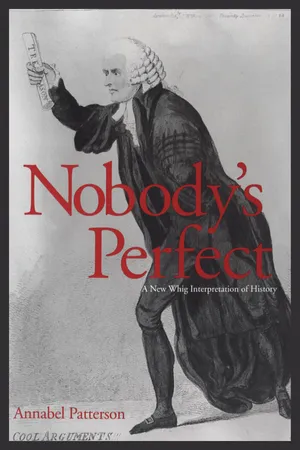
Is history driven more by principle or interest? Are ideas of historical progress obsolete? Is it unforgivable to change one’s mind or political allegiance? Did the eighteenth century really exchange the civilizing force of commercial advantage for political conflict? In this new account of liberal thought from its roots in seventeenth-century English thinking to the end of the eighteenth century, Annabel Patterson tackles these important historiographical questions. She rescues the term “whig” from the low regard attached to it; denies the primacy of self-interest in the political struggles of Georgian England; and argues that while Whigs may have strayed from liberal principles on occasion (nobody’s perfect), nevertheless many were true progressives.
In a series of case studies, mainly from the reign of George III, Patterson examines or re-examines the careers of such prominent individuals as John Almon, Edmund Burke, Sir Joshua Reynolds, Thomas Erskine, and, at the end of the century, William Wordsworth. She also addresses a host of secondary characters, reshaping our thinking about both well-known and lesser figures of the time. Tracking a coherent, sustained, and adaptable liberalism throughout the eighteenth century, Patterson overturns common assumptions of political, cultural, and art historians. The author delivers fresh insights into the careers of those who called themselves Whigs, their place in British political thought, and the crucial ramifications of this thinking in the American political arena.
Annabel Patterson is Sterling Professor of English, Yale University.