Thanks to the digital revolution, even a traditional discipline like philology has been enjoying a renaissance within academia and beyond. Decades of work have been producing groundbreaking results, raising new research questions and creating innovative educational resources. This book describes the rapidly developing state of the art of digital philology with a focus on Ancient Greek and Latin, the classical languages of Western culture. Contributions cover a wide range of topics about the accessibility and analysis of Greek and Latin sources. The discussion is organized in five sections concerning open data of Greek and Latin texts; catalogs and citations of authors and works; data entry, collection and analysis for classical philology; critical editions and annotations of sources; and finally linguistic annotations and lexical databases. As a whole, the volume provides a comprehensive outline of an emergent research field for a new generation of scholars and students, explaining what is reachable and analyzable that was not before in terms of technology and accessibility.
eBook - ePub
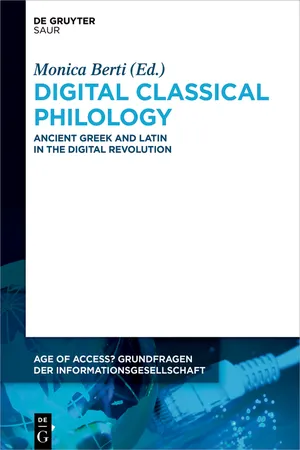
Digital Classical Philology
Ancient Greek and Latin in the Digital Revolution
- 362 pages
- English
- ePUB (mobile friendly)
- Available on iOS & Android
eBook - ePub
About this book
Information
Subtopic
Computer Science GeneralIndex
HistoryIntroduction
Classicists often regard intertextuality as a relationship between two short pieces of text in two different works, following from the tradition of finding loci similes.1 But not always. The study of window references, for one, considers a receiving text that borrows from another one, which itself borrows from a previous one.2 The question this article poses is: what happens if we extend our consideration from the short span studied in a window reference to the long, varied life of a piece of language? Scholars of reception studies have proposed developing reception histories for individual texts.3 Can we possibly, and profitably, develop long histories of short sections of text?
A simple answer would be, “yes,” since scholars have already done it. Consider Sergio Audano’s 2012 book, Classici lettori di classici: da Virgilio a Marguerite Yourcenar.4 Audano traces the legacy of two Vergilian phrases. The first is Vergil’s praise of a civilized life, with the phrase inventas aut qui vitam excoluere per artis (Aen. 6.663). Audano follows this phrase all the way down to the (non-hexametrical) motto on Nobel prize medals in medicine, sciences, and literature: inventas vitam iuvat excoluisse per artas. The second regards patriotism and the desire for glory: vincet amor patriae laudumque inmensa cupido (Aen. 6.823). Audano’s study shows, among other things, the continuing influence and adaptation of Vergilian thought, as well as the elements of the Roman and classical traditions Vergil’s thought conveys.
Can we undertake the sort of reading Audano performs with phrases less celebrated than those that appear on Nobel prize medals, where the imitation is more subtle? Can we do it on a still larger scale, ensuring that we capture (nearly) every instance, in a way that illuminates each of the contexts in which it appears? This article will argue “yes” here as well.
To demonstrate how we can readily find the recurrence of echoing phrases over many texts, this article will show how a suite of digital methods were employed that make such detection possible. Information about these methods can enable scholars who want to carry out such investigations, or at least provide a starting point for the discussion of best practices.
To demonstrate that this way of studying intertextuality can be enlightening, this article offers the case study of one echoing phrase, emanating again from the Aeneid. Here we will see a familiar type of influence, where subsequent poets are plainly borrowing from Vergil with nods to and variations on their predecessor. We will also consider the raw poetic materials from which Vergil forged his phrase. And we will discover instances where the phrase seems to pass beyond the realm of poetic imitation, or even generic language, to become a constellation of ideas and images that float free into the thought-world drawn on by later poets and even prose authors. In these last cases, the conceptual cluster remains distinctive, but the link to the Aeneid fades all but entirely.
Considering this wide swath of textual relationships together brings us to a model of intertextuality different from the common one mentioned above. It is a conception that does not always privilege the source text as generative of meaning, since the language at times breaks free from the source. What remains distinctive are some of the essential components of the phrase that, in this case, a canonical author forged, but carry on living, as it were, beyond a discernible relationship with that author’s text, to become what we might call a viral phrase.5
The successful genotype: Aeneid 12.67–69
In the closing book of Vergil’s Aeneid, facing the defeat of the Latin forces at the hands of Aeneas and his Trojans, Turnus proposes to meet Aeneas in single combat to decide the conflict. Turnus’s potential mother-in-law Amata bemoans his plan, implying that Turnus might lose by saying that she does not want to see Aeneas as her son-in-law. Standing nearby, Turnus’s intended bride, Lavinia, blushes:
Indum sanguineo veluti violaverit ostro
siquis ebur, aut mixta rubent ubi lilia multa
alba rosa, talis virgo dabat ore colores.
Aeneid 12.67–69
As when someone stains Indian ivory with crimson dye, or white lilies blush when mingled with many a rose – such hues her maiden features showed.6
Just what this blush means has been much debated. Lavinia could be a modest maiden blushing at the thought of marriage, especially to an enemy of her supposed betrothed. She could feel self-conscious because Turnus gazed at her, she believes she is causing strife, or she is in love with Turnus.7 My focus in this article will not be on these causes, but rather on the imagery Vergil employs to describe Lavinia’s blush, in particular the white and red flowers.8
This passage came to my attention through an exploratory search comparing Vergil’s Aeneid and Prudentius’ Psychomachy using the Tesserae multi-text tool. Tesserae provides a website that allows for various forms of intertextual search in Greek, Latin, and English.9 The multi-text tool allows users to find similar phrases in two works, and then find other locations in a selected corpus where the common language from the first two texts also occurs. My search found that this passage of the Aeneid resembled one in the Psychomachy, as well as numerous others. To complement the Tesserae findings, I also searched the Packard Humanities Institute Latin corpus for similar words, employed the “Cited Loci of the Aeneid” tool published by Matteo Romanello, searched Google Books, and consulted the 2012 commentary on Aeneid 12 by Richard Tarrant.10 In the readings below, I will indicate in the notes where I found each parallel in order to demonstrate how search methods can be combined to develop readings of viral intertexts.
DNA fragments: Ennius and Propertius
In Latin literature prior to Vergil, we find disparate elements of his Lavinia image. Ennius had compared a blush (whose we don’t know) to milk mixed with purple dye.11
et simul erubuit ceu lacte et purpura mixta.Annales 361 Sk.
And she blushed then like milk and crimson mingled.12
As in this case, sources prior to Vergil contrast the colors white and red, but do not connect lilies and roses with blushing.13 This seems to be true of Greek literature as well. The two most common Greek words for lily (κρίνον) and rose (ῥόδον) appear together in only three passages prio...
Table of contents
- Title Page
- Copyright
- Contents
- Editor’s Preface
- Introduction
- Open Data of Greek and Latin Sources
- The Digital Latin Library: Cataloging and Publishing Critical Editions of Latin Texts
- Sustaining Linked Ancient World Data
- Cataloging and Citing Greek and Latin Authors and Works
- The CITE Architecture: a Conceptual and Practical Overview
- The Canonical Text Services in Classics and Beyond
- Data Entry, Collection, and Analysis for Classical Philology
- Character Encoding of Classical Languages
- Building a Text Analysis Pipeline for Classical Languages
- Intertextuality as Viral Phrases: Roses and Lilies
- Critical Editing and Annotating Greek and Latin Sources
- eComparatio – a Software Tool for Automatic Text Comparison
- The Homer Multitext within the History of Access to Homeric Epic
- Historical Fragmentary Texts in the Digital Age
- Linguistic Annotation and Lexical Databases for Greek and Latin
- The Project of the Index Thomisticus Treebank
- Semantic Analysis and Thematic Annotation
- Notes on Contributors
- Index
Trusted by 375,005 students
Access to over 1.5 million titles for a fair monthly price.
Study more efficiently using our study tools.
Frequently asked questions
Yes, you can cancel anytime from the Subscription tab in your account settings on the Perlego website. Your subscription will stay active until the end of your current billing period. Learn how to cancel your subscription
No, books cannot be downloaded as external files, such as PDFs, for use outside of Perlego. However, you can download books within the Perlego app for offline reading on mobile or tablet. Learn how to download books offline
Perlego offers two plans: Essential and Complete
- Essential is ideal for learners and professionals who enjoy exploring a wide range of subjects. Access the Essential Library with 800,000+ trusted titles and best-sellers across business, personal growth, and the humanities. Includes unlimited reading time and Standard Read Aloud voice.
- Complete: Perfect for advanced learners and researchers needing full, unrestricted access. Unlock 1.5M+ books across hundreds of subjects, including academic and specialized titles. The Complete Plan also includes advanced features like Premium Read Aloud and Research Assistant.
We are an online textbook subscription service, where you can get access to an entire online library for less than the price of a single book per month. With over 1.5 million books across 990+ topics, we’ve got you covered! Learn about our mission
Look out for the read-aloud symbol on your next book to see if you can listen to it. The read-aloud tool reads text aloud for you, highlighting the text as it is being read. You can pause it, speed it up and slow it down. Learn more about Read Aloud
Yes! You can use the Perlego app on both iOS and Android devices to read anytime, anywhere — even offline. Perfect for commutes or when you’re on the go.
Please note we cannot support devices running on iOS 13 and Android 7 or earlier. Learn more about using the app
Please note we cannot support devices running on iOS 13 and Android 7 or earlier. Learn more about using the app
Yes, you can access Digital Classical Philology by Monica Berti in PDF and/or ePUB format, as well as other popular books in History & Computer Science General. We have over 1.5 million books available in our catalogue for you to explore.