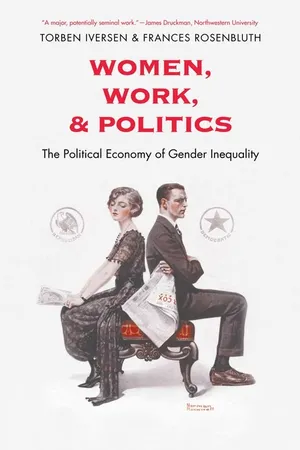
Women, Work, and Politics
The Political Economy of Gender Inequality
- 288 pages
- English
- PDF
- Available on iOS & Android
Women, Work, and Politics
The Political Economy of Gender Inequality
About this book
Looking at women's power in the home, in the workplace, and in politics from a political economy perspective, Torben Iversen and Frances Rosenbluth demonstrate that equality is tied to demand for women's labor outside the home, which is a function of structural, political, and institutional conditions. They go on to explain several anomalies of modern gender politics: why women vote differently from men; why women are better represented in the workforce in the United States than in other countries but less well represented in politics; why men share more of the household work in some countries than in others; and why some countries have such low fertility rates.
The first book to integrate the micro-level of families with the macro-level of national institutions, Women, Work, and Politics presents an original and groundbreaking approach to gender inequality.
Frequently asked questions
- Essential is ideal for learners and professionals who enjoy exploring a wide range of subjects. Access the Essential Library with 800,000+ trusted titles and best-sellers across business, personal growth, and the humanities. Includes unlimited reading time and Standard Read Aloud voice.
- Complete: Perfect for advanced learners and researchers needing full, unrestricted access. Unlock 1.4M+ books across hundreds of subjects, including academic and specialized titles. The Complete Plan also includes advanced features like Premium Read Aloud and Research Assistant.
Please note we cannot support devices running on iOS 13 and Android 7 or earlier. Learn more about using the app.
Information
Table of contents
- CONTENTS
- PREFACE
- ACKNOWLEDGMENTS
- 1. A Political Economy Approach to Gender Inequality
- 2. The Structure of Patriarchy: How Bargaining Power Shapes Social Norms and Political Attitudes
- 3 .The Gender Division of Labor, or Why Women Work Double Shifts
- 4 .Fertility
- 5. Political Preferences
- 6. Gender and Political Careers: A Comparative Labor Market Analysis of Female Political Representation
- 7. Conclusions
- NOTES
- REFERENCES
- INDEX