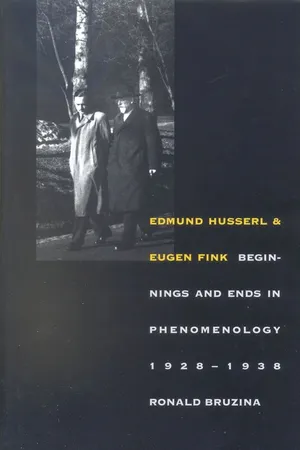
Edmund Husserl and Eugen Fink
Beginnings and Ends in Phenomenology, 1928?1938
- 658 pages
- English
- PDF
- Available on iOS & Android
About this book
Eugen Fink was Edmund Husserlâs research assistant during the last decade of the renowned phenomenologistâs life, a period in which Husserlâs philosophical ideas were radically recast. In this landmark book, Ronald Bruzina shows that Fink was actually a collaborator with Husserl, contributing indispensable elements to their common enterprise.
Drawing on hundreds of hitherto unknown notes and drafts by Fink, Bruzina highlights the scope and depth of his theories and critiques. He places these philosophical formulations in their historical setting, organizes them around such key themes as the world, time, life, and the concept and methodological place of the âmeontic,â and demonstrates that they were a pivotal impetus for the renewing of âregress to the originsâ in transcendental-constitutive phenomenology.
Frequently asked questions
- Essential is ideal for learners and professionals who enjoy exploring a wide range of subjects. Access the Essential Library with 800,000+ trusted titles and best-sellers across business, personal growth, and the humanities. Includes unlimited reading time and Standard Read Aloud voice.
- Complete: Perfect for advanced learners and researchers needing full, unrestricted access. Unlock 1.4M+ books across hundreds of subjects, including academic and specialized titles. The Complete Plan also includes advanced features like Premium Read Aloud and Research Assistant.
Please note we cannot support devices running on iOS 13 and Android 7 or earlier. Learn more about using the app.
Information
Table of contents
- Contents
- Preface
- Abbreviations
- Chapter 1. Contextual Narrative: The Freiburg Phenomenology Workshop, 1925â1938
- Chapter 2. Orientation I: Phenomenology Beyond the Preliminary
- Chapter 3. Orientation II: Who Is Phenomenology? Husserlâ Heidegger?
- Chapter 4. Fundamental Thematics I: The World
- Chapter 5. Fundamental Thematics II: Time
- Chapter 6. Fundamental Thematics III: Life and Spirit, and Entry into the Meontic
- Chapter 7. Critical-Systematic Core: The Meonticâin Methodology and in the Recasting of Metaphysics
- Chapter 8. Corollary Thematics I: Language
- Chapter 9. Corollary Thematics II: Solitude and Communityâ Intersubjectivity
- Chapter 10. Beginning Again after the End of the Freiburg Phenomenology Workshop, 1938â1946
- Appendix. Longer Notations
- Index