Readers of Shakespeare's greatest tragedies have long noted the absence of readily explainable motivations for some of Shakespeare's greatest characters: why does Hamlet delay his revenge for so long? Why does King Lear choose to renounce his power? Why is Othello so vulnerable to Iago's malice? But while many critics have chosen to overlook these omissions or explain them away, Millicent Bell demonstrates that they are essential elements of Shakespeare's philosophy of doubt. Examining the major tragedies, Millicent Bell reveals the persistent strain of philosophical skepticism. Like his contemporary, Montaigne, Shakespeare repeatedly calls attention to the essential unknowability of our world. In a period of social, political, and religious upheaval, uncertainty hovered over matters great and small-the succession of the crown, the death of loved ones from plague, the failure of a harvest. Tumultuous social conditions raised ultimate questions for Shakespeare, Bell argues, and ultimately provoked in him a skepticism which casts shadows of existential doubt over his greatest masterpieces.
- 303 pages
- English
- PDF
- Available on iOS & Android
eBook - PDF
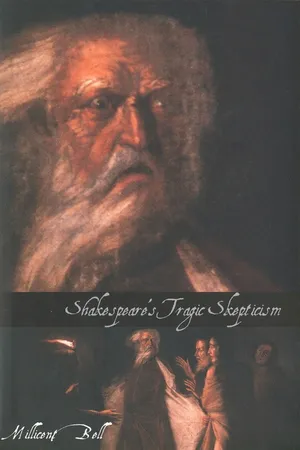
Shakespeare's Tragic Skepticism
About this book
Information
Topic
LiteraturaSubtopic
Arte dramático shakespearianoTable of contents
- Contents
- Preface
- Introduction
- 1. Hamlet, Revenge!
- 2. Othello’s Jealousy
- 3. ‘‘Unaccommodated’’ Lear
- 4. Macbeth’s Deeds
- Epilogue
- Selected Bibliography
Trusted by 375,005 students
Access to over 1.5 million titles for a fair monthly price.
Study more efficiently using our study tools.
Frequently asked questions
Yes, you can cancel anytime from the Subscription tab in your account settings on the Perlego website. Your subscription will stay active until the end of your current billing period. Learn how to cancel your subscription
No, books cannot be downloaded as external files, such as PDFs, for use outside of Perlego. However, you can download books within the Perlego app for offline reading on mobile or tablet. Learn how to download books offline
Perlego offers two plans: Essential and Complete
- Essential is ideal for learners and professionals who enjoy exploring a wide range of subjects. Access the Essential Library with 800,000+ trusted titles and best-sellers across business, personal growth, and the humanities. Includes unlimited reading time and Standard Read Aloud voice.
- Complete: Perfect for advanced learners and researchers needing full, unrestricted access. Unlock 1.5M+ books across hundreds of subjects, including academic and specialized titles. The Complete Plan also includes advanced features like Premium Read Aloud and Research Assistant.
We are an online textbook subscription service, where you can get access to an entire online library for less than the price of a single book per month. With over 1.5 million books across 990+ topics, we’ve got you covered! Learn about our mission
Look out for the read-aloud symbol on your next book to see if you can listen to it. The read-aloud tool reads text aloud for you, highlighting the text as it is being read. You can pause it, speed it up and slow it down. Learn more about Read Aloud
Yes! You can use the Perlego app on both iOS and Android devices to read anytime, anywhere — even offline. Perfect for commutes or when you’re on the go.
Please note we cannot support devices running on iOS 13 and Android 7 or earlier. Learn more about using the app
Please note we cannot support devices running on iOS 13 and Android 7 or earlier. Learn more about using the app
Yes, you can access Shakespeare's Tragic Skepticism by Millicent Bell in PDF and/or ePUB format, as well as other popular books in Literatura & Arte dramático shakespeariano. We have over 1.5 million books available in our catalogue for you to explore.