About this book
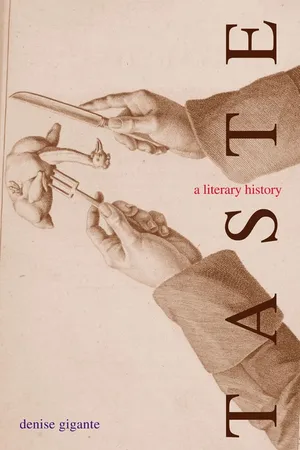
What does eating have to do with aesthetic taste? While most accounts of aesthetic history avoid the gustatory aspects of taste, this book rewrites standard history to uncover the constitutive and dramatic tension between appetite and aesthetics at the heart of British literary tradition. From Milton through the Romantics, the metaphor of taste serves to mediate aesthetic judgment and consumerism, gusto and snobbery, gastronomes and gluttons, vampires and vegetarians, as well as the philosophy and physiology of food.
The author advances a theory of taste based on Milton's model of the human as consumer (and digester) of food, words, and other commodities - a consumer whose tasteful, subliminal self remains haunted by its own corporeality. Radically rereading Wordsworth's feeding mind, Lamb's gastronomical essays, Byron's cannibals and other deviant diners, and Kantian nausea, Taste resituates Romanticism as a period that naturally saw the rise of the restaurant and the pleasures of the table as a cultural field for the practice of aesthetics.
Frequently asked questions
- Essential is ideal for learners and professionals who enjoy exploring a wide range of subjects. Access the Essential Library with 800,000+ trusted titles and best-sellers across business, personal growth, and the humanities. Includes unlimited reading time and Standard Read Aloud voice.
- Complete: Perfect for advanced learners and researchers needing full, unrestricted access. Unlock 1.4M+ books across hundreds of subjects, including academic and specialized titles. The Complete Plan also includes advanced features like Premium Read Aloud and Research Assistant.
Please note we cannot support devices running on iOS 13 and Android 7 or earlier. Learn more about using the app.
Information
Table of contents
- Contents
- Acknowledgments
- Abbreviations
- 1. Aesthetics and Appetite: An Introduction
- 2. Mortal Taste: Milton
- 3. The Century of Taste: Shaftesbury, Hume, Burke
- 4. Digesting Wordsworth
- 5. Lamb’s Low-Urban Taste
- 6. Taste Outraged: Byron
- 7. Keats’s Nausea
- 8. The Gastronome and the Snob: George IV
- Notes
- Index
