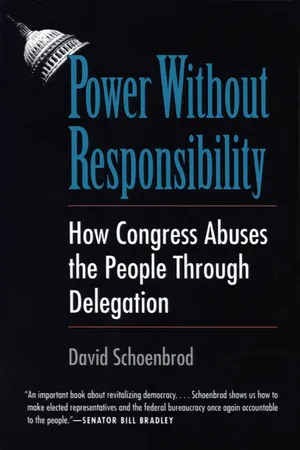
Power Without Responsibility
How Congress Abuses the People through Delegation
- 276 pages
- English
- PDF
- Available on iOS & Android
About this book
This book argues that Congress's process for making law is as corrosive to the nation as unchecked deficit spending.
David Schoenbrod shows that Congress and the president, instead of making the laws that govern us, generally give bureaucrats the power to make laws through agency regulations. Our elected "lawmakers" then take credit for proclaiming popular but inconsistent statutory goals and later blame the inevitable burdens and disappointments on the unelected bureaucrats. The 1970 Clean Air Act, for example, gave the Environmental Protection Agency the impossible task of making law that would satisfy both industry and environmentalists. Delegation allows Congress and the president to wield power by pressuring agency lawmakers in private, but shed responsibility by avoiding the need to personally support or oppose the laws, as they must in enacting laws themselves.
Schoenbrod draws on his experience as an attorney with the Natural Resources Defense Council and on studies of how delegation actually works to show that this practice produces a regulatory system so cumbersome that it cannot provide the protection that people need, so large that it needlessly stifles the economy, and so complex that it keeps the voters from knowing whom to hold accountable for the consequences. Contending that delegation is unnecessary and unconstitutional, Schoenbrod has written the first book that shows how, as a practical matter, delegation can be stopped.
Frequently asked questions
- Essential is ideal for learners and professionals who enjoy exploring a wide range of subjects. Access the Essential Library with 800,000+ trusted titles and best-sellers across business, personal growth, and the humanities. Includes unlimited reading time and Standard Read Aloud voice.
- Complete: Perfect for advanced learners and researchers needing full, unrestricted access. Unlock 1.4M+ books across hundreds of subjects, including academic and specialized titles. The Complete Plan also includes advanced features like Premium Read Aloud and Research Assistant.
Please note we cannot support devices running on iOS 13 and Android 7 or earlier. Learn more about using the app.
Information
Table of contents
- Contents
- Preface
- Acknowledgments
- Part I. Introduction
- 1. The Nub of the Argument
- Part II: Evolving Ideas of Delegation
- 2. The Vain Search for Virtuous Lawmakers
- Part III: Delegation in Practice
- 3. Broad Delegation: Regulating Navel Oranges
- 4. Narrow Delegation: Regulating Air Pollution
- 5. How Delegation Changes the Politics of Lawmaking
- Part IV: Is Delegation Good Policy?
- 6. Delegation Weakens Democracy
- 7. Delegation Endangers Liberty
- 8. Delegation Makes Law Less Reasonable
- 9. Congress Has Enough Time to Make the Laws
- Part V :The Courts Should Bar Delegation
- 10. The Constitution Prohibits Delegation
- 11. Why the Courts Should Stop Delegation (and Nobody Else Can)
- 12. How the Courts Should Define Unconstitutional Delegation
- Part VI: Conclusion
- 13. America Is No Exception
- Notes
- Index