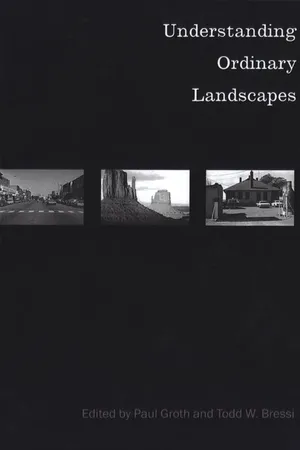
Understanding Ordinary Landscapes
About this book
How does knowledge of everyday environments foster deeper understanding of both past and present cultural life? In this book authorities in social history, architectural history, American studies, cultural geography, and landscape architecture explore aspects of the emergent field of cultural landscape studies, demonstrating the value of investigating the many meanings of ordinary settings.
While traditional studies in this field have been of rural life, most of the authors in this collection take on urban subjects, and with them the challenging issues of power, class, race, ethnicity, subculture, and cultural opposition. There is a chapter by J.B. Jackson, the field’s foremost proponent and exemplar, on the nature of the vernacular house and the garage. Some of the other contributors include James Borchert on the social stratification of Cleveland suburbs; Rina Swentzell on a comparison of native and federal environments on the Santa Clara Pueblo in New Mexico; Reuben Rainey on the Gettysburg battlefield; Dolores Hayden on the potentials of ethnic landscape documentation; and Denis Cosgrove on spectacle and society. Still other authors Wilbur Zelinsky, Richard Walker, Dell Upton, David Lowenthal, Jay Appleton, and Robert Riley—explore the problems and potentials of vision and space as sources of social interpretation. The book also includes a historical review of recent trends in the field of landscape studies and an annotated bibliography.
Paul Groth is associate professor of architecture and geography at the University of California, Berkeley. Todd W. Bressi is executive editor of Places and adjunct instructor in urban design and planning at Hunter College, New York University, and Pratt Institute.
Frequently asked questions
- Essential is ideal for learners and professionals who enjoy exploring a wide range of subjects. Access the Essential Library with 800,000+ trusted titles and best-sellers across business, personal growth, and the humanities. Includes unlimited reading time and Standard Read Aloud voice.
- Complete: Perfect for advanced learners and researchers needing full, unrestricted access. Unlock 1.4M+ books across hundreds of subjects, including academic and specialized titles. The Complete Plan also includes advanced features like Premium Read Aloud and Research Assistant.
Please note we cannot support devices running on iOS 13 and Android 7 or earlier. Learn more about using the app.
Information
Table of contents
- Contents
- Preface
- 1. Frameworks for Cultural Landscape Study
- Landscape Studies
- 2. Visual Landscapes of a Streetcar Suburb
- 3. Landscape and Archives as Texts
- 4. Conflicting Landscape Values: The Santa Clara Pueblo and Day School
- 5. Hallowed Grounds and Rituals of Remembrance: Union Regimental Monuments at Gettysburg
- 6. The Visual Character of Chinatowns
- 7. Where the One-Eyed Man Is King: The Tyranny of Visual and Formalist Values in Evaluating Landscapes
- 8. Spectacle and Society: Landscape as Theater in Premodern and Postmodern Cities
- 9. Urban Landscape History: The Sense of Place and the Politics of Space
- 10. The Politics of Vision
- 11. The Future of the Vernacular
- Commentaries and Future Directions
- 12. Seeing Beyond the Dominant Culture
- 13. Unseen and Disbelieved: A Political Economist among Cultural Geographers
- 14. Seen, Unseen, and Scene
- 15. European Landscape Transformations : The Rural Residue
- 16. The Integrity of the Landscape Movement
- 17. The Visible, the Visual, and the Vicarious: Questions about Vision, Landscape, and Experience
- Notes
- Bibliography: Basic Works in Cultural Landscape Studies
- Contributors
- Index
