- English
- PDF
- Available on iOS & Android
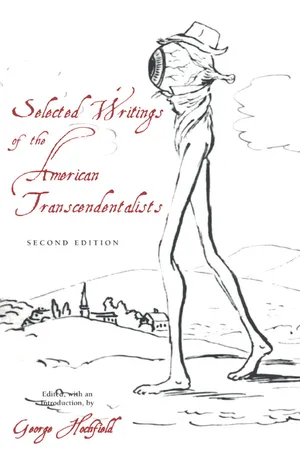
Selected Writings of the American Transcendentalists
About this book
Transcendentalism was the name given to the New England movement of the 1830s and 1840s that brought together Romanticism in literature and social reform in politics. Its partisans argued for the rights of women, the abolition of slavery, and, in some cases, the socialization of labor and equal distribution of profits. They were America’s first avant-garde.
This volume presents substantial selections from the writings of key American Transcendentalists, such as George Ripley, Margaret Fuller, Orestes Brownson, Theodore Parker, and Bronson Alcott. Included are sermons and diary entries, essays on labor, religion, education, and literature, on German metaphysics and Coleridge’s philosophy of mind. Many are expressive of the movement’s over-arching project: to define the innermost meanings of democracy—the nature of man, his place in the world, and his relation to the divine. First published in 1966, the book has been updated and expanded for this edition.
George Hochfield is professor emeritus at the State University of New York, Buffalo.
Frequently asked questions
- Essential is ideal for learners and professionals who enjoy exploring a wide range of subjects. Access the Essential Library with 800,000+ trusted titles and best-sellers across business, personal growth, and the humanities. Includes unlimited reading time and Standard Read Aloud voice.
- Complete: Perfect for advanced learners and researchers needing full, unrestricted access. Unlock 1.4M+ books across hundreds of subjects, including academic and specialized titles. The Complete Plan also includes advanced features like Premium Read Aloud and Research Assistant.
Please note we cannot support devices running on iOS 13 and Android 7 or earlier. Learn more about using the app.
Information
Table of contents
- Contents
- Introduction
- A Note on the Text
- Part 1. The Vanguard
- Unitarian Christianity (1819)
- On the Evidences of Revealed Religion (1821)
- Likeness to God (1828)
- On Genius (1821)
- Observations on the Growth of the Mind (1826)
- Journals (1826–1838)
- Preliminary Essay to Coleridge’s Aids to Reflection (1829)
- On the Difference in Kind of Reason and the Understanding (1825)
- Coleridge’s Literary Character—German Metaphysics
- Part 2. The New School
- The Doctrine and Discipline of Human Culture (1836)
- Cousin’s Philosophy (1836)
- Martineau’s Rationale (1836)
- New Views of Christianityy Society, and the Church (1836)
- Discourses on the Philosophy of Religion (1836)
- Record of a School (1836)
- A Discourse on the Latest Form of Infidelity (1839)
- The Latest Form of Infidelity Examined (1839)
- A Third Letter to Mr. Andrews Norton (1840)
- Jones Very (1839)
- Epic Poetry (1839)
- Shakespeare (1839)
- Hamlet (1839)
- Poems (1839)
- American Literature (1840)
- The Laboring Classes (1840)
- The Transient and Permanent in Christianity (1841)
- A Sermon of Slavery
- Part 3. The Voice of the Dial
- The Editors to the Reader (1840)
- A Short Essay on Critics (1840)
- The Religion of Beauty (1840)
- Orphic Sayings (1840)
- Questionings (1841)
- German Literature (1841)
- Glimmerings (1841)
- A Dialogue: Poet, Critic (1841)
- Thoughts on Labor (1841)
- Christ’s Idea of Society (1841)
- Fourierism and the Socialists (1842)
- On Student Rebellions at Harvard (1842)
- Anacreon (1843)
- The Great Lawsuit: Man vs. Men, Woman vs. Women (1843)
- Notes on Art and Architecture (1843)
- Part 4. The Brook Farm Experiment
- Letter to R. W. Emerson (1840)
- Reply to George Ripley
- Letter from a Minister (1843)
- Reply to an Inquiry
- Letter on Association
- Plan of the West Roxbury Community (1841)
- Introductory Statement to the Revised Constitution of Brook Farm (1844)
- Part 5. Full Circle
- Transcendentalism (1846)
- Theodore Parker’s Experience as a Minister (1859)
- About the Authors
- Selected Bibliography