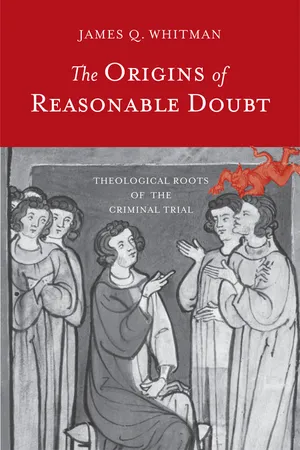
The Origins of Reasonable Doubt
eBook - PDF

The Origins of Reasonable Doubt

Theological Roots of the Criminal Trial

  1. English
  2. PDF
  3. Available on iOS & Android
eBook - PDF

The Origins of Reasonable Doubt

Theological Roots of the Criminal Trial

About this book

To be convicted of a crime in the United States, a person must be proven guilty “beyond a reasonable doubt.” But what is reasonable doubt? Even sophisticated legal experts find this fundamental doctrine difficult to explain. In this accessible book, James Q. Whitman digs deep into the history of the law and discovers that we have lost sight of the original purpose of “reasonable doubt.” It was not originally a legal rule at all, he shows, but a theological one.

The rule as we understand it today is intended to protect the accused. But Whitman traces its history back through centuries of Christian theology and common-law history to reveal that the original concern was to protect the souls of jurors. In Christian tradition, a person who experienced doubt yet convicted an innocent defendant was guilty of a mortal sin. Jurors fearful for their own souls were reassured that they were safe, as long as their doubts were not “reasonable.” Today, the old rule of reasonable doubt survives, but it has been turned to different purposes. The result is confusion for jurors, and a serious moral challenge for our system of justice.

Frequently asked questions

Yes, you can cancel anytime from the Subscription tab in your account settings on the Perlego website. Your subscription will stay active until the end of your current billing period. Learn how to cancel your subscription.
No, books cannot be downloaded as external files, such as PDFs, for use outside of Perlego. However, you can download books within the Perlego app for offline reading on mobile or tablet. Learn more here.
Perlego offers two plans: Essential and Complete
  • Essential is ideal for learners and professionals who enjoy exploring a wide range of subjects. Access the Essential Library with 800,000+ trusted titles and best-sellers across business, personal growth, and the humanities. Includes unlimited reading time and Standard Read Aloud voice.
  • Complete: Perfect for advanced learners and researchers needing full, unrestricted access. Unlock 1.4M+ books across hundreds of subjects, including academic and specialized titles. The Complete Plan also includes advanced features like Premium Read Aloud and Research Assistant.
Both plans are available with monthly, semester, or annual billing cycles.
We are an online textbook subscription service, where you can get access to an entire online library for less than the price of a single book per month. With over 1 million books across 1000+ topics, we’ve got you covered! Learn more here.
Look out for the read-aloud symbol on your next book to see if you can listen to it. The read-aloud tool reads text aloud for you, highlighting the text as it is being read. You can pause it, speed it up and slow it down. Learn more here.
Yes! You can use the Perlego app on both iOS or Android devices to read anytime, anywhere — even offline. Perfect for commutes or when you’re on the go.
Please note we cannot support devices running on iOS 13 and Android 7 or earlier. Learn more about using the app.
Yes, you can access The Origins of Reasonable Doubt by Ernst Kris, Otto Kurz in PDF and/or ePUB format, as well as other popular books in Law & Law Theory & Practice. We have over one million books available in our catalogue for you to explore.

Information

Year
2008
eBook ISBN
9780300150100
Edition
1
Topic
Law
Index
Law

Table of contents

  1. Contents
  2. Illustrations
  3. Acknowledgments
  4. Introduction
  5. 1. Of Factual Proof and Moral Comfort
  6. 2. The Christian Judge and the Taint of Blood: The Theology of Killing in War and Law
  7. 3. The Decline of the Judicial Ordeal: From God as Witness to Man as Witness
  8. 4. Salvation for the Judge, Damnation for the Witnesses: The Continent
  9. 5. Salvation for the Judge, Damnation for the Jury: England
  10. 6. The Crises of the Seventeenth Century
  11. 7. The Eighteenth Century: The Rule Emerges
  12. Conclusion
  13. Abbreviations
  14. Notes
  15. Index