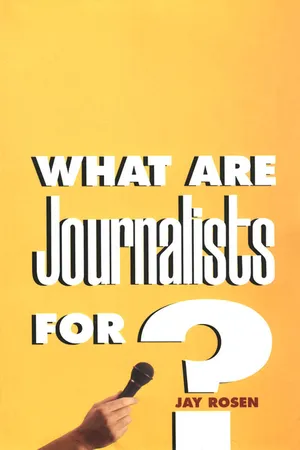
What Are Journalists For?
eBook - PDF

What Are Journalists For?

  1. English
  2. PDF
  3. Available on iOS & Android
eBook - PDF

What Are Journalists For?

About this book

American journalists in the 1990s confronted disturbing trends - an erosion of trust in the news media, weakening demand for serious news, flagging interest in politics and civic affairs, and a discouraging public climate that seemed to be getting worse. In response, some news professionals sought to breach the growing gap between press and public with an experimental approach - public journalism. This book is an account of the movement for public journalism, or civic journalism, told by Jay Rosen, one of its leading developers and defenders. Rosen recalls the events that led to the movement’s founding and gives a range of examples of how public journalism is practiced in American newsrooms. He traces the intellectual roots of the movement and shows how journalism can be made vital again by rethinking exactly what journalists are for.

Those who have supported the cause of public journalism have focused on first principles: democracy as something we do, citizens as the ones who do it, politics as public problem-solving, and deliberation as a means to that end. Rosen tells what happened as the movement gained momentum in newsrooms around the country and in the professional culture of the press. He reviews the flood of criticism and commentary aimed at public journalism and responds to those who express alarm at the experiment. Examining the mark that the movement has made on the field, Rosen upholds public journalism not only as a way for journalists to find a renewed sense of civic purpose for their craft, but also as a way to improve civic life and strengthen democracy.

Frequently asked questions

Yes, you can cancel anytime from the Subscription tab in your account settings on the Perlego website. Your subscription will stay active until the end of your current billing period. Learn how to cancel your subscription.
No, books cannot be downloaded as external files, such as PDFs, for use outside of Perlego. However, you can download books within the Perlego app for offline reading on mobile or tablet. Learn more here.
Perlego offers two plans: Essential and Complete
  • Essential is ideal for learners and professionals who enjoy exploring a wide range of subjects. Access the Essential Library with 800,000+ trusted titles and best-sellers across business, personal growth, and the humanities. Includes unlimited reading time and Standard Read Aloud voice.
  • Complete: Perfect for advanced learners and researchers needing full, unrestricted access. Unlock 1.4M+ books across hundreds of subjects, including academic and specialized titles. The Complete Plan also includes advanced features like Premium Read Aloud and Research Assistant.
Both plans are available with monthly, semester, or annual billing cycles.
We are an online textbook subscription service, where you can get access to an entire online library for less than the price of a single book per month. With over 1 million books across 1000+ topics, we’ve got you covered! Learn more here.
Look out for the read-aloud symbol on your next book to see if you can listen to it. The read-aloud tool reads text aloud for you, highlighting the text as it is being read. You can pause it, speed it up and slow it down. Learn more here.
Yes! You can use the Perlego app on both iOS or Android devices to read anytime, anywhere — even offline. Perfect for commutes or when you’re on the go.
Please note we cannot support devices running on iOS 13 and Android 7 or earlier. Learn more about using the app.
Yes, you can access What Are Journalists For? by Mark Nathan Cohen in PDF and/or ePUB format, as well as other popular books in Politics & International Relations & Politics. We have over one million books available in our catalogue for you to explore.

Table of contents

  1. Contents
  2. Acknowledgments
  3. Introduction: What We’re Doing Isn’t Working
  4. Part One. Origins
  5. 1. As Democracy Goes, So Goes the Press: The Roots of Public Journalism
  6. 2. In Search of a Different Story: Journalists, Scholars, and the Public Square
  7. Part Two. Practice
  8. 3. Applying Practice to Theory: Case Studies in Public Journalism
  9. 4. Does It Help the Citizen Decide? The Intellectual Journey of the Virginian-Pilot
  10. 5. Doing Less Harm: Public Journalism as Personal Tale
  11. Part Three. Reactions
  12. 6. Journalism Is What It Is: Critics React to the Experiment
  13. 7. The New York Times and the Washington Post on Public Journalism
  14. Part Four. Lessons
  15. 8. Design Flaw or Driver Error: The Hazards of Going Public
  16. 9. What Was Public Journalism? The Idea in Built Form
  17. 10. Conclusion: What Are Journalists For?
  18. Notes
  19. Index