- 387 pages
- English
- ePUB (mobile friendly)
- Available on iOS & Android
eBook - ePub
Current Approaches to Metaphor Analysis in Discourse
About this book
No detailed description available for "Current Approaches to Metaphor Analysis in Discourse".
Information
Publisher
De Gruyter MoutonYear
2019Print ISBN
9783110764321
9783110625882
Edition
1eBook ISBN
9783110625974
1 Introduction
In the past few years I have proposed a “multi-level view of metaphor” within the framework of Conceptual Metaphor Theory (Kövecses 2015a, 2017). In essence, the proposal was that the four types of conceptual structure relevant to the study of metaphor, such as image schemas, domains, frames, and mental spaces, can be regarded as occupying different levels in what I called “schematicity hierarchies.” Schematicity hierarchies have these conceptual structures arranged in vertical hierarchies on different levels of schematicity – from most schematic to least schematic. Specifically, we can distinguish four levels of schematicity at which the four types of conceptual structures can be placed. The four levels go from the most schematic to the least schematic, as represented in the diagram below:
The upward arrow in figure 2.1 indicates increasing schematicity, whereas the downward arrow indicates increasing specificity.

Figure 2.1: Schematicity hierarchy for four conceptual structures.
I also suggested that three distinctions apply to these four levels. The first distinction from the top is between image schemas and the three lower levels. Image schemas are analogue structures in the brain/mind, while domains, frames, and mental spaces are not (they are propositional). The second distinction is between mental spaces, on the one hand, and frames, domains, and image schemas, on the other. The basis for the distinction is that whereas frames, domains, and image schemas are structures in long-term memory, mental spaces are operative in working memory (see Fauconnier 2007). The third distinction is between the level of linguistic utterances used in actual communication and those of the conceptual structures mentioned. Figure 2.2 displays the various distinctions:
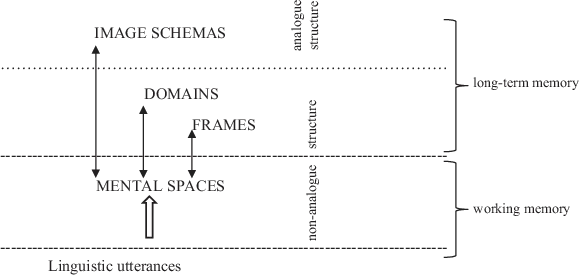
Figure 2.2: The multi-level view of conceptual and linguistic structures.
Furthermore, I claimed that the multi-level view of metaphor helps us resolve, or at least clarify, some issues in conceptual metaphor theory. In particular, I raised the following issues (Kövecses 2015a): (1) Which linguistic expressions related to a source domain are used metaphorically in relation to a target? (2) What is the appropriate conceptual structure that participates in metaphorical conceptualization? (3) At which level of generality should we formulate conceptual metaphors? (4) Do the mappings always go from source to target? (5) Are all linguistic metaphors systematic? Given these questions, I argued that the issues are not independent of each other but are closely related. They all have to do with how we think about our conceptual system: in particular, how we think about its essential structures in terms of their schematicity and what kind of distinction(s) we postulate regarding its operation in our attempt to account for the functioning of the system.
In the present paper, I wish to examine three consequences of the new, multi-level view of metaphor in relation to (1) a proposal by George Lakoff, (2) a distinction emphasized by Gerard Steen, and (3) a fundamental issue in the methodology of studying metaphor within a CMT framework. In particular, they are as follows:
- What are “deep” vs. “shallow” or “superficial metaphors? What is their ontological status in the metaphorical conceptual system?
- Do “deliberate” metaphors exist independently of “nondeliberate” ones? How best can we characterize them in a multi-level view of metaphor?
- What is the “best” method to study metaphors out of the many available ones in the various disciplines that deal with metaphor?
In what follows, I address the three questions and attempt to examine them in light of the multi-level view of metaphor.
2 Deep vs. shallow metaphors
In a 1995 paper, George Lakoff distinguishes two different kinds of metaphor: “deep” and “superficial.” He explains the basis for the distinction in the following way:
The metaphors I have discussed so far in the paper have been both conceptual in nature and deep, in the sense that they are used largely without being noticed, that they have enormous social consequences, and that they shape our very understanding of our everyday world. It is important to contrast such deep conceptual metaphors such as Morality is Strength and The Nation is a Family with superficial metaphors, which are only of marginal interest but which often lead analysts astray.(Lakoff 1995, http://www.wwcd.org/issues/Lakoff.html)
In other words, conceptual and deep metaphors are used without being noticed, they have enormous social consequences, and they shape our understanding of the world. Given this characterization, we can ask what the ontological status of deep and superficial metaphors is – especially in relation to the four-level hierarchy as described in other publications (Kövecses 2015a, 2017). How do deep and superficial metaphors fit into the schematicity hierarchy defined by the conceptual structures of image schemas, domains, frames, and mental spaces, as shown above?
The particular example Lakoff uses to demonstrate superficial metaphors is that of the safety net. He illustrates the metaphor from a newspaper article: “Senator Phil Gramm told a college commencement audience that the social safety net erected by government by the N...
Table of contents
- Title Page
- Copyright
- Contents
- Metaphor analysis in discourse. Introduction
- Part I: Metaphor and knowledge configuration in discourse
- Part II: Consciousness in metaphor usage
- Part III: Metaphor analysis in multimodal discourse
- Subject Index
Trusted by 375,005 students
Access to over 1.5 million titles for a fair monthly price.
Study more efficiently using our study tools.
Frequently asked questions
Yes, you can cancel anytime from the Subscription tab in your account settings on the Perlego website. Your subscription will stay active until the end of your current billing period. Learn how to cancel your subscription
No, books cannot be downloaded as external files, such as PDFs, for use outside of Perlego. However, you can download books within the Perlego app for offline reading on mobile or tablet. Learn how to download books offline
Perlego offers two plans: Essential and Complete
- Essential is ideal for learners and professionals who enjoy exploring a wide range of subjects. Access the Essential Library with 800,000+ trusted titles and best-sellers across business, personal growth, and the humanities. Includes unlimited reading time and Standard Read Aloud voice.
- Complete: Perfect for advanced learners and researchers needing full, unrestricted access. Unlock 1.5M+ books across hundreds of subjects, including academic and specialized titles. The Complete Plan also includes advanced features like Premium Read Aloud and Research Assistant.
We are an online textbook subscription service, where you can get access to an entire online library for less than the price of a single book per month. With over 1.5 million books across 990+ topics, we’ve got you covered! Learn about our mission
Look out for the read-aloud symbol on your next book to see if you can listen to it. The read-aloud tool reads text aloud for you, highlighting the text as it is being read. You can pause it, speed it up and slow it down. Learn more about Read Aloud
Yes! You can use the Perlego app on both iOS and Android devices to read anytime, anywhere — even offline. Perfect for commutes or when you’re on the go.
Please note we cannot support devices running on iOS 13 and Android 7 or earlier. Learn more about using the app
Please note we cannot support devices running on iOS 13 and Android 7 or earlier. Learn more about using the app
Yes, you can access Current Approaches to Metaphor Analysis in Discourse by Ignasi Navarro i Ferrando in PDF and/or ePUB format, as well as other popular books in Languages & Linguistics & Communication Studies. We have over 1.5 million books available in our catalogue for you to explore.