eBook - ePub
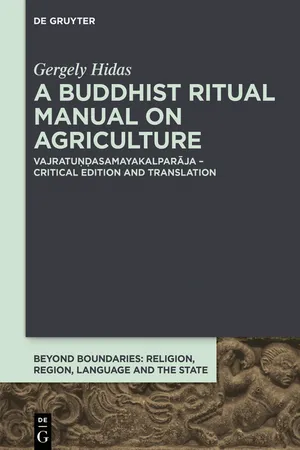
A Buddhist Ritual Manual on Agriculture
Vajratuṇḍasamayakalparāja – Critical Edition
- 152 pages
- English
- ePUB (mobile friendly)
- Available on iOS & Android
eBook - ePub
About this book
This volume is the first in-depth study of a recently discovered Sanskrit dharani spell text from around the 5th century CE surviving in two palm-leaf and three paper manuscript compendia from Nepal. This rare Buddhist scripture focuses on the ritual practice of thaumaturgic weather control for successful agriculture through overpowering mythical Nagas. Traditionally, these serpentine beings are held responsible for the amount of rainfall. The six chapters of the Vajratundasamayakalparaja present the vidyadhara spell-master as a ritualist who uses mandalas, mudras and other techniques to gain mastery over the Nagas and thus control the rains. By subjugating the Nagas, favourable weather and good crops are guaranteed. This links this incantation tradition to economic power and the securing of worldly support for the Buddhist community.
Information
1Previous research
1.1Primary references
The first work that mentions the Vajratuṇḍa is Waddell (1912: 175), where it is listed along with other Garuḍa-related dhāraṇī texts and described as the “Vajra Tuṇḍa. Thunderbolt Beak of Garuḍa” under no. 33.1 This scripture is indicated to be extant only in Tibetan and its use is outlined as “Against Nāgas to protect crops and cause seasonable rain.”2 In another publication two years later, Waddell (1914: 41–42) translates the opening part to the end of the first dhāraṇī with a brief summary of the rest of that chapter.3 The seemingly sole further reference to this text comes from a century later, when Szántó (2012: I.235–36) shows that the Vajratuṇḍanāgasamaya is included in composite rainmaking ritual manuals from Nepal and survives in the original Sanskrit.
1.2Secondary references
There are several works on mythical Nāgas,4 often along with mentions of Garuḍa.5 The classic monograph on this extensive topic is Vogel (1926) and recent studies include Rhi (2009), Legittimo (2010) and Cozad (2015). Gunawardana (1979: 215–219) and Shaw (2004: 17–19, 50–52; 2018: 233–234) consider the connections between Nāgas and agriculture in Sri Lanka and central India respectively and Deeg (2008 and 2016) discusses Nāga-related Buddhist rain rituals in a broad context on the basis of Chinese and Sanskrit sources.6 On the non-Buddhist side, Sanderson (2015)7 analyses Śākta texts and provides instances of various relevant rituals for crop protection, calming bad weather and Nāgas, and binding Nāgas at their residence lake.8 In another recent article, Davidson (2017a) gives a treatment of Buddhist rites focussing on a Nāga altar in fifth-century India, along with Chinese sources. Finally, there are a couple of studies on South Asian weather rituals in general: Khatry (1996) describes the Buddhist Matsyendranāth rain festival in the Kathmandu Valley; Willis (2009) examines Udayagiri monsoon rites, while Vajracharya (2016) discusses this wider topic along with the presentation of manifold materials from Nepal.
2Sources
2.1Sanskrit
The Vajratuṇḍasamayakalparāja (henceforth VTSKR) survives in longer Varṣāpaṇavidhi (“rainmaking ritual manual”) collections from Nepal.9 Five such compendia have been identified preserving this text,10 three kept in Kathmandu11 and two in Tokyo.12 This scripture is not included in Sanskrit Dhāraṇīsaṃgraha collections known to me.13
2.2Chinese
While there is no Chinese version of the VTSKR, T 1007, the “Root Mantra (-dhāraṇī) Sūtra”, translated into Chinese in the sixth century and studied in Davidson (2017a), reveals a number of similarities. T 1027, the “Vajra Blaze Dhāraṇī to Stop Wind and Rain”, translated by Bodhiruci around 700 CE and referred to in Schmithausen (1997: 63–64), also shares many features with this scripture.
2.3Tibetan
The VTSKR is listed in the Lhan Karma catalogue (c.800 CE) under no. 336 as ’phags pa rdo rje mchu’i gzuṅs (Ārya-vajratuṇḍa-dhāraṇī)14 and included in various Kangyurs as rdo rje mchu shes bya ba kluhi dam tshig go (Vajratuṇḍa-nāmanāgasamaya).15 The text of the Vajralohatuṇḍa-dhāraṇī and two Lohatuṇḍadhāraṇīs follow this scripture in the Tibetan canon and thus it appears that “tuṇḍa-texts” were grouped together in many cases.16 A Tibetan manuscript of the VTSKR survives in Dunhuang.17
2.4Mongolian
The VTSKR is translated under no. 589 in the Mongolian Kangyur as Qutuγ-tu včir-a-bani köke degel-tü-yin ǰang üile neretü tarni.18
2.5Commentaries, citations, parallels, auxiliary texts
Although no commentaries or auxiliary texts of the VTSKR survive, the unpublished Mārīcīkalpoktakrama included in Varṣāpaṇavidhi collections contains portions, often with slightly different wording, from parts [2.18], [2.20], [2.24] and [2.25].19
3Structure
The VTSKR consists of six chapters as it has come down to us:20
| [1] | Nāgahṛdayasya sasyapīḍākalpa – The Nāga Heart[-mantra] Ritual Manual for Crop Damage |
| [2] | Vaiśramaṇabhavanapraveśanāgasamaya nāma varṣaṇa-m-utsarga – The Sending forth of Rain, called Entry into the Residence of Vaiśramaṇa Nāga Vow21 |
| [3] | Mahāgaruḍavegavajravegajvālitagaruḍahṛdayamaṇḍalī nāma dhāraṇī – The Great Garuḍa Thrust Vajra Thrust Blazing Garuḍa Heart Ruler Dhāraṇī22 |
| [4] | Mūlamantravidhisopacāra – The Manual of the Root Mantra with the ... |
Table of contents
- Cover
- Title Page
- Copyright
- Contents
- Introduction
- 1 Previous research
- 2 Sources
- 3 Structure
- 4 Contents
- 5 Contexts
- 6 Practice
- 7 A critical edition
- Edition and translation
- References
- Index
Trusted by 375,005 students
Access to over 1.5 million titles for a fair monthly price.
Study more efficiently using our study tools.
Frequently asked questions
Yes, you can cancel anytime from the Subscription tab in your account settings on the Perlego website. Your subscription will stay active until the end of your current billing period. Learn how to cancel your subscription
No, books cannot be downloaded as external files, such as PDFs, for use outside of Perlego. However, you can download books within the Perlego app for offline reading on mobile or tablet. Learn how to download books offline
Perlego offers two plans: Essential and Complete
- Essential is ideal for learners and professionals who enjoy exploring a wide range of subjects. Access the Essential Library with 800,000+ trusted titles and best-sellers across business, personal growth, and the humanities. Includes unlimited reading time and Standard Read Aloud voice.
- Complete: Perfect for advanced learners and researchers needing full, unrestricted access. Unlock 1.5M+ books across hundreds of subjects, including academic and specialized titles. The Complete Plan also includes advanced features like Premium Read Aloud and Research Assistant.
We are an online textbook subscription service, where you can get access to an entire online library for less than the price of a single book per month. With over 1.5 million books across 990+ topics, we’ve got you covered! Learn about our mission
Look out for the read-aloud symbol on your next book to see if you can listen to it. The read-aloud tool reads text aloud for you, highlighting the text as it is being read. You can pause it, speed it up and slow it down. Learn more about Read Aloud
Yes! You can use the Perlego app on both iOS and Android devices to read anytime, anywhere — even offline. Perfect for commutes or when you’re on the go.
Please note we cannot support devices running on iOS 13 and Android 7 or earlier. Learn more about using the app
Please note we cannot support devices running on iOS 13 and Android 7 or earlier. Learn more about using the app
Yes, you can access A Buddhist Ritual Manual on Agriculture by Gergely Hidas in PDF and/or ePUB format, as well as other popular books in Theology & Religion & Asian History. We have over 1.5 million books available in our catalogue for you to explore.