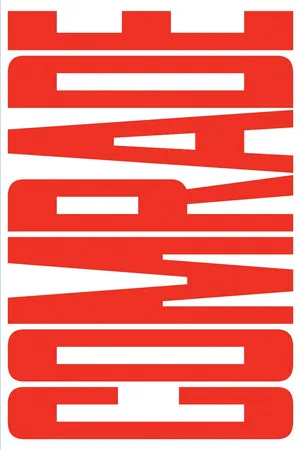
Between mass participation in two world wars and mass participation in Communist parties, in the 20th century millions of people across the globe addressed each other as 'comrade'. Now, it's more common to hear talk of 'allies' on the left than it is of comrades. In Comrade, Jodi Dean insists that this shift exemplifies the key problem with the contemporary left: the substitution of political identity for a relation of political belonging that must be built, sustained, and defended.
In Comrade, Dean offers a theory of the comrade as a mode of address, figure of belonging, and carrier of expectations for action. Comrades are equals on the same side of a political struggle. Voluntarily coming together in the struggle for justice, their relation is characterized by discipline, joy, courage, and enthusiasm. Considering the generic egalitarianism of the comrade in light of differences of race and gender, Dean draws from an array of historical and literary examples such as Harry Haywood, CLR James, Alexandra Kollontai, and Doris Lessing. She argues that if we are to be a Left at all, we have to be comrades.
- 166 pages
- English
- ePUB (mobile friendly)
- Available on iOS & Android
eBook - ePub
About this book
Information
CHAPTER ONE
From Allies to Comrades
SEVERAL JOKES IN PRESIDENT Barack Obama’s address at the 2016 White House Correspondents’ Dinner targeted Senator Bernie Sanders. Sanders was running a surprisingly strong campaign against the Democratic Party’s presumptive presidential nominee, former secretary of state Hillary Clinton. After a few shoutouts to celebrities and politicians, Obama turned to the subject of Sanders, saying:
A lot of folks have been surprised by the Bernie phenomenon, especially his appeal to young people. But not me, I get it. Just recently, a young person came up to me and said she was sick of politicians standing in the way of her dreams. As if we were actually going to let Malia go to Burning Man this year. (Laughter.) That was not going to happen. (Laughter.) Bernie might have let her go. (Laughter.) Not us. (Laughter.)I am hurt, though, Bernie, that you’re distancing yourself a little from me. (Laughter.) I mean, that’s just not something that you do to your comrade. (Laughter and applause.)1
The last joke points to the socialist opening Sanders’s campaign cut into US politics. At first glance, the joke seems like red-baiting—Obama’s thinly veiled reminder that Sanders was a self-identified socialist and thus unacceptable to the US political class. But perhaps not. Maybe it was a reminder for the audience that Sanders wasn’t a member of the Democratic Party, and so he wasn’t Obama’s party comrade at all. Sanders wanted the Democratic nomination for president but he wasn’t actually a Democrat. There is also a third way of reading the joke. Recall how persistently the US right red-baited Obama, accusing him of being a communist or socialist. For eight years, the right excoriated the country’s first black president as the most radical left-wing official ever to inhabit the White House. Mocking “Comrade Obama,” the right associated Obama with Lenin and Stalin, Che and Mao. Read this way, the joke points not to Sanders as a comrade but to Obama as a comrade. Obama could have been referring to himself as Sanders’s comrade, as someone who shares with Sanders a common political horizon, the emancipatory egalitarian horizon denoted by the term comrade. If they were on the same side, with Obama being Sanders’s comrade, then Obama should have been able to expect a little solidarity. The joke worked because everybody in the room—from celebrities, to Washington insiders, to media moguls—knew full well that Obama wasn’t a comrade. He doesn’t come close to sharing Sanders’s politics, even if the right can’t tell the difference between them.
The term comrade indexes a political relation, a set of expectations for action toward a common goal. It highlights the sameness of those on the same side—no matter their differences, comrades stand together. As Obama’s joke implies, when you share a politics, you don’t generally distance yourself from your comrades. Comradeship binds action, and in this binding, this solidarity, it collectivizes and directs action in light of a shared vision for the future. For communists, this is the egalitarian future of a society emancipated from the determinations of private property and capitalism and reorganized according to the free association, common benefit, and collective decisions of the producers.
But the term comrade predates its use by communists and socialists. In romance languages, comrade first appears in the sixteenth century to designate one who shares a room with another. Juan A. Herrero Brasas cites a Spanish historical-linguistic dictionary’s definition of the term: “Camarada is someone who is so close to another man that he eats and sleeps in the same house with him.”2 In French, the term was originally feminine, camarade, and referred to a barracks or room shared by soldiers.3 Etymologically, comrade derives from camera, the Latin word for room, chamber, and vault. The technical connotation of vault indexes a generic function, the structure that produces a particular space and holds it open.4 A chamber or room is a repeatable structure that takes its form by producing an inside separate from an outside and providing a supported cover for those underneath it. Sharing a room, sharing a space, generates a closeness, an intensity of feeling and expectation of solidarity that differentiates those on one side from those on the other. Comradeship is a political relation of supported cover.
Interested in comrade as a mode of address, carrier of expectations, and figure of belonging in the communist and socialist traditions, I emphasize the comrade as a generic figure for the political relation between those on the same side of a political struggle. Comrades are those who tie themselves together instrumentally, for a common purpose: If we want to win—and we have to win—we must act together. As Angela Davis describes her decision to join the Communist Party:
I wanted an anchor, a base, a mooring. I needed comrades with whom I could share a common ideology. I was tired of ephemeral ad-hoc groups that fell apart when faced with the slightest difficulty; tired of men who measured their sexual height by women’s intellectual genuflection. It wasn’t that I was fearless, but I knew that to win, we had to fight and the fight that would win was the one collectively waged by the masses of our people and working people in general. I knew that this fight had to be led by a group, a party with more permanence in its membership and structure and substance in its ideology.5
Comrades are those you can count on. You share enough of a common ideology, enough of a commitment to common principles and goals, to do more than one-off actions. Together you can fight the long fight.
As comrades, our actions are voluntary, but they are not always of our own choosing. Comrades have to be able to count on each other even when we don’t like each other and even when we disagree. We do what needs to be done because we owe it to our comrades. In The Romance of American Communism, Vivian Gornick reports the words of a former member of the Communist Party USA, or CPUSA, who hated the daily grind of selling papers and canvassing expected of party cadre, but nevertheless, according to her, “I did it. I did it because if I didn’t do it, I couldn’t face my comrades the next day. And we all did it for the same reason: we were accountable to each other.”6 Put in psychoanalytic terms, the comrade functions as an ego ideal: the point from which party members assess themselves as doing important, meaningful work.7 Being accountable to another entails seeing your actions through their eyes. Are you letting them down or are you doing work that they respect and admire?
In Crowds and Party, I present the good comrade as an ideal ego, that is to say, as how party members imagine themselves.8 They may imagine themselves as thrilling orators, brilliant polemicists, skilled organizers, or courageous militants. In contrast with my discussion there, in the current book, I draw out how the comrade also functions as an ego ideal, the perspective that party members—and often fellow travelers—take toward themselves. This perspective is the effect of belonging on the same side as it works back on those who have committed themselves to common struggle. The comrade is a symbolic as well as an imaginary figure and it is the symbolic dimension of ego ideal I focus on here.
My thinking about the comrade as a generic figure for those on the same side flows out of my work on communism as the horizon of left politics and my work on the party as the political form necessary for this politics.9 To see our political horizon as communist is to highlight the emancipatory egalitarian struggle of the proletarianized against capitalist exploitation—that is, against the determination of life by market forces; by value; by the division of labor (on the basis of sex and race); by imperialism (theorized by Lenin in terms of the dominance of monopoly and finance capital); and by neocolonialism (theorized by Nkrumah as the last stage of imperialism). Today we see this horizon in struggles such as those led by women of color against police violence, white supremacy, and the murder and incarceration of black, brown, and working-class people. We see it in the infrastructure battles around pipelines, climate justice, and barely habitable cities with undrinkable water and contaminated soil. We see it in the array of social reproduction struggles against debt, foreclosure, and privatization, and for free, quality public housing, childcare, education, transportation, healthcare, and other basic services. We see it in the ongoing fight of LGBTQ people against harassment, discrimination, and oppression.
It is readily apparent today that the communist horizon is the horizon of political struggle not for the nation but for the world; it is an international horizon. This is evident in the antagonism between the rights of immigrants and refugees and intensified nationalisms; in the necessity of a global response to planetary warming; and in anti-imperialist, decolonization, and peace movements. In these examples, communism is a force of negativity, the negation of the global capitalist present.
Communism is also the name for the positive alternative to capitalism’s permanent and expanding exploitation, crisis, and immiseration, the name of a system of production based on meeting social needs—from each according to ability to each according to need, to paraphrase Marx’s famous slogan—in a way that is collectively determined and carried out by the producers. This positive dimension of communism attends to social relations, to how people treat each other, animals, things, and the world around them. Building communism entails more than resistance and riot. It requires the emancipated egalitarian organization of collective life.
With respect to the party, intellectuals on the contemporary left tend to extract the party from the aspirations and accomplishments it enabled. Communist philosophers who disagree on a slew of theoretical questions, such as Antonio Negri and Alain Badiou, converge on the organizational question—no party! The party has been rejected as authoritarian, as outmoded, as ill-fitting a society of networks. Every other mode of political association may be revised, renewed, rethought, or reimagined except for the party of communists.
This rejection of the party as a form for left politics is a mistake. It ignores the effects of association on those engaged in common struggle. It fails to learn from the everyday experiences of generations of activists, organizers, and revolutionaries. It relies on a narrow, fantasied notion of the party as a totalitarian machine. It neglects the courage, enthusiasm, and achievements of millions of party members for over a century. Rejection of the party form has been left dogmatism for the last thirty years and has gotten us nowhere.
Fortunately, the movements of the squares in Greece and Spain, as well as lessons from the successes and limits of the Occupy movement, have pushed against this left dogmatism. They have reenergized interest in the party as a political form that can scale; a form that is flexible, adaptive, and expansive enough to endure beyond the joyous and disruptive moments of crowds in the streets. A theory of the comrade contributes to this renewal by drawing out the ways that shared commitment to a common struggle generates new strengths and new capacities. Over and against the reduction of party relations to the relations between the leaders and the led, comrade attends to the effects of political belonging on those on the same side of a political struggle. As we fight together for a world free of exploitation, oppression, and bigotry, we have to be able to trust and count on each other. Comrade names this relation.
The comrade relation remakes the place from which one sees, what it is possible to see, and what possibilities can appear. It enables the revaluation of work and time, what one does, and for whom one does it. Is one’s work done for the people or for the bosses? Is it voluntary or done because one has to work? Does one work for personal provisions or for a collective good? We should recall Marx’s lyrical description of communism in which work becomes “life’s prime want.” We get a glimpse of that in comradeship: one wants to do political work. You don’t want to let down your comrades; you see the value of your work through their eyes, your new collective eyes. Work, determined not by markets but by shared commitments, becomes fulfilling. French communist philosopher and militant Bernard Aspe discusses the problem of contemporary capitalism as a loss of “common time”; that is, the loss of an experience of time generated and enjoyed through our collective being-together.10 From holidays, to meals, to breaks, whatever common time we have is synchronized and enclosed in forms for capitalist appropriation. Communicative capitalism’s apps and trackers amplify this process such that the time of consumption can be measured in much the same way that Taylorism measured the time of production: How long did a viewer spend on a particular web page? Did a person watch a whole ad or click off of it after five seconds? In contrast, the common action that is the actuality of communist movement induces a collective change in capacities. Breaking from capitalism’s 24-7 injunctions to produce and consume for the bosses and owners, the discipline of common struggle expands possibilities for action and intensifies the sense of its necessity. The comrade is a figure for the relation through which this transformation of work and time occurs.
How do we imagine political work? Under conditions where political change seems completely out of reach, we might imagine political work as self-transformation. At the very least, we can work on ourselves. In the intensely mediated networks of communicative capitalism, we might see our social media engagements as a kind of activism where Twitter and Facebook function as important sites of struggle. Perhaps we understand writing as important political work and hammer out opinion pieces, letters to the editors, and manifestoes. When we imagine political work, we often take electoral politics as our frame of reference, focusing on voting, lawn signs, bumper stickers, and campaign buttons. Or we think of activists as those who arrange phone banks, canvass door-to-door, and set up rallies. In yet another political imaginary, we might envision political work as study, whether done alone or with others. We might imagine political work as cultural production, the building of new communities, spaces, and ways of seeing. Our imaginary might have a militant, or even militarist, inflection: political work is carried out through marches, occupations, strikes, and blockades; through civil disobedience, direct action, and covert operations. Even with the recognition of the wide array of political activities, the ways people use them to respond to specific situations and capacities, and how they combine to enhance each other, we might still imagine radical political work as punching a Nazi in the face.
Throughout these various actions and activities, how are the relations among those fighting on the same side imagined? How do the activists and organizers, militants and revolutionaries relate to one another? During the weeks and months when the Occupy movement was at its peak, relations with others were often infused with a joyous sense of being together, with an enthusiasm for the collective co-creation of new patterns of action and ways of living.11 But the feeling didn’t last. The pressures of organizing diverse people and politics under conditions of police repression and real material need wore down even the most committed activists. Since then, on social media and across the broader left, relations among the politically engaged have again become tense and conflicted, often along lines of race and gender. Dispersed and disorganized, we’re uncertain of whom to trust and what to expect. We encounter contradictory injunctions to self-care and call out. Suspicion undermines support. Exhaustion displaces enthusiasm.
Attention to comradeship, to the ways that shared expectations make political work not just possible but also gratifying, may help redirect our energies back to our common struggle. As former CPUSA member David Ross explained to Gornick:
I knew that I could never feel passionately about the new movements as I had about the old, I realized that the CP has provided me with a sense of comradeship I would never have again, and that without that comradeship I could never be political.12
For Ross, the Communist Party is what made Marxism. The party gave Marxism life, political purpose. This life-giving capacity came from comradeship. Ross continues: “The idea of politics as simply a diffused consciousness linked only to personal integrity was—is—anathema to me.” His description of politics as “a diffused consciousness linked only to personal integrity” fits today’s left milieus. Perhaps, then, his remedy—comradeship—will as well.
Various people have told me their stories of feeling a rush of warmth when they were first welcomed into their party as a comrade. I’ve had this feeling myself. In his memoir Incognegro: A Memoir of Exile and Apartheid, the theorist Frank Wilderson, a former member of uMkhonto weSizwe, or MK, the armed wing of the African National Congress (ANC), describes his first meeting with Chris Hani, the leader of the South African Communist Party and the chief of staff of MK. Wilderson writes, “I beamed like a schoolboy when he called me ‘comrade.’”13 Wilderson chides himself for what he calls a “childish need for recognition.”14 Perhaps because he still puts Hani on a pedestal, he feels exposed in his enjoyment of the egalitarian disruption of comradeship. Wilderson hasn’t yet internalized the idea that he and Hani are political equals. “Comrade” holds out an equalizing promise, and when that promise is fulfilled, we confront our own continuing yet unwanted attachments to hierarchy, prestige, inadequacy. Accepting equality takes courage.
Wilderson’s joy in ...
Table of contents
- Cover Page
- Half Title Page
- Title Page
- Copyright Page
- Dedication
- Contents
- Acknowledgments
- Chapter 1: From Allies to Comrades
- Chapter 2: The Generic Comrade
- Chapter 3: Four Theses on the Comrade
- Chapter 4: You Are Not My Comrade
- Notes
Trusted by 375,005 students
Access to over 1.5 million titles for a fair monthly price.
Study more efficiently using our study tools.
Frequently asked questions
Yes, you can cancel anytime from the Subscription tab in your account settings on the Perlego website. Your subscription will stay active until the end of your current billing period. Learn how to cancel your subscription
No, books cannot be downloaded as external files, such as PDFs, for use outside of Perlego. However, you can download books within the Perlego app for offline reading on mobile or tablet. Learn how to download books offline
Perlego offers two plans: Essential and Complete
- Essential is ideal for learners and professionals who enjoy exploring a wide range of subjects. Access the Essential Library with 800,000+ trusted titles and best-sellers across business, personal growth, and the humanities. Includes unlimited reading time and Standard Read Aloud voice.
- Complete: Perfect for advanced learners and researchers needing full, unrestricted access. Unlock 1.5M+ books across hundreds of subjects, including academic and specialized titles. The Complete Plan also includes advanced features like Premium Read Aloud and Research Assistant.
We are an online textbook subscription service, where you can get access to an entire online library for less than the price of a single book per month. With over 1.5 million books across 990+ topics, we’ve got you covered! Learn about our mission
Look out for the read-aloud symbol on your next book to see if you can listen to it. The read-aloud tool reads text aloud for you, highlighting the text as it is being read. You can pause it, speed it up and slow it down. Learn more about Read Aloud
Yes! You can use the Perlego app on both iOS and Android devices to read anytime, anywhere — even offline. Perfect for commutes or when you’re on the go.
Please note we cannot support devices running on iOS 13 and Android 7 or earlier. Learn more about using the app
Please note we cannot support devices running on iOS 13 and Android 7 or earlier. Learn more about using the app
Yes, you can access Comrade by Jodi Dean in PDF and/or ePUB format, as well as other popular books in Politics & International Relations & Communism, Post-Communism & Socialism. We have over 1.5 million books available in our catalogue for you to explore.