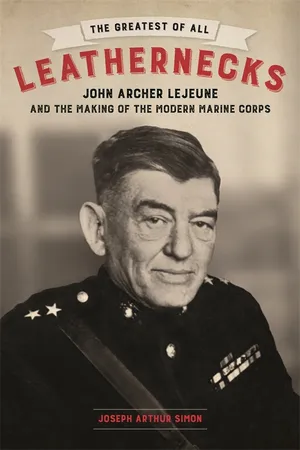
Joseph Arthur Simon's The Greatest of All Leathernecks is the first comprehensive biography of John Archer Lejeune (1867–1942), a Louisiana native and the most innovative and influential leader of the United States Marine Corps in the twentieth century. As commandant of the Marine Corps from 1920 to 1929, Lejeune reorganized, revitalized, and modernized the force by developing its new and permanent mission of amphibious assault. Before that transformation, the corps was a constabulary infantry force used mainly to protect American business interests in the Caribbean, a mission that did not place it as a significant contributor to the United States defense establishment. The son of a plantation owner from Pointe Coupee Parish, Lejeune enrolled at Louisiana State University in 1881, aged fourteen. Three years later, he entered the U.S. Naval Academy, afterward serving for two years at sea as a midshipman. In 1890, he transferred to the Marines, where he ascended quickly in rank. During the Spanish-American War, Lejeune commanded and landed Marines at San Juan, Puerto Rico, to rescue American sympathizers who had been attacked by Spanish troops. A few years later, he arrived with a battalion of Marines at the Isthmus of Panama—part of Colombia at the time—securing it for Panama and making possible the construction of the Panama Canal by the United States. He went on to lead Marine expeditions to Cuba and Veracruz, Mexico. During World War I, Lejeune was promoted to major general and given command of an entire U.S. Army division. After the war, Lejeune became commandant of the Marine Corps, a role he used to develop its new mission of amphibious assault, transforming the corps from an ancillary component of the U.S. military into a vibrant and essential branch. He also created the Marine Corps Reserve, oversaw the corps's initial use of aviation, and founded the Marine Corps Schools, the intellectual planning center of the corps that currently exists as the Marine Corps University. As Simon masterfully illustrates, the mission and value of the corps today spring largely from the efforts and vision of Lejeune.
eBook - ePub
The Greatest of All Leathernecks
John Archer Lejeune and the Making of the Modern Marine Corps
- 368 pages
- English
- ePUB (mobile friendly)
- Available on iOS & Android
eBook - ePub
The Greatest of All Leathernecks
John Archer Lejeune and the Making of the Modern Marine Corps
About this book
Information
Subtopic
Military BiographiesIndex
History1
EARLY YEARS IN LOUISIANA

Louisiana-born John Archer Lejeune was the beneficiary of a distinguished lineage. The exemplary qualities repeatedly shown by Lejeune as a Marine—perseverance, tenacity, resilience, integrity, a sense of honor, resourcefulness, vision, and ambition—are apparent in his ancestry. Shortly after King George’s War, 1744–1748, Lejeune’s great-grandfather Jean Baptiste Lejeune, who was born in Bretagne, left France and located in Acadia (Nova Scotia), Canada.1 He and his two brothers rallied to the French standard during the French and Indian War in North America (1754–63) and fought under the Marquis de Montcalm on the Plains of Abraham, overlooking Quebec. Vanquished but unsubdued after British General James Wolfe’s triumph, the Lejeunes chose to leave Canada by traveling down the St. Lawrence River and across the Great Lakes. After lingering briefly in Kaskaskia, Illinois, they led twenty men down the Mississippi River and settled in the Fausse Rivière district of Louisiana.2
Jean Baptiste would live a long, full life in Louisiana. Eventually, at the venerable age of 105, he fell off his horse after visiting a doctor for a tooth extraction and died from blood loss on April 10, 1854.3
Jean Baptiste’s son, Joseph, married Augustine Le Moyne (later changed to Lemoine).4 Augustine traced her lineage to Charles Le Moyne, a Frenchman awarded two seigneuries in Canada in the 1670s.5 He was an interpreter, soldier, businessman, and father of numerous sons, three of whom attained distinction in early Louisiana: Pierre Le Moyne d’Iberville, Jean Baptiste Le Moyne de Bienville, and Antoine Le Moyne de Châteauguay. Joseph and Augustine lived in lower Pointe Coupee Parish when their son Ovide was born on August 31, 1820.6
Unfortunately, Joseph died in 1821 and Augustine died about 1826, leaving Ovide—John Lejeune’s father—an orphan. Ovide remembered his mother as “determined, strong-willed, but very unselfish and kind.”7 A guardian and tutor, Alexandre Labry Jr., assumed responsibility for the young boy until Ovide went to school in Cape Girardeau, Missouri.8 In 1837, Ovide left for what was supposed to be a brief visit to Pointe Coupee Parish. Independence, however, proved too invigorating a force for the seventeen-year-old to suppress, so, instead of returning to Missouri, he transferred to a boarding school in Baton Rouge, studied business in New Orleans, and later obtained a position with a local commission merchant. Ovide’s fortunes prospered, especially after returning to Raccourci to raise sugarcane on land inherited from his parents.9 Romance followed success. As described by his son John A. Lejeune, in 1857 Ovide, “the tall, black-haired, black-eyed bachelor,” met sixteen-year-old Laura Archer Turpin, a native of Mississippi who was visiting her uncle Dr. John G. Archer at Longwood Plantation. The Archers, close friends and neighbors of Ovide, welcomed his visits. The reason was obvious: “My father was immediately attracted to my mother,” wrote John, “and they were married.”10 The wedding took place on June 14, 1859, at the Presbyterian Church near the Turpin home in Jefferson, Mississippi.11
Like Ovide, Laura Archer Turpin descended from prominent families. Her parents were Joseph A. Turpin, born in Jefferson, and Maryland native Laura Archer. The Turpins were French Huguenots who fled to England after the revocation of the Edict of Nantes by Louis XIV in 1685, which terminated the protection of Protestants in France and renewed the persecution of Protestants by Catholics and the government.12 The Turpins migrated to the American colonies early in the eighteenth century and established homes in the section presently known as Queen Anne’s County, Maryland. Part of the family left Maryland in 1808 and settled in the Territory of Mississippi.13 The Archer line stemmed from Dr. John Archer (May 5, 1741– September 28, 1810) of the Harford County area of Maryland, the first medical doctor in the American colonies. Dr. Archer graduated from the Medical School in Philadelphia in 1768.14 Archer was also a popular Presbyterian minister, a major in the Revolutionary War, a judge, an elector-at-large, and a Jeffersonian Democrat in Congress. Born on a cotton plantation near Natchez, Mississippi, on December 6, 1840, Laura Archer Turpin was reared in accordance with strict Presbyterian traditions. After completing her education in Baltimore, Laura returned home, where she met Ovide Lejeune of Raccourci.
John Archer Lejeune adored his parents: “My father was absolutely fearless. . . . he was of tireless energy, fiery in spirit, but . . . [had] the kindest heart of any man I ever knew.” Laura Lejeune “always exercised perfect self-control, was gifted with excellent judgment, was charitable in word and deed, and beloved by the community.”15 The couple was hardworking and like many plantation owners enjoyed moderate financial success in pre– Civil War Pointe Coupee Parish.
The majority of the population in the parish and in Louisiana as a whole consisted of slaves of African descent, owned primarily by plantation families. Much of the white population was small farmers and sharecroppers who did not own slaves and earned a subsistence living. Living conditions for residents of rural areas outside of New Orleans were fairly primitive. The state government of antebellum Louisiana—as compared to the governments of the more prosperous northern states—provided few social services and little in the way of public education or infrastructure such as roads and railroads.16 In spite of these poor conditions, the literature of the early and mid-twentieth century often romanticized the antebellum South. One writer, for example, noted that during this period the Pointe Coupee area was “rich in tradition, legend, and history. Here developed the aristocratic French and Spanish cultures, while east of the Mississippi River, amid the Tunica Hills of West Feliciana Parish, surged the societies of the Anglo-Saxon land barons. Over time these divergent cultures met and gradually blended.”17
The Lejeune plantation—Old Hickory—was acquired by Ovide Lejeune in 1850 at Old River, Louisiana. Old Hickory was an integral part of the parish, alternately and successfully producing sugarcane, cotton, corn, and assorted vegetables. The year 1860 was likely the most successful one economically for the Lejeune family. The value of Ovide’s real property was $130,000, while the value of his personal property was $45,000. The Lejeunes owned 700 acres of improved (cultivated) land and 850 acres of unimproved property valued at $62,000, with farming implements and machinery worth $50,000, plus a good number of horses, mules, sheep, and swine. The plantation produced Indian corn, wool, peas, beans, Irish and sweet potatoes, cane sugar, molasses, and cotton ginned into four-hundred-pound bales.18
According to figures given by Joseph Karl Menn, the Lejeune plantation had seventy-seven slaves and thirty-two slave dwellings, making Ovide Lejeune a small plantation owner.19 It is difficult to determine the market value of the Lejeune slaves. Ovide probably received these slaves as part of the purchase of Old Hickory and did not put a value on them. In general, however, the price of a “prime field hand” in 1860 was $1,800.20 This probably meant young men. The Lejeune plantation had thirty-three male slaves between the late teenage years up to the age of fifty-five who would have worked in the fields, assuming all were healthy. There were twenty-four females between the ages of sixteen and fifty who would have labored in the fields as well. There were also several slaves in their sixties and seventies, as well as a few children from the ages of three to seven years old and five babies.21 The way of life of southern planters such as Ovide Lejeune, overseeing an active plantation dependent on slave labor, would end as a result of the Civil War and the Congressional Reconstruction that followed from 1867 to 1877.22
Ovide Lejeune strongly opposed the secession of Louisiana from the Union, but when the state became part of the Confederacy, the forty-one-year-old planter spent over $10,000 of his own money to raise a troop of local cavalry. While Laura Lejeune and her infant daughter Augustine waited alone at Old Hickory, Captain Lejeune led his troop to supplement the First Louisiana Regiment of Cavalry commanded by Colonel John Sims Scott from East Feliciana Parish. They rode with the Army of the Tennessee in Alabama, Tennessee, and Kentucky. Three of Laura Lejeune’s brothers served in the same army. One brother, White Turpin, was killed at the Battle of Franklin, Tennessee. Ovide’s wartime service was cut short in 1862 when recurring pain due to hemorrhoids became a disability, forcing him to resign his command of Company I and to request an exemption from military duty.23
Located west and east of the Mississippi River and bordered on the south by the Gulf of Mexico, Louisiana was more vulnerable to federal invasion than many of the other Confederate states. Commodore David Farragut’s Union naval force sailed from the Gulf of Mexico up the Mississippi River and fought past two Confederate strongholds, Fort Jackson and Fort St. Philip (that included an assorted Confederate naval fleet and forty or fifty fire rafts) to capture New Orleans. Thus, the South’s largest port surrendered early in the war on May 1, 1862, without a shot being fired.24
Baton Rouge soon fell, followed in 1863 by Vicksburg and Port Hudson, leaving only the north-central part of Louisiana and the northwestern sections that were situated on the Red River under Confederate control. Thus, unlike the other Confederate states, Reconstruction began in south Louisiana in 1863.25
While Pointe Coupee was relatively distant from the main areas of battle from 1862 until the end of the war, small roving expeditions of Confederate and Union soldiers as well as deserters from both armies regularly raided the rich plantation region along the Mississippi River and north of the Red River, taking and destroying property and livestock. In addition, Union forces in these areas destroyed property and buildings as well as confiscated crops in an effort to destroy the South’s ability to wage war.26 Into this austere post–Civil War and Reconstruction setting—arguably one of the darkest periods for the old southern aristocracy—arrived John Archer Lejeune on January 10, 1867. He was named after his attending physician, great-uncle Dr. John Archer. Soon after Lejeune’s birth, Ovide was forced to declare bankruptcy, selling Old Hickory and accepting employment as manager and overseer of the Taylor sugar plantation in lower Pointe Coupee Parish.27 But Ovide, now called “Captain Lejeune” by the other nearby planters, remained ambitious. With good credit his only resource, he repurchased Old Hickory in 1872 by assuming its heavy mortgage.28 As in pre–Civil War days, agriculture dominated the parish economy. Planters employed freedmen as farmhands by issuing periodic supplies against a predetermined share of their crops. Most planters worked their tenants on a “half-hand” or “one-fourth-hand” basis, the percentage depending upon the quality of the crop and the dependability of the farmhand. In turn, total plantation yield was pledged to New Orleans commission merchants, who sold farm implements and provisions to the planter on credit.29 One prominent neighbor of the Lejeune family was Ovide B. LaCour, the largest landowner in Pointe Coupee. LaCour’s general store, located a mile from Old Hickory, was the gathering place for the area’s sharecroppers.30 Undoubtedly young John Lejeune frequently walked down the dusty, often muddy, trail to the store on errands.31
Despite the heavy responsibility of plantation ownership, the Lejeunes received only modest profits. Cotton prices were depressed while supply costs remained high. Captain Lejeune was constantly occupied with multiple duties, such as organizing the hands, supervising their work, managing the cotton ginning and pressing, overseeing the corn processing, and bookkeeping. His reputation for dedication and commitment still survived in the parish into the middle 1960s: “He seemed to be everywhere at once,” said an older resident, “maneuvering speedy buggies about the plantation keeping tabs on the workers.”32
Old Hickory was located near what is now Lacour, Louisiana, one and one-half miles south of Old River and Raccourci Island, and three and one-half miles north of the Mississippi River’s New Texas Landing. Within the farm complex and spacious quadrangle were cotton-gin houses, several outbuildings, a garden, and billets for the field hands. Towering above was an impressive array of water oaks and pecan trees. To the southeast lay the cotton, corn, hay acreage, the batture (the alluvial land between the low tide of the Mississippi and the levee), and partially wooded grazing tracts. Assiduous toil did not guarantee fruition, because soon the Lejeunes were forced to relinquish most of Old Hickory, retaining only the quadrangle area, the batture, and seventy-five acres. This loss was probably due to the severe economic downturn that occurred in the United States and Europe between 1873 and 1877, lowering the price of cotton by half and plunging many merchants and planters into bankruptcy.33 Captain Lejeune sold the remainder of his land to his good friend Ovide B. LaCour, who allowed Lejeune to rent any necessary land.34
Financial hardship was only one challenge to the inhabitants of Pointe Coupee Parish. Social turmoil ensued when enslaved black persons received their freedom within a southern culture which at that time believed in white supremacy. Other challenges included the regular flooding from the Mississippi River overflows in the lowlands that claimed lives and destroyed property, and the absence of primary schools for the area’s young people.
Reconstruction and the guarantee of freedom and legal equality to African Americans was a bitter pill to swallow for many white southerners, who continued to consider blacks an inferior race. Former Confederates and many other whites fought the establishment of black equality in the South every step of the way during Reconstruction, especially during Radical Reconstruction beginning in 1867. While some historians maintain that few real accomplishments occurred during the era of Radical Reconstruction in Louisiana, others note that “to the Republicans’ lasting credit, a decade and a half later 34,642 Negroes received the rudiments of an education.”35 Although the Republican Reconstruction governments in Georgia, Alabama, Arkansas, and Texas were partially successful in financing more comprehensive and integrated railroad systems and a more diversified economy, the program was marred by corruption.36 There was also corruption and self-serving in Republican-led Louisiana, and the grand design of the Radicals to build...
Table of contents
- Cover
- Title Page
- Copyright Page
- Dedication
- Contents
- Illustrations
- Preface & Acknowledgments
- Abbreviations
- Introduction
- 1. Early Years in Louisiana
- 2. A Naval Cadet
- 3. Junior Officer Years, 1890–1900
- 4. Building a Reputation, 1900–1910
- 5. Expeditions and the Advanced Base Force, 1910–1917
- 6. Lejeune, the Marine Corps, and World War I
- 7. War Plan Orange: The Marine Corps at a Crossroads, 1919–1920
- 8. Reinvigoration of the Marine Corps
- 9. The Development of Amphibious Assault, 1920–1929
- 10. Lejeune’s Legacy: The Marine Corps of the 1930s
- Notes
- Selected Bibliography
- Index
Trusted by 375,005 students
Access to over 1.5 million titles for a fair monthly price.
Study more efficiently using our study tools.
Frequently asked questions
Yes, you can cancel anytime from the Subscription tab in your account settings on the Perlego website. Your subscription will stay active until the end of your current billing period. Learn how to cancel your subscription
No, books cannot be downloaded as external files, such as PDFs, for use outside of Perlego. However, you can download books within the Perlego app for offline reading on mobile or tablet. Learn how to download books offline
Perlego offers two plans: Essential and Complete
- Essential is ideal for learners and professionals who enjoy exploring a wide range of subjects. Access the Essential Library with 800,000+ trusted titles and best-sellers across business, personal growth, and the humanities. Includes unlimited reading time and Standard Read Aloud voice.
- Complete: Perfect for advanced learners and researchers needing full, unrestricted access. Unlock 1.5M+ books across hundreds of subjects, including academic and specialized titles. The Complete Plan also includes advanced features like Premium Read Aloud and Research Assistant.
We are an online textbook subscription service, where you can get access to an entire online library for less than the price of a single book per month. With over 1.5 million books across 990+ topics, we’ve got you covered! Learn about our mission
Look out for the read-aloud symbol on your next book to see if you can listen to it. The read-aloud tool reads text aloud for you, highlighting the text as it is being read. You can pause it, speed it up and slow it down. Learn more about Read Aloud
Yes! You can use the Perlego app on both iOS and Android devices to read anytime, anywhere — even offline. Perfect for commutes or when you’re on the go.
Please note we cannot support devices running on iOS 13 and Android 7 or earlier. Learn more about using the app
Please note we cannot support devices running on iOS 13 and Android 7 or earlier. Learn more about using the app
Yes, you can access The Greatest of All Leathernecks by Joseph Arthur Simon in PDF and/or ePUB format, as well as other popular books in History & Military Biographies. We have over 1.5 million books available in our catalogue for you to explore.