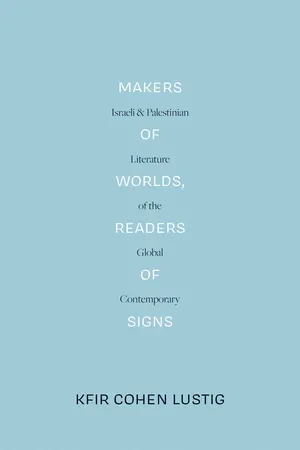
Makers of Worlds, Readers of Signs charts the aesthetic and political formation of neoliberalism and globalization in Israeli and Palestinian literature from the 1940s to the present. By tracking literature's move from making worlds to reading signs, Cohen Lustig proposes a new way to read theorize our global contemporary.
Cohen Lustig argues that the period of Israeli statism and its counterpart of Palestinian statelessness produced works that sought to make and create whole worlds and social time - create the new state of Israel, preserve collective visions of Palestinian statehood.
During the period of neoliberalism, the period after 1985 in Israel and the 1993 Oslo Accords in Palestine, literature became about the reading of signs, where politics and history are now rearticulated through the private lives of individual subjects. Here characters do not make social time but live within it and inquire after its missing origin. Cohen Lustig argues for new ways to track the subjectivities and aesthetics produced by larger shifts in production. In so doing, he proposes a new model to understand the historical development of Israeli and Palestinian literature as well as world literature in our contemporary moment.
With a preface from Fredric Jameson.
eBook - ePub
Makers of Worlds, Readers of Signs
Israeli and Palestinian Literature of the Global Contemporary
- 304 pages
- English
- ePUB (mobile friendly)
- Available on iOS & Android
eBook - ePub
Makers of Worlds, Readers of Signs
Israeli and Palestinian Literature of the Global Contemporary
About this book
Information
1
Heteronomy, Inequality, and the
Poetics of Making: Israeli Literature
of the Statist Period 1940–1985
1.
Beginning in medias res, we arrive in Mandatory Palestine in the early 1940s, at the moment when Zionism, reaching the peak of its political ambitions, is on the verge of establishing a sovereign state and turning Hebrew literature into a literature of a sovereign people henceforth called “Israeli.” That we begin in the 1940s and not squarely in 1948, the year Israel was established, has to do with the fact that at this point the historical conditions that will underlie literary production until the 1980s are already in place, distinguishing this period from those before and those after it. These conditions already emerged in the early 1930s when the leading Zionist labor party, Mapai,1 was able to establish and control a centralized social structure that fuses together political and economic organization, state and civil society, private and public spheres. As we shall have occasion to see, this statist structure, far from being inertly reflected in literary form, will act as a “limit” or condition of possibility from which diverse and sometimes opposing imaginary worlds will emerge as political responses.
In contrast to current literary studies that read Hebrew literature in light of the general ideological tenets of Zionist nationalism, this inquiry emphasizes specific historical conditions underlying social and cultural life in Israel.2 This shift in explanatory grounds stems from the fact that “Zionist ideology” is an abstract construct that is simply not subtle enough for the task of explaining and interpreting literary form let alone historical developments in Israel and Palestine. I already noted that an appeal to Zionist ideology will be hard-pressed to explain the disjunction between, on the one hand, the persistence of a robust Zionist nationalism, and, on the other, the complete transformation of cultural production in Israel since the mid-1980s. The absence of historical perspective in contemporary studies is even more damaging when we consider their central concern—the separation of Arabs and Jews—a moral condemnation turned into a humanist and multicultural research program that pushes the literary critic to work with a synchronous model, distinguishing between those writers and texts that support or at least presuppose this separation as legitimate, and other writers and texts that criticize it and imagine a more multicultural, hybrid and bi-national coexistence.3 The limitations of such a conception become apparent when we consider, first, that the separation of Arab and Jew will be as true in 1914 as it is in 2014, which is to say that it is a static conception that explains very little about the historical specificity of Zionism over time and the way it conditions literary forms and their political import. Second, the binary division of the literary field into a Zionist position on the one hand and non-Zionist position on the other results in a peculiar asymmetry. If Zionist texts are seriously read at all, the merit of the reading rests either on demonstrating how Zionist ideology is reflected in the literary text, or on uncovering the gap between Zionist ideology and colonial violence. Conversely, when we shift to non-Zionist texts, the latter are usually presented as pure presence, having no unconscious of their own, no non-dit arranging their own disavowals and lacunas. Arguing that a text resists Zionist separatist ideology without spelling out the position from which this resistance springs to life, how it conditions its form, or what it can (and can’t) think politically, collapses the distance between critic and text and forfeits the critical value such a method claims to have. The latter approach, dubbed literary postcolonial or post-Zionist studies, developed in Israel and the US beginning in the late 1980s. In its practice, critics subordinate Hebrew literature and literary criticism to a liberal and moral stance that privileges the Israeli-Palestinian conflict and reduces literature to a container of ideology, and Zionism to nationalism. Thus, however timely, the position defining Zionism solely as a separatist ideology is a narrow and eventually uncritical conception of what I suggest understanding more broadly, and more subtly, as a social form that evolves over time and acts as a historical “limit.” What follows is a short analysis of the social form of the first period and especially of its key feature, the construction of state autonomy, a condition that will help us then read several literary texts and explain the different political responses they encode.
2.
Emerging towards the end of the nineteenth century as a response to both anti-Semitism and economic crises in the Russian Empire and eastern Europe, Zionism was a politically heterogeneous national movement seeking a solution to the Jewish question. The attempt of eighteenth-and nineteenth-century European Jews to move out of their “traditional” religious communities and integrate as equals into their respective European civil societies ending in failure, Zionist Jews began colonizing Ottoman Palestine as of 1882 with the intent of making it their national home. As one Zionist leader put it, as early as 1904, the aim was “to establish autonomous Jewish community,” or, more specifically “a Jewish state.”4 How such autonomy was accomplished, how it made the Zionist entity and then Israeli life in this period different from Western Europe, and finally, how it conditioned aesthetic autonomy and literary form, will be our immediate objects here.
Critical historians divide the pre-state period between 1882 and 1948 into several waves of colonization (in Zionist parlance these are called ’Aliyot or immigration ascents). In this period, we observe a general shift of political solutions moving from heterogeneity to homogeneity, where one political program, that of labor-Zionism, won over others. Accordingly, we will comment briefly on labor-Zionism during its formative moment in the second wave, 1904–1914. For, according to Gershon Shafir’s seminal socio-historical study, in this period the future statist structure of Israel was established, setting the collision course for the 1948 war that culminated in the establishment of the Israeli state and the Palestinian refugee problem.5
Shafir’s detailed study of the period between 1904 and 1914 rejects one of the principle myths of Zionist history, namely, that the collectivist social forms established by labor-Zionism were not a matter of imported socialist ideas and values from eastern Europe, but rather an outcome of the harsh reality of the labor and land markets in Palestine in the beginning of the twentieth century. Arriving in Palestine with the hope of working in the agricultural sector, the second-wave colonizers soon discovered that the landowning Jewish farmers of the first wave, contrary to their “national duty,” refused to hire Jewish workers on their farms as they were under-skilled in comparison to Palestinian workers and demanded higher wages.6 As Shafir explains, faced with a crisis of employment that threatened the viability of its political project, labor-Zionism begins to supplant the individual Jewish farmers and to alter the divisions within the labor market.7 This conflict indicates first that the Zionist separatist structure evolved also out of internal Jewish conflict. Second, we can see that the encounter was not between Jews and Arabs in general, but rather a specific encounter between Jewish and Arab workers who met each other through the mediation of a capitalist labor market. According to Shafir, this crisis led labor-Zionism to pursue two strategies that would set the social form of the Jewish polity to come: First, labor-Zionism raised capital through the World Zionist Organization for the purpose of purchasing land and establishing Jewish-only collectivist settlements (kibbutzim). These efficiently secured the livelihood of the workers by subsidies that shielded them from the realities of the labor market. Second, labor-Zionism sought to secure work for Jewish agricultural workers by excluding Palestinians as much as possible from the Jewish labor market and creating a de facto split labor market. The separation and eventual control of the Jewish labor market, the purchase of land, the mobilization of Jewish capital from Europe and elsewhere, and the establishment of unique labor institutions,8 led over time to the centralization and collectivization of the conditions of Zionist life and to their almost exclusive control by the dominant labor party, Aḥdut ha-’avoda (which, uniting with another party, Ha-po’el ha-ẓa’ir, became Mapai in 1930). According to Shafir, the statist structure, in which it is the state rather than the market that organizes all public resources, was deemed necessary given the relative scarcity of Zionist resources (money and military power) and the demographic superiority of the Palestinian population.
Before moving on, it is important to acknowledge the place of the bourgeoisie which did not necessarily share the state-making interests of Mapai. From various reasons, this urban petty bourgeoisie, which grew significantly during the fourth wave of colonization starting in 1924 and eventually comprised most of the economy in Israel, was not taken over by Mapai. However, it was controlled from the outside through the allocation of credit.9 Thus, contrary to “advanced” liberal-capitalist states in which land, labor and capital are in private hands, in the Zionist social form of the first period they were controlled by political parties and then, after 1948, officially by the state. Michael Shalev effectively summarizes this period as follows:
The privileged position characteristically enjoyed by the bourgeoisie in Western societies is not only the product of its technical indispensability to the economic fortunes of society as a whole, but also reflects capital’s hegemony at the level of ideas and consciousness. However, in the new-born state of Israel by far the strongest political force in society was the labour movement, which espoused a blend of labourist and statist ideologies. Moreover, it was the state rather than capital which was most readily identifiable with the collectivity’s most urgent and universal interests. The government, the bureaucracy, and the military had accepted responsibility for an extremely broad and fateful agenda—populating and defending territory in the face of external hostility, attracting and absorbing masses of immigrants, and so forth. … To this must be added a cohesive political party apparatus [Mapai] in control of all of the society’s key institutions, with little to no obligation to private capital … and with its own internal networks of élite recruitment and interchange.10
This structure, in which capital and the private sphere are tethered to the project of state-making, points to several key differences between Western Europe and Israel in the first period which I now turn to elaborate.
I have mentioned that the historical marker of capitalism as a new form of social relations hinges on the emergence of abstract labor. This is the moment when work no longer receives its meaning from, or is embedded in, what Postone calls “overt social relations,” and becomes abstract labor power that underlies social relations. This process, as we have seen, occurred alongside the rearticulation of the political and private spheres in which overt political relations are lifted from civil society and deposited in the state proper. Further, the abstraction of overt social relations, the previous anchor of a naturalized and theological order of inequality, allows for abstract social equivalence that serves as the condition of possibility for the democratic notion of civil equivalence.
It might already be clear that by plunging its political roots into civil society, labor-Zionism invests social relations with an overt political content. By subordinating public resources to the project of state-making, labor-Zionism fuses the private and public spheres, and, although it establishes a democracy underlined by formal civic equivalence, relations of inequality, because embedded in direct political relations, persist as constitutive relations in Israeli society. Thus, unlike postcolonial critics who stress the European imaginary of Zionism, the desire to join the “civilized” “cultured” nations, the real structure of Israeli statism is markedly different than capitalist Western Europe. It is this structural difference that can explain why, between the 1940s and the 1980s, despite imaging itself as Western, Israeli culture failed to “pass” as European. And, conversely, why these days, due to neoliberal transformations that make Israeli social life more private and hence more like the US and Europe, artworks produced by Israelis can become as “universal” as any American or European ones. This remarkable transformation in the value of Israeli culture in the world, and more specifically in the position of Israeli literature within world literature, goes unattended by contemporary scholarship focused on the category of nationalism alone.
It is important that we grasp the relation of the statist project to its “others”: the statist project is not simply one force among others. Not only is it the most dominant political program whose interests are encoded in the law, it also appears in the world as a form of universality, a measure with which all other political programs are either recognized or not. In addition to subordinating or repressing all other political projects, this universality conditions or limits all other political claims. Hegel’s concept of “limit” can help us grasp this condition.11 As we saw previously, for Hegel a “limit” is not a border the subject confronts outside itself (external limit; quantity), but it is that preliminary condition that makes the subject what it is (internal limit; quality). Following Hegel, I claim that not only those writers who endorse the statist project are conditioned by its concept of collective autonomy and freedom, but that the statist state, as a historical limit, inheres in those writers that resist it as well. The reason this is so stems from the fact that in this period the state controls the conditions of possibility of society and does not allow any other political project to establish its law. To wit, the literary themes of Palestinian literature are markedly different than those in Israel, especially after 1960, and this is because only Palestinian writers directly resist the Israeli state rather than presuppose it.
The misconception of contemporary Hebrew literary studies is that they consider Zionism as what Hegel would call an “external” limit—as an ideology or even literary form—that non-Zionist works simply transgress or surpass. In their account, such writers would be self-grounding, or self-legislating, conditioned by no pre-existing social condition, which is another way of saying that they are abstract or ideal. This fallacy is not limited to the critics alone. Imagining a self-legislating world/character, a poetic tendency not too different from Kant’s concept of the aesthetic/reflective judgment, was the manner writers themselves attempted to think freedom and autonomy in a period that denied it.
3.
How does the statist structure condition the preliminary semantic materials of the literary artwork? Here we need to translate the historical social form into, conceptual and poetic terms. The deepest meaning of the statist structure concerns the fact that the autonomy of the state is a collective object to be made. What I call “state-making” is a collective act into the conditions that provide its existence. In a manner of speaking, it is a self-referential act because by acting collectively on such constitutive conditions the collective itself is made possible. It is this social making that aspires to subordinate all spheres to its concept of finality or end, making the individual heteronomous. If statism could be put in linguistic terms it would take a conditional modality: Not until the collective is free can the individual be free. Hence, the category of the “political” (state) subordinates the “personal” category (kinship), and especially the body. The key category of state-making is antagonism, through which the conditions of possibility of the community are made. This antagonism is always in the open and hence makes explicit the causes of the self and the community. State-making generates national, social Time—itself an object of making—and it accordingly localizes, particularizes or otherwise completely represses any other times and histories. Here is how Shula Keshet discusses the culture of the kibbutz in the 1930s, the cornerstone of Zionist state-making efforts:
The new [land] was all man-made. The intensive work performed by the pioneers exp...
Table of contents
- Cover Page
- Halftitle Page
- Title Page
- Copyright Page
- Dedication
- Contents
- Foreword
- Note on Translations and Transliterations
- Introduction: On Social and Aesthetic Abstraction
- 1. Heteronomy, Inequality, and the Poetics of Making: Israeli Literature of the Statist Period 1940–1985
- 2. Autonomy, Equivalence, and the Poetics of Textuality: Israeli Literature of the Neoliberal Period 1985–
- 3. No Kant in Palestine, Or, The Aesthetic of Statelessness 1948–1993
- 4. Palestine as Text and Sign: The Aesthetic of Private Life, 1993–
- Conclusion: From World to Global Literature
- Acknowledgments
- Notes
- Index of Names and Select Concepts
Trusted by 375,005 students
Access to over 1.5 million titles for a fair monthly price.
Study more efficiently using our study tools.
Frequently asked questions
Yes, you can cancel anytime from the Subscription tab in your account settings on the Perlego website. Your subscription will stay active until the end of your current billing period. Learn how to cancel your subscription
No, books cannot be downloaded as external files, such as PDFs, for use outside of Perlego. However, you can download books within the Perlego app for offline reading on mobile or tablet. Learn how to download books offline
Perlego offers two plans: Essential and Complete
- Essential is ideal for learners and professionals who enjoy exploring a wide range of subjects. Access the Essential Library with 800,000+ trusted titles and best-sellers across business, personal growth, and the humanities. Includes unlimited reading time and Standard Read Aloud voice.
- Complete: Perfect for advanced learners and researchers needing full, unrestricted access. Unlock 1.5M+ books across hundreds of subjects, including academic and specialized titles. The Complete Plan also includes advanced features like Premium Read Aloud and Research Assistant.
We are an online textbook subscription service, where you can get access to an entire online library for less than the price of a single book per month. With over 1.5 million books across 990+ topics, we’ve got you covered! Learn about our mission
Look out for the read-aloud symbol on your next book to see if you can listen to it. The read-aloud tool reads text aloud for you, highlighting the text as it is being read. You can pause it, speed it up and slow it down. Learn more about Read Aloud
Yes! You can use the Perlego app on both iOS and Android devices to read anytime, anywhere — even offline. Perfect for commutes or when you’re on the go.
Please note we cannot support devices running on iOS 13 and Android 7 or earlier. Learn more about using the app
Please note we cannot support devices running on iOS 13 and Android 7 or earlier. Learn more about using the app
Yes, you can access Makers of Worlds, Readers of Signs by Kfir Cohen Lustig in PDF and/or ePUB format, as well as other popular books in Literature & Middle Eastern History. We have over 1.5 million books available in our catalogue for you to explore.