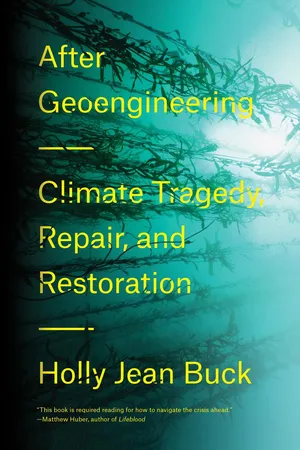
Climate engineering is a dystopian project. But as the human species hurtles ever faster towards its own extinction, geoengineering as a temporary fix, to buy time for carbon removal, is a seductive idea. We are right to fear that geoengineering will be used to maintain the status quo, but is there another possible future after geoengineering? Can these technologies and practices be used to bring carbon levels back down to pre-industrial levels? Are there possibilities for massive intentional intervention in the climate that are democratic, decentralised, or participatory?
These questions are provocative, because they go against a binary that has become common sense: geoengineering is assumed to be on the side of industrial agriculture, inequality and ecomodernism, in opposition to degrowth, renewable energy, sustainable agriculture and climate justice. After Geoengineering rejects this binary, to ask: what if the people seized the means of climate production? Both critical and utopian, the book examines the possible futures after geoengineering. Rejecting the idea that geoengineering is some kind of easy work-around, Holly Buck outlines the kind of social transformation that would be necessary to enact a programme of geoengineering in the first place.
- 288 pages
- English
- ePUB (mobile friendly)
- Available on iOS & Android
eBook - ePub
About this book
Information
Topic
Scienze biologicheSubtopic
Economia politicaPart I: Cultivation
1
Cultivating Energy
What has drawn the Modern World into being is a strange, almost occult yearning for the future.—Wendell Berry
La Jolla, California, July 2014, pleasant weather
Unlike a pistol, designed for fluidity of motion, the helium-powered gene gun was awkward to hold. The lab group circled nervously, wearing bulky pilot-grade noise-canceling headphones to protect us from the sonic force. Glasses: check. Lab coats: check. Gloves: check. All this protected us from the tool and the microscopic amounts of liquid we were going to use it on. We handed the gun (manufacture: Bio-Rad) around the circle ritualistically as we took turns modifying life.
The gun was loaded with particles of gold that we had coated with DNA. We were shooting the DNA-laden gold onto petri dishes prepped with algae cells. The microscopic gold particles can blast through the cell walls of the algae, allowing the DNA to get in. It is an inelegant technique, not very efficient, but enough of the particles make it through. The point was to make the algae colorless. It was a training exercise, a drill. We were enrolled in a course that taught the basic recipes of manipulating life—not as part of a college degree, though we were on a university campus in Southern California. Rather, it was a part of an effort to train new workers in the biofuel industry. Green jobs. You didn’t actually need to know much of the scientific grounding of microbiology to follow the recipes. They worked anyway.
Blasting the algae with the gold particles only took a few moments. Afterward, I took off the heavy headphones and stepped out of the lab into the light and sound of the day: the eucalyptus trees rustling, the blue sky, the uncanny thunder of the jets blasting away from the nearby Miramar air base, doing their laps across the skies above the biotech hub of San Diego. In the manicured office parks of La Jolla, companies are seeking to turn algae into value: protein, medicine, and fuel. It is this latter transformation, algae into fuel, that intersects our story of climate intervention. Of all the crops that can be cultivated to suck up carbon, algae is one of the most promising.
Cultivation is one of the most tried-and-tested techniques to change the carbon balance. Plants, of course, take up carbon, but they can also be used for storing energy. Plants can also be made into physical end products, which is the basis of the bioeconomy: an economy based not upon dead matter, but upon living things. The bioeconomy probably “exists” more than “geoengineering” does, though it still dwells in the imaginative realm of charismatic meta-categories. The promise of the bioeconomy is that it allows throwaway, mineral-based goods to be replaced by renewable ones (which is why it is sometimes called the “circular bioeconomy,” as products aren’t thrown away, but return to the circle of life to be processed into new ones). The bioeconomy is also often defined in terms of products or sectors that compose it: food, agriculture, paper and pulp, forestry and the wood industry, fisheries and aquaculture, bio-based industries, biochemicals and plastics, and enzymes and biofuels. It’s an intuitively attractive concept, given how biophilic humans are.
Engineering new uses for plants and setting up a cultivation-based economy sounds green-futuristic, but it’s actually an old dream. The bioeconomy vision had a precursor almost a century ago, during the dawning of the petroleum age in the 1930s and 1940s. In the United States, widespread production of oil emerged against the backdrop of the Great Depression, rural out-migration, and a farm production surplus (not to mention a looming war). Could there be a comprehensive solution to the social and economic ills of the time? You might be thinking of the New Deal, but industrialists like Henry Ford and scientists like George Washington Carver had another idea: chemurgy. At its simplest, “chemurgy” meant using farm products for stuff besides food. With the goal of productively using agricultural waste, chemurgy had a strong ethos of efficiency, as well as of self-sufficiency. To some of its promoters, using the wealth in plant resources also offered the dream of universal abundance and a peaceful world.
Vegetable or mineral? Living fuel or dead fuel? In the chemurgy movement, we can see traces of the division between biological and geological systems, a binary that lingers in the carbon removal conversation today. Leading figures of the time knew that petroleum was not going to work out well for us. Petroleum reserves were imagined sufficient to last only a matter of decades. As journalist Christy Borth wrote in 1942, “We do not have to go into the bowels of the earth for fossilized sunshine. We need not destroy one another with warfare because some nations happen to have fossilized sunlight and other nations have none.” The necessary shift, as Borth put it, was from dependence upon “the sub-surface fixed resources to the surface flow resources.”1 Chemist William Hale, the husband of Helen Dow of the Dow Chemical family, also saw the crisis facing the world as part of a transition from the machine age to the chemical age. He also saw the necessity of developing “agricrude” fuel, or ethanol. It seemed nonsensical to burn fossil fuels when renewable fuels were so easily obtainable, and Hale lamented that the “selfish interests” of the petroleum industry had “hoodwinked” the American people. The cracking of petroleum for gasoline was “one of the most wasteful deeds of man,” according to Hale, especially since future generations might need that petroleum for their endeavors. “To burn petroleum with the reckless abandon of today is to withhold from posterity an asset in which they, as much as we, have equal rights.” Hale’s words are haunting:
After all, these storehouses of gas, petroleum, and coal are precious endowments to man by nature. Human decency should teach us not to destroy them indiscriminately. Human kindness should teach us to preserve as much as possible for our children. Nevertheless, utter profligacy has gained the upper hand; as pirates and plunderers we seem destined to go down the road of defeated nations.2
Why has nobody heard of chemurgy? It was a startup movement; a risky field. It achieved some successes: four new national research laboratories, the beginnings of an American flax paper industry, the development of the Southern pine industry, and wood-to-energy efforts all owe their dues to the field. But the word had largely fallen out of favor by 1950 (and one wonders if “geoengineering” will be similarly obsolete in a few decades). The simplest explanation for chemurgy’s failure is that petroleum was a cheaper material for fuel and other goods. But there were other factors underlying chemurgy’s failure to take off. There was often a wide gulf in the scale of chemurgical pilot projects or prototypes and full-scale production. Some analysts point to inherent problems with the movement: it promised too much to too many; it easily disappointed converts; its emphasis on rapid technological change didn’t appeal to farmers’ more conservative approach to technology adoption.3 Chemurgy was a longer-term program, and for farmers, the New Deal offered more immediate subsidies; the goal of self-sufficiency also lacked appeal for farmers who profited from selling globally. Moreover, agricultural industries aren’t lucrative for investors, because they have downtime in between harvests and only have raw materials available once a year, making chemurgy’s progress slow.4 There was also active lobbying against chemurgy by the petroleum industry. And there were problems internal to the movement, such as personality conflicts at the top and a narrow dependence upon private funders. In the assessment of historian Randall Beeman, chemurgy was guided by corporate-technocratic scientists in the employ of industry, rather than by agrarian leaders.5 Finally, its proposals for technocratic reapportionment of nature’s resources and “sunlit lands” sometimes took on dark neocolonial and racist undertones.
What if chemurgy had emerged not in the embattled late 1930s, but today? In fact, is chemurgy back? “Chemurgy is returning with vengeance,” asserts management professor Quentin Skrabec, “but don’t look for the term to return. Today it is called biotechnology, ecology, green, or bioengineering.”6 Early chemurgy promoters like Ford and Dow Chemical are on the forefront of the return of chemurgy. But the first version of chemurgy, the eccentric path-not- taken, is worth keeping in mind as proposals for expansion of the bioeconomy, as well as the Green New Deal, are floated in response to climate crisis. The failure of chemurgy showcases the challenge of mounting a technologically rooted response to complex social problems. It illustrates how the dark side of the promoters and their ideology can muddle their efforts and legacy. It also highlights how elite commitment to fossil fuels has a history of thwarting alternatives, even when the alternatives come from within established industrial interests.
Technologically, the vision of a bioeconomy filled with renewable, plant-based goods should be easier than ever to attain. But socially, it seems even more distant. Right now, chemical firms are investing in small innovations, while chemical innovation on the scale of the postwar era seems too risky and long term.7 Within chemistry and materials science, it could be that at the moment when we need bold, strategic thinking, we have a form of capitalism incapable of handling the temporalities at hand. Yet there are interesting scientific and cultural currents at work within biotechnology and agriculture. In Part I of this book, I’ll discuss how some practitioners of cultivation are transcending conventional agriculture toward a kind of carbon alchemy: a sophisticated transmutation of life and land for the ends of sequestering carbon, in laboratories as well as in fields and seas. Like the philosophers of yore, they are innovating new recipes and tools to change matter from one thing into another. Their aim is to take the carbon that is heating us up and put it back into a regenerated earth system.
We’ll begin by looking at a technique that has been included in integrated assessment models of how the world could decarbonize: bioenergy with carbon capture and sequestration (BECCS). In order to reach two-degree-Celsius targets, these models assume significant amounts of BECCS. The idea of BECCS is that a chain of actors grow biomass, burn it in a power plant that can separate out the carbon, and then transport the carbon somewhere to be stored underground. This carbon-storage part is key. Without it, the system is just regular old biofuels, which don’t remove net carbon from the atmosphere. Carbon capture and storage is a well-established technology (and one that we’ll discuss more in Part III of this book). Because both bioenergy and carbon capture and storage are known, BECCS sounds doable: doable enough technically that it was factored into the models. But it may actually be the least likely of these carbon removal techniques to be implemented.
Addis Ababa, Ethiopia, May 2013, 25°C / 77°F
The road teemed with blue Lada taxis in the hot, dusty night. Exoskeletons of rickety wood scaffolding clung to the rising skyscrapers. The China Road and Bridge Corporation had just opened the gleaming black Bole Road with a plaque celebrating China’s friendship, and it felt like the place to be. This was just after the biofuel boom.
I was in a bar, drinking Ethiopia’s most popular beer, St. George, with a couple of foreign correspondents. They had come off of a long day’s work helicoptering to the far western reaches of the country, courtesy of the Ethiopian government. The government had orchestrated a ceremony for the divergence of the Blue Nile, as the Grand Ethiopian Renaissance Dam had reached a milestone in its construction. The Blue Nile is one of the Nile’s tributaries, snaking its way down from the Ethiopian Highlands to Sudan, where it meets the White Nile. The dam will be the largest hydroelectric facility in Africa, generating a projected 6,450 megawatts and carrying a price tag of around $5 billion. That’s a lot of power, considering Ethiopia’s current electricity generation is around 4,000 megawatts, for one hundred million people.8 But there are ongoing fears in Egypt, and from analysts around the world, about how it will impact Egypt’s water supply, given that 90 percent of Egyptians rely on the Nile.
Ethiopia’s appetite for grand-scale dams intersected my area of research interest—large-scale land grabs for biofuels—and so I was keen to talk to these correspondents. In particular, I was seeking information on how the rush for land for feedstock was impacting water and people. The water from Ethiopia’s other new megadams, the Gibe series on the Omo River in the country’s south, was advertised to investors as enabling large-scale irrigation on land they could lease. Foreign companies were being recruited to till Ethiopian soil and export the wheat, flowers, and oils.9 This would help the government receive much-needed foreign currency. If you read about these deals in the press, you’d think they were being handed out like candy. Some deals were inked for cultivation of food crops, others for biofuels. Reports by NGOs like the Oakland Institute or tracking sites like the Land Matrix put the newly leased acreage in Ethiopia at over 3 million hectares, an area close to the size of Belgium.10 Analysts responded with alarm as a cycle of information flowed between NGOs, the press, and academics, who saw their worst fears of accumulation by dispossession playing out. “The current land acquisitions in Africa can indeed be termed a new ‘scramble,’ because influential and wealthy foreign powers hasten to acquire land in order to secure their interests (future fuel needs and food market demand abroad),” wrote one scholar.11 But what was happening on the ground? One could track down heavily photocopied leases to companies with names like Agropeace Bio or Saudi Star, stamped with the Ethiopian star and words in Amharic. But where were the products of cultivation, and where were they flowing? Did any of these biofuel plantations actually exist?
From afar, I had been tracking down scraps of evidence from the Internet: a YouTube clip of Ethiopian men and foreign investors touring flat fields with spiky castor plants; a chance press report from a journalist who was actually standing in a field, instead of just a press release announcing a new deal or memorandum of understanding. The reports from the province of Gambella, a lowland, infrastructure-poor region on the border with Sudan, were that 35,000 households had been “villagized” to make way for land deals—meaning people were forced off their land and placed into settlements, often in places that were forested or uncultivable. Socially, something terrible seemed to be happening related to these land acquisitions. But in terms of seeds in the soil, it was unclear what exactly was going on.
Understanding how the global land rush intersected the last decade’s biofuel boom can help us see why projections around the scale-up of bioenergy with carbon capture and sequestration are so concerning. In 2007 and 2008, food and oil prices both spiked. Assessments vary as to the causes for the underlying price spikes: financialization of food markets and weather played some role, as did diversion of food crops (soy, maize, sugar) and land area toward biofuel production. Moreover, after the 2008 financial crisis, investors were seeking to diversify into a more real asset class. The “population bomb” narrative, popularized by biologist Paul Ehrlich in the 1960s, also reared its head again, never having really gone away. Hedge funds, seeing food prices projected to be high for decades, and relatively low farmland prices in many parts of Africa, believed the land to have a great potential for capital appreciation. They viewed land as offering stable returns and as a hedge against inflation.12 With soaring food and commodity prices came an appetite for land from even more kinds of investors: sovereign and pension funds, as well as conglomerates from sectors like energy, agribus...
Table of contents
- Cover Page
- Title Page
- Copyright Page
- Contents
- Introduction: Desperation Point
- Part I: Cultivation
- Part II: Burial
- Part III: The After-Zero Society
- Part IV: Buying Time
- Acknowledgments
- Notes
- Index
Trusted by 375,005 students
Access to over 1.5 million titles for a fair monthly price.
Study more efficiently using our study tools.
Frequently asked questions
Yes, you can cancel anytime from the Subscription tab in your account settings on the Perlego website. Your subscription will stay active until the end of your current billing period. Learn how to cancel your subscription
No, books cannot be downloaded as external files, such as PDFs, for use outside of Perlego. However, you can download books within the Perlego app for offline reading on mobile or tablet. Learn how to download books offline
Perlego offers two plans: Essential and Complete
- Essential is ideal for learners and professionals who enjoy exploring a wide range of subjects. Access the Essential Library with 800,000+ trusted titles and best-sellers across business, personal growth, and the humanities. Includes unlimited reading time and Standard Read Aloud voice.
- Complete: Perfect for advanced learners and researchers needing full, unrestricted access. Unlock 1.5M+ books across hundreds of subjects, including academic and specialized titles. The Complete Plan also includes advanced features like Premium Read Aloud and Research Assistant.
We are an online textbook subscription service, where you can get access to an entire online library for less than the price of a single book per month. With over 1.5 million books across 990+ topics, we’ve got you covered! Learn about our mission
Look out for the read-aloud symbol on your next book to see if you can listen to it. The read-aloud tool reads text aloud for you, highlighting the text as it is being read. You can pause it, speed it up and slow it down. Learn more about Read Aloud
Yes! You can use the Perlego app on both iOS and Android devices to read anytime, anywhere — even offline. Perfect for commutes or when you’re on the go.
Please note we cannot support devices running on iOS 13 and Android 7 or earlier. Learn more about using the app
Please note we cannot support devices running on iOS 13 and Android 7 or earlier. Learn more about using the app
Yes, you can access After Geoengineering by Holly Jean Buck,Holly Buck in PDF and/or ePUB format, as well as other popular books in Scienze biologiche & Economia politica. We have over 1.5 million books available in our catalogue for you to explore.