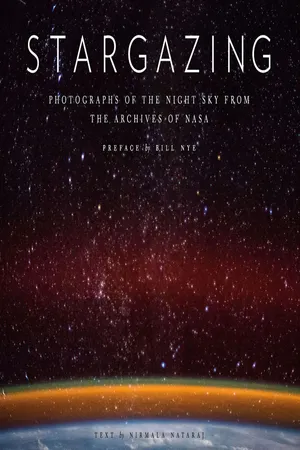
A compendium of images of the night sky, the perfect gift for stargazers, space lovers, science geeks, photography lovers, and NASA fans.
This collection of photographs illuminates the darkness of space in a whole new way. Images from the archives of NASA reveal the night sky's most extraordinary phenomena, from the radiant aurora borealis to awe-inspiring lunar eclipses. Each breathtaking photo is paired with an informative caption about the scientific phenomena it reveals and the technology used to capture it. Featuring a preface by author and Emmy award-nominated TV host Bill Nye, this ebook will rekindle the wonder of looking up at the stars.
"[A] gorgeous photographic tour of space . . . Remarkable."—
Publishers Weekly on
The Planets: Photographs from the Archives of NASA by Nirmala Nataraj
- 128 pages
- English
- ePUB (mobile friendly)
- Available on iOS & Android
eBook - ePub
About this book
Information
Topic
ArtSubtopic
PhotographyPHOTOGRAPHS FROM THE ARCHIVES OF NASA

STARGAZING FROM THE ISS
This panoramic digital image of the Milky Way’s dense star field was captured by Expedition 44 crew members aboard the ISS. In a 24-hour period, the ISS experiences 16 orbits around Earth. In this image, it looms above the central equatorial Pacific, where dense clouds cover almost the entire surface of the ocean. The bright spot toward the bottom right corner is lightning illuminated through clouds; this light bounced off the solar arrays of the ISS, and from there, to the camera. The mottled dark areas in the star field are dust clouds that hinder a clear view of the stars toward the center of the Milky Way.

OMEGA CENTAURI
Omega Centauri, a cluster of stars in the constellation Centaurus, is the Milky Way’s largest, most radiant globular cluster of stars and is visible in the southern half of the United States, seen most clearly in the evening sky in late April, May, and June. In the Southern Hemisphere, Omega Centauri is much higher and brighter in the sky. A globular cluster tends to be symmetrical and round in appearance, and it is home to anywhere from tens of thousands to millions of stars that are bound together by their gravity. This cluster is outside the galactic disk, 16,000 to 18,000 light-years away from Earth. It is one of the few globular clusters in the Milky Way that is visible to the naked eye.
SAGITTARIUS A*
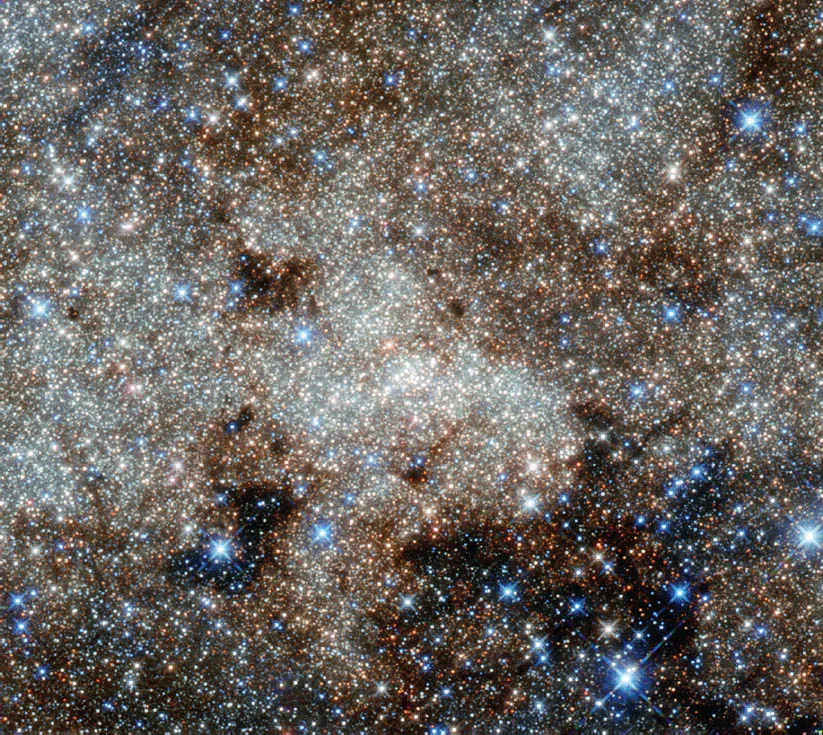
This image features the dense, starry nucleus of the Milky Way near the constellation Sagittarius. Beyond these crowded pockets of stars, however, is a phenomenon that can’t be found in this image: a black hole known as Sagittarius A*, roughly 4 million times the mass of our Sun and 26,000 light-years from Earth. It’s one of the few black holes in our known universe into which astronomers have observed the flow of nearby matter. Astronomers have also detected stars spinning around the black hole as it swallows clouds of surrounding dust. It’s believed that less than 1 percent of the material impacted by the black hole’s gravitational pull reaches the event horizon (or point of no return), since much of it is ejected before that point. This image is the most detailed one that the Hubble’s Wide Field Camera 3 has ever taken of this particular region of the galaxy.

A BURST BUBBLE
This false-color image of the emission nebula RCW 79 was captured by NASA’s Spitzer Space Telescope. An emission nebula is a dense cloud of ionized gas that emits light at various wavelengths. RCW 79 is about 70 light-years across and 17,200 light-years away from Earth, in the constellation Centaurus. The nebula has continued to expand, resulting in new star formation, as well as large plumes of gas and dust flowing out into interstellar space. This infrared image shows clusters of new stars, which appear as yellowish points around the edge of the nebula. The bright “bubble” on the lower left edge also features an area of star formation. These stars emit ultraviolet light, which continues to excite dust within the bubble and makes it glow bright red in the infrared image.

PACMAN NEBULA
NGC 281 is a star-forming nebula in the constellation Cassiopeia, 9,200 light-years from Earth in the Perseus spiral arm of the Milky Way. It’s also known as the Pacman Nebula. (Although the mouth of the Pacman character looks dark in most images, it glows brightly in this infrared image.) The stars in the nebula are massive, and powerful hot winds flow from their surfaces and dissipate into interstellar space, producing enormous columns of gas and dust. Many of these stars will eventually explode into supernovas and provide the galaxy with raw material for new stars.

SKIES OVER KIRUNA
This photograph captures the deep blue skies above the Esrange Space Center close to Kiruna, Sweden. This is where the NASA-funded Balloon Array for Radiation-Belt Relativistic Electron Losses launched six miniature balloons with scientific payloads. They went on to measure X-rays in the atmosphere near the North Pole and study the content of electrons in the Earth’s ionosphere. The X-rays in the atmosphere are the result of electrons from the Van Allen belts, two zones of energetically charged particles that originate from the solar wind and surround Earth several thousand miles above the planet’s surface. The vaguely visible green glow in the sky is an aurora.

ORIOLE IV LAUNCHING INTO AN AURORA
This time-lapse image captures NASA’s Oriole IV sounding rocket, which carried the payload for the Aural Spatial Structures Probe (ASSP). The ASSP studied how electric currents far up in the atmosphere, where auroras are generated, cause the atmosphere to expand. The ASSP experiment launched one massive instrument and six small probes that were ejected in midflight and created a picturesque formation dancing over the aurora in the background of this image.
GEMINID METEOR SHOWER
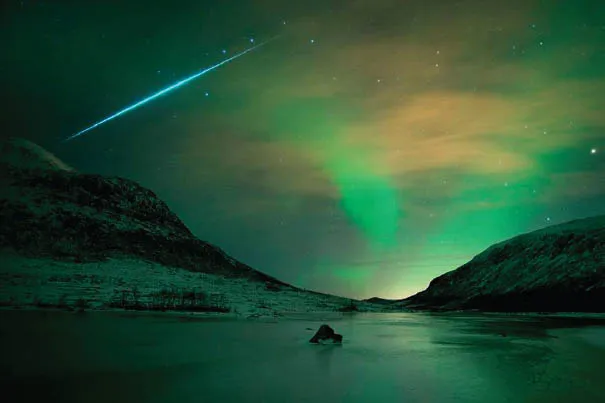
A spectacular Geminid meteor shower display accompanies the subtle shimmer of the aurora borealis in the skies above Norway. Every year...
Table of contents
- Cover
- Title
- Copyright
- Contents
- Preface
- Introduction
- Photographs from the Archives of Nasa
- Bibliography
- Image Credits
- About the Author
- Chronicle Ebooks
Trusted by 375,005 students
Access to over 1.5 million titles for a fair monthly price.
Study more efficiently using our study tools.
Frequently asked questions
Yes, you can cancel anytime from the Subscription tab in your account settings on the Perlego website. Your subscription will stay active until the end of your current billing period. Learn how to cancel your subscription
No, books cannot be downloaded as external files, such as PDFs, for use outside of Perlego. However, you can download books within the Perlego app for offline reading on mobile or tablet. Learn how to download books offline
Perlego offers two plans: Essential and Complete
- Essential is ideal for learners and professionals who enjoy exploring a wide range of subjects. Access the Essential Library with 800,000+ trusted titles and best-sellers across business, personal growth, and the humanities. Includes unlimited reading time and Standard Read Aloud voice.
- Complete: Perfect for advanced learners and researchers needing full, unrestricted access. Unlock 1.5M+ books across hundreds of subjects, including academic and specialized titles. The Complete Plan also includes advanced features like Premium Read Aloud and Research Assistant.
We are an online textbook subscription service, where you can get access to an entire online library for less than the price of a single book per month. With over 1.5 million books across 990+ topics, we’ve got you covered! Learn about our mission
Look out for the read-aloud symbol on your next book to see if you can listen to it. The read-aloud tool reads text aloud for you, highlighting the text as it is being read. You can pause it, speed it up and slow it down. Learn more about Read Aloud
Yes! You can use the Perlego app on both iOS and Android devices to read anytime, anywhere — even offline. Perfect for commutes or when you’re on the go.
Please note we cannot support devices running on iOS 13 and Android 7 or earlier. Learn more about using the app
Please note we cannot support devices running on iOS 13 and Android 7 or earlier. Learn more about using the app
Yes, you can access Stargazing by Nirmala Nataraj in PDF and/or ePUB format, as well as other popular books in Art & Photography. We have over 1.5 million books available in our catalogue for you to explore.