For anyone who has longed for a garden of their own—whether a city dweller or one with less-than-green thumbs—this is a handy little guide to growing and maintaining houseplants. Cheerful and informative, Happy Houseplants will guide any budding indoor botanist through a bevy of topics, from soil and water to light and fertilizer. With beautiful illustrations accompanying 30 different profiles of plants, from the easygoing Air Plant to the striking Zebra Cactus, this nifty book is the perfect gift for anyone looking to bring a piece of the outdoors inside.
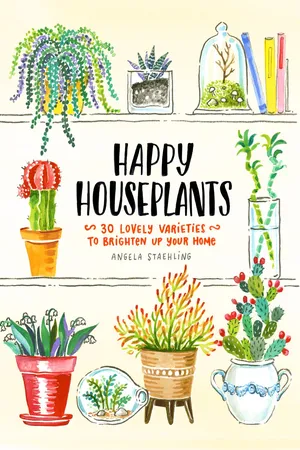
- 96 pages
- English
- ePUB (mobile friendly)
- Available on iOS & Android
eBook - ePub
About this book
Information
Topic
DesignSubtopic
Graphic DesignThe Happy Houseplants
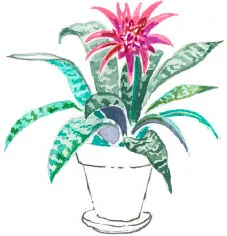

• Saintpaulia ionantha •
African violets have long been a popular plant sold seasonally for Valentine’s Day, Easter, and Mother’s Day. These tropical plants display colorful flowers in varying shades of purple, pink, white, blue, and red. For maximum flowering, keep African violets in ten to fourteen hours of bright, indirect light each day. Pinch off blooms as they fade to encourage the development of more flowers. The African violet prefers temperatures between 65° and 75°F / 18° and 24°C.
step-by-step care
SOIL: Use an African violet potting mix, or make your own mixture of one-third peat moss, one-third vermiculite, and one-third perlite.
LIGHT: African violets prefer bright, indirect light. Place in an east-facing window to receive morning sun.
WATER: Keep soil evenly moist but not soggy. African violets are picky about their water.
When the soil feels dry to the touch, use room-temperature water to hydrate the plant. Avoid getting leaves wet, as this can lead to leaf spotting.
FERTILIZER: Fertilize every two weeks during summer with a high-phosphorous fertilizer, such as 15-30-15 (phosphorous is the middle number). This nutrient helps roots grow and stimulates flowering. A balanced houseplant fertilizer will also work.


• Tillandsia •
An air plant is a tropical plant that comes in hundreds of varieties and is accustomed to growing on trees, rocks, other plants, and rocky cliffs. The bromeliads are a joy to grow, as they require no soil and look great hanging in unusual containers, architectural forms, and glass vases. Air plants can be mounted to other surfaces using adhesives like E6000, Liquid Nails, or hot glue. Make sure these surfaces are waterproof, as you will still need to water your plant. Fishing line, natural twine, or non-copper wire also work well to mount your plant.
step-by-step care
SOIL: Air plants don’t require soil to grow.
LIGHT: Air plants prefer bright, indirect light. They can tolerate a few hours of full sun but then will require more water.
WATER: Mist air plants once or twice a week depending on the humidity in your home. Give them an extra soak in a bowl of water for twenty to thirty minutes once a week. Gently shake off excess water.
FERTILIZER: Fertilizing air plants isn’t necessary, but it can stimulate blooming and reproduction. Use a water- soluble bromeliad fertilizer (17-8-22) diluted to one-quarter strength. Add drops once a month during spring and summer when soaking plants in a bowl of water.


• Aloe vera •
The aloe vera plant is well known for its clear, cool gel that helps heal burns and cuts. Its thick, fleshy leaves point out in all directions and will have serrated edges or white spots, depending on the variety. When an aloe plant reaches maturity (at approximately four years of age), and if it receives enough light, it may produce a tall flowering stalk in spring. If you purchase your aloe plant in a small plastic container, consider repotting it in a larger clay container. Aloe plants become very top-heavy as they grow and will have a tendency to fall over. A heavy clay or terracotta pot will keep your plant stable.
step-by-step care
SOIL: Use a cactus and succulent potting mix, or create your own quick-draining soil with one-third potting mix, one-third coarse sand, and one-third perlite. Add coconut coir or peat moss to help with water absorption and aeration.
LIGHT: Aloe vera plants prefer partial to direct sun in a west- or south-facing window. Rotate the pot once a week to promote upright growth. If leaves turn brown, provide less direct sun.
WATER: Water thoroughly and let the soil dry out between waterings. Water less in the winter. Aloe vera is a drought-tolerant plant and prefers drier soils.
FERTILIZER: Feed once a month during spring and summer with a houseplant fertilizer high in phosphorous, such as 10-40-10. Dil...
Table of contents
- Cover
- Title
- Dedication
- Copyright
- Contents
- Introduction
- Getting Started
- The Happy Houseplants
- Resources
- Acknowledgments
- Chronicle Ebooks
Trusted by 375,005 students
Access to over 1.5 million titles for a fair monthly price.
Study more efficiently using our study tools.
Frequently asked questions
Yes, you can cancel anytime from the Subscription tab in your account settings on the Perlego website. Your subscription will stay active until the end of your current billing period. Learn how to cancel your subscription
No, books cannot be downloaded as external files, such as PDFs, for use outside of Perlego. However, you can download books within the Perlego app for offline reading on mobile or tablet. Learn how to download books offline
Perlego offers two plans: Essential and Complete
- Essential is ideal for learners and professionals who enjoy exploring a wide range of subjects. Access the Essential Library with 800,000+ trusted titles and best-sellers across business, personal growth, and the humanities. Includes unlimited reading time and Standard Read Aloud voice.
- Complete: Perfect for advanced learners and researchers needing full, unrestricted access. Unlock 1.5M+ books across hundreds of subjects, including academic and specialized titles. The Complete Plan also includes advanced features like Premium Read Aloud and Research Assistant.
We are an online textbook subscription service, where you can get access to an entire online library for less than the price of a single book per month. With over 1.5 million books across 990+ topics, we’ve got you covered! Learn about our mission
Look out for the read-aloud symbol on your next book to see if you can listen to it. The read-aloud tool reads text aloud for you, highlighting the text as it is being read. You can pause it, speed it up and slow it down. Learn more about Read Aloud
Yes! You can use the Perlego app on both iOS and Android devices to read anytime, anywhere — even offline. Perfect for commutes or when you’re on the go.
Please note we cannot support devices running on iOS 13 and Android 7 or earlier. Learn more about using the app
Please note we cannot support devices running on iOS 13 and Android 7 or earlier. Learn more about using the app
Yes, you can access Happy Houseplants by Angela Staehling in PDF and/or ePUB format, as well as other popular books in Design & Graphic Design. We have over 1.5 million books available in our catalogue for you to explore.